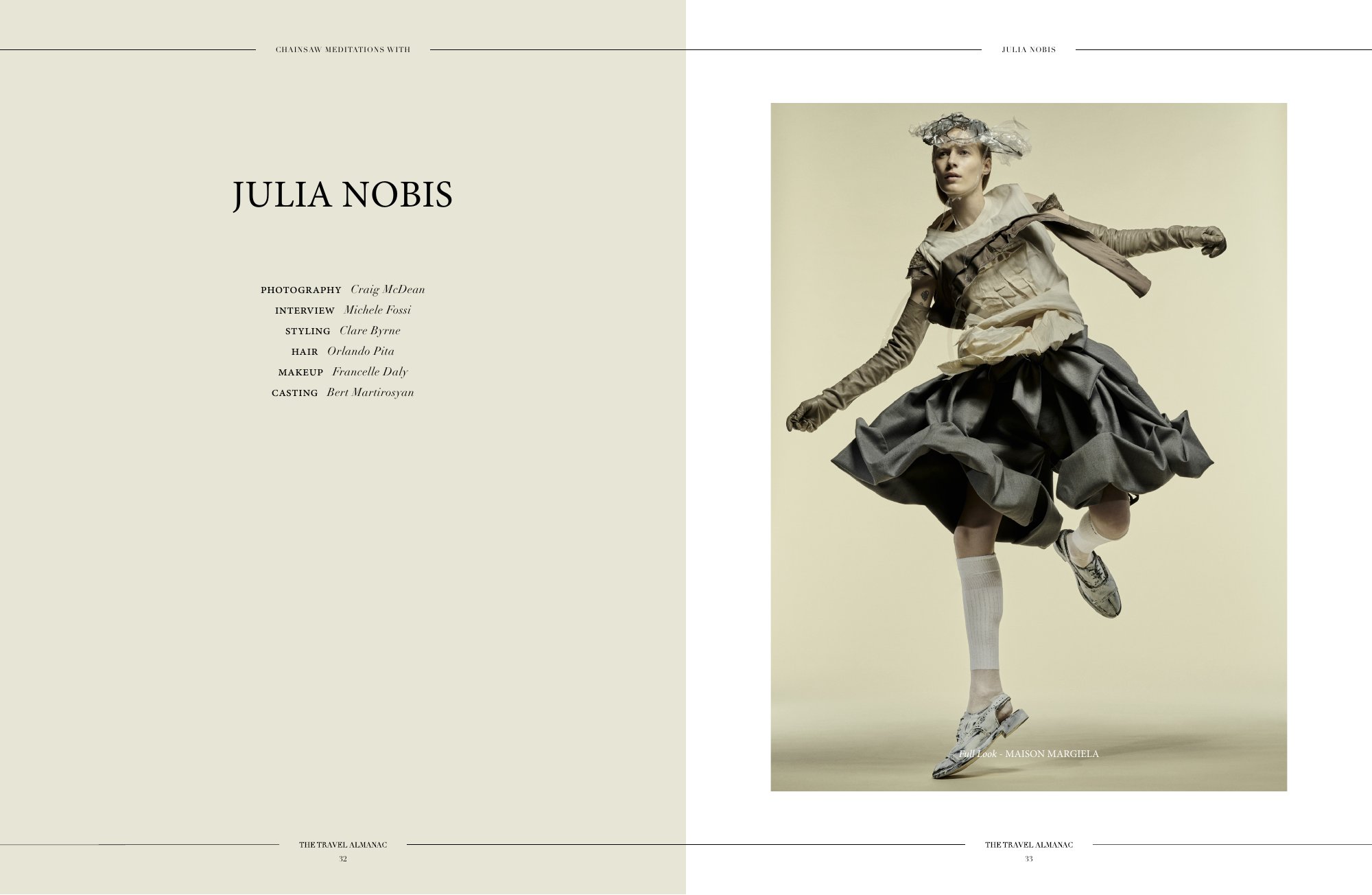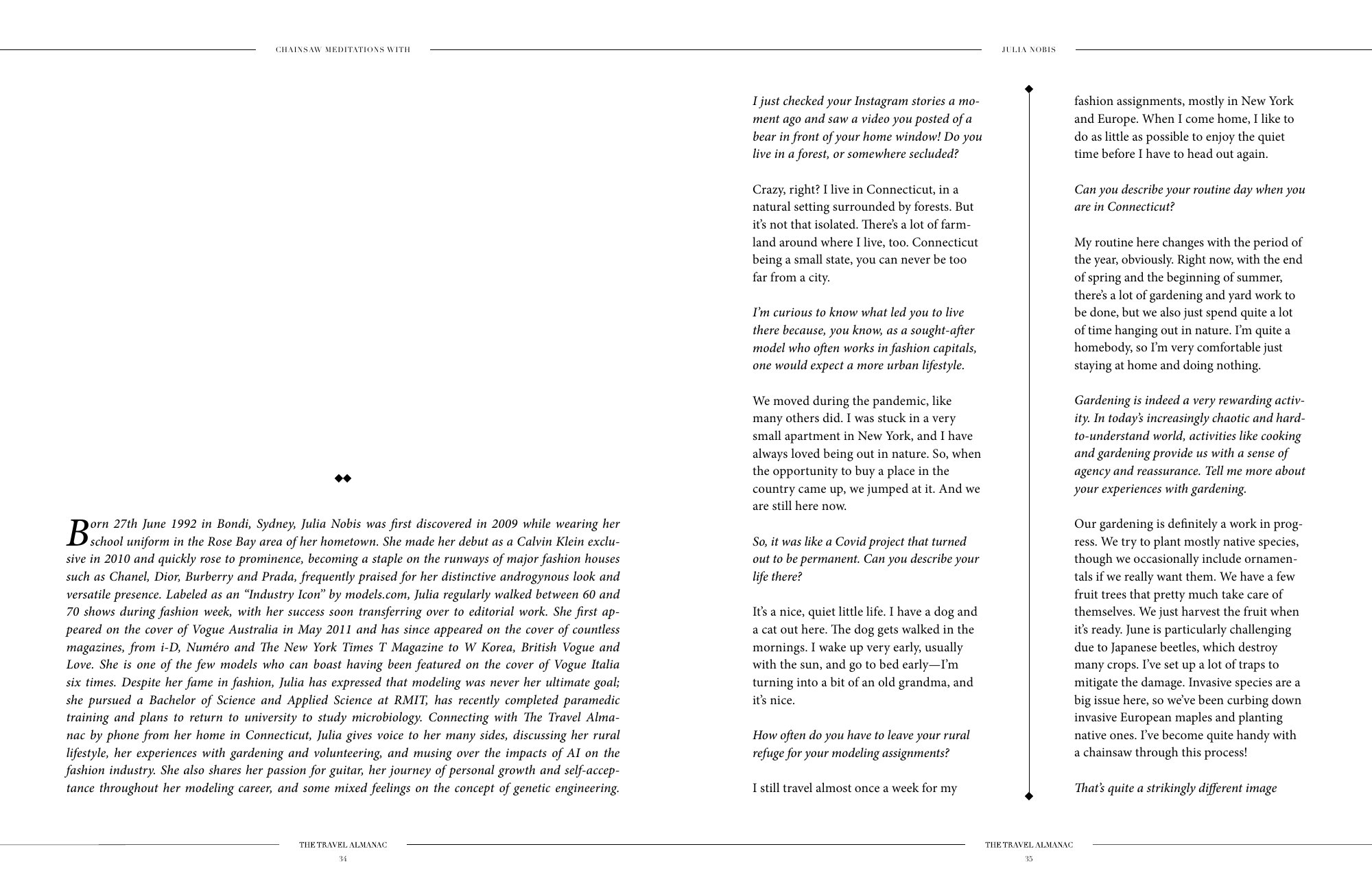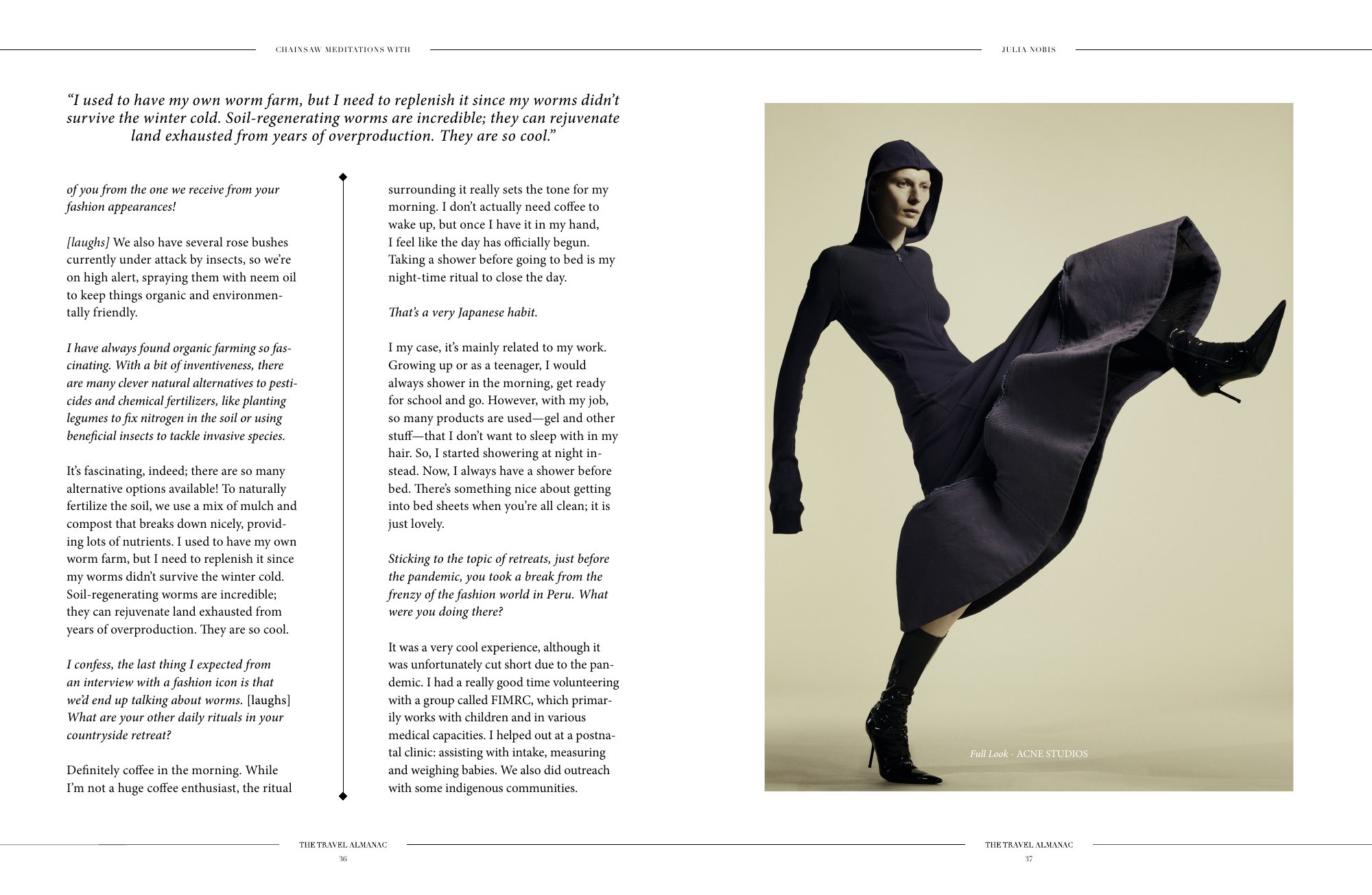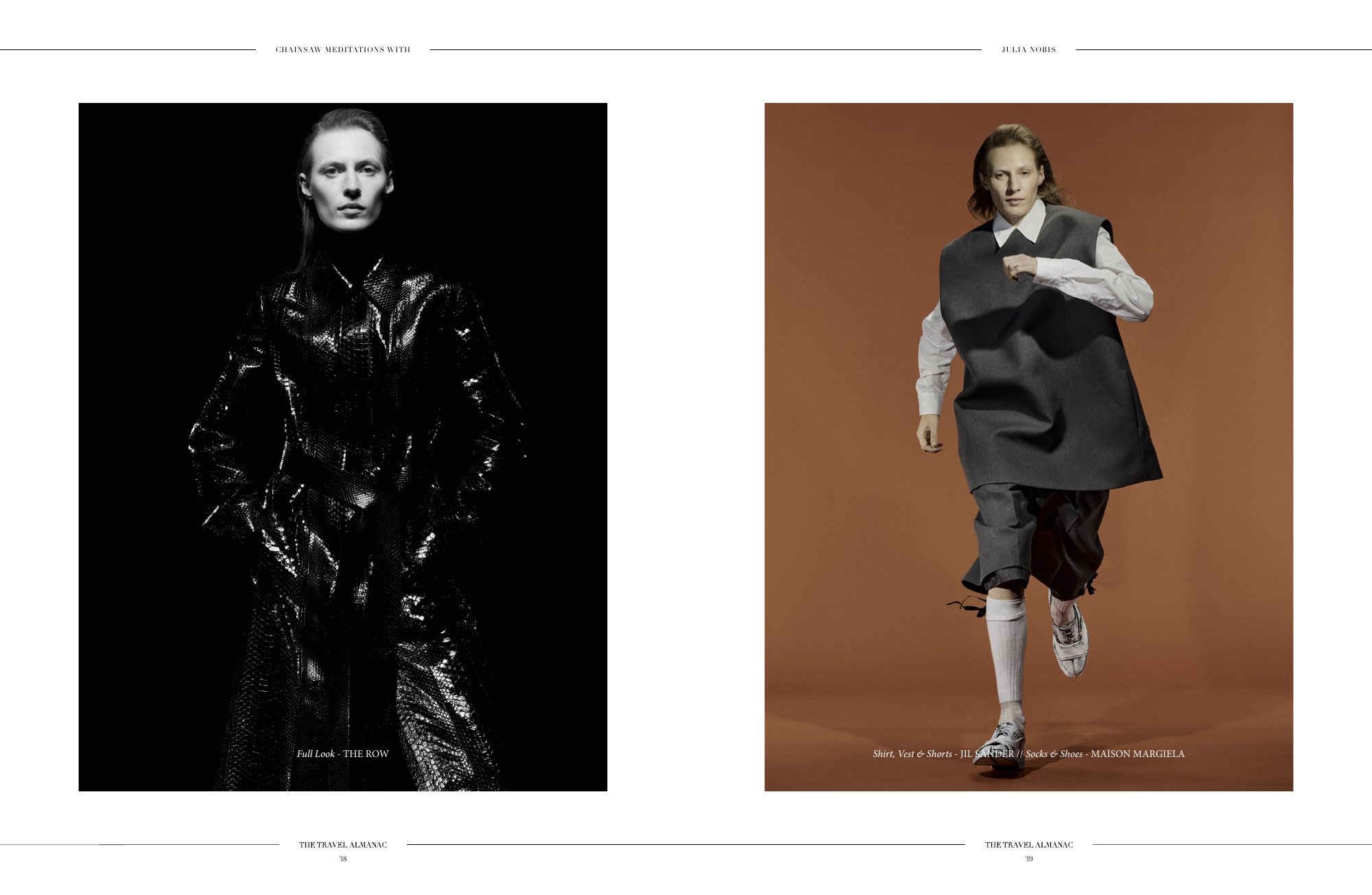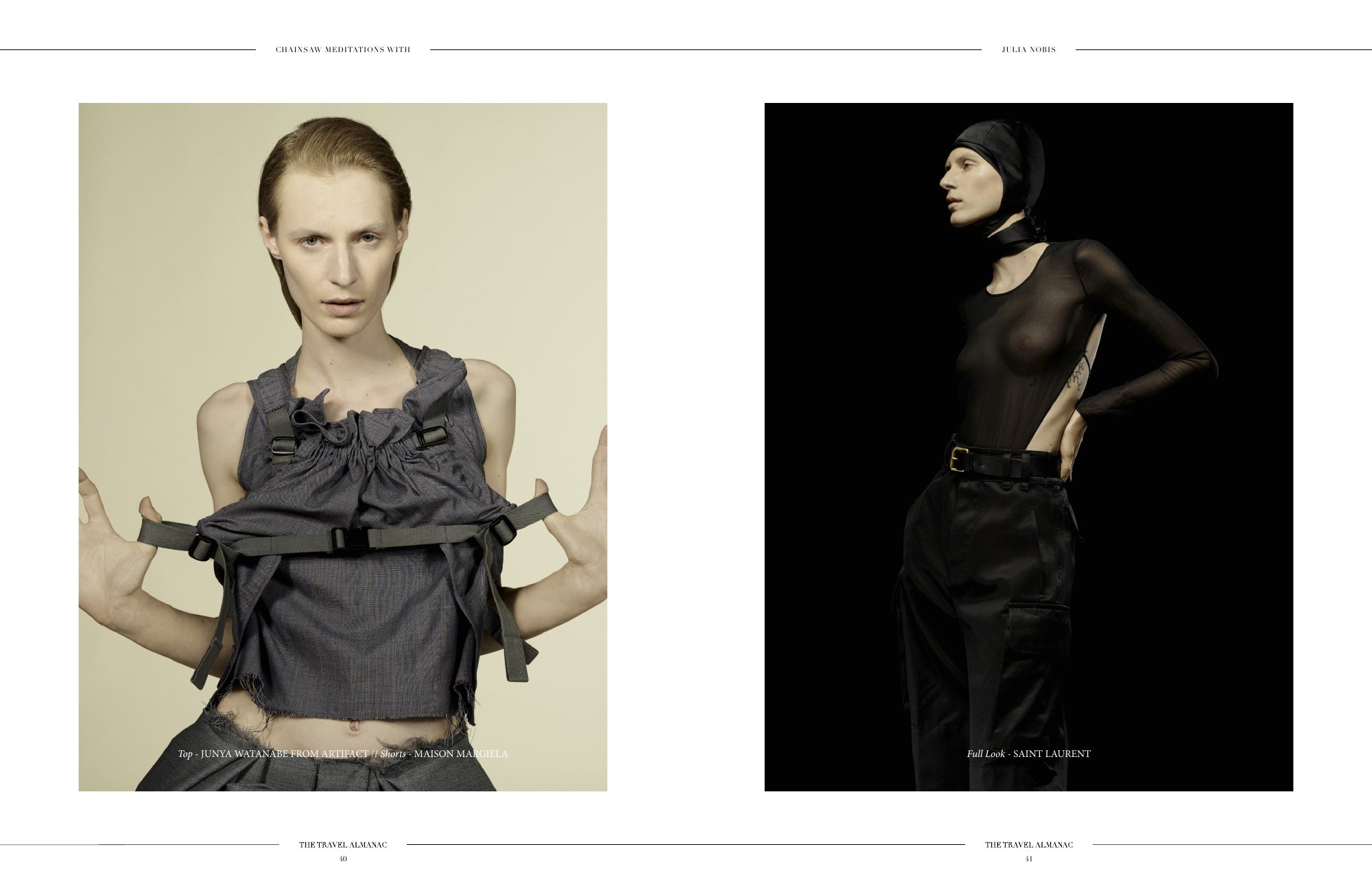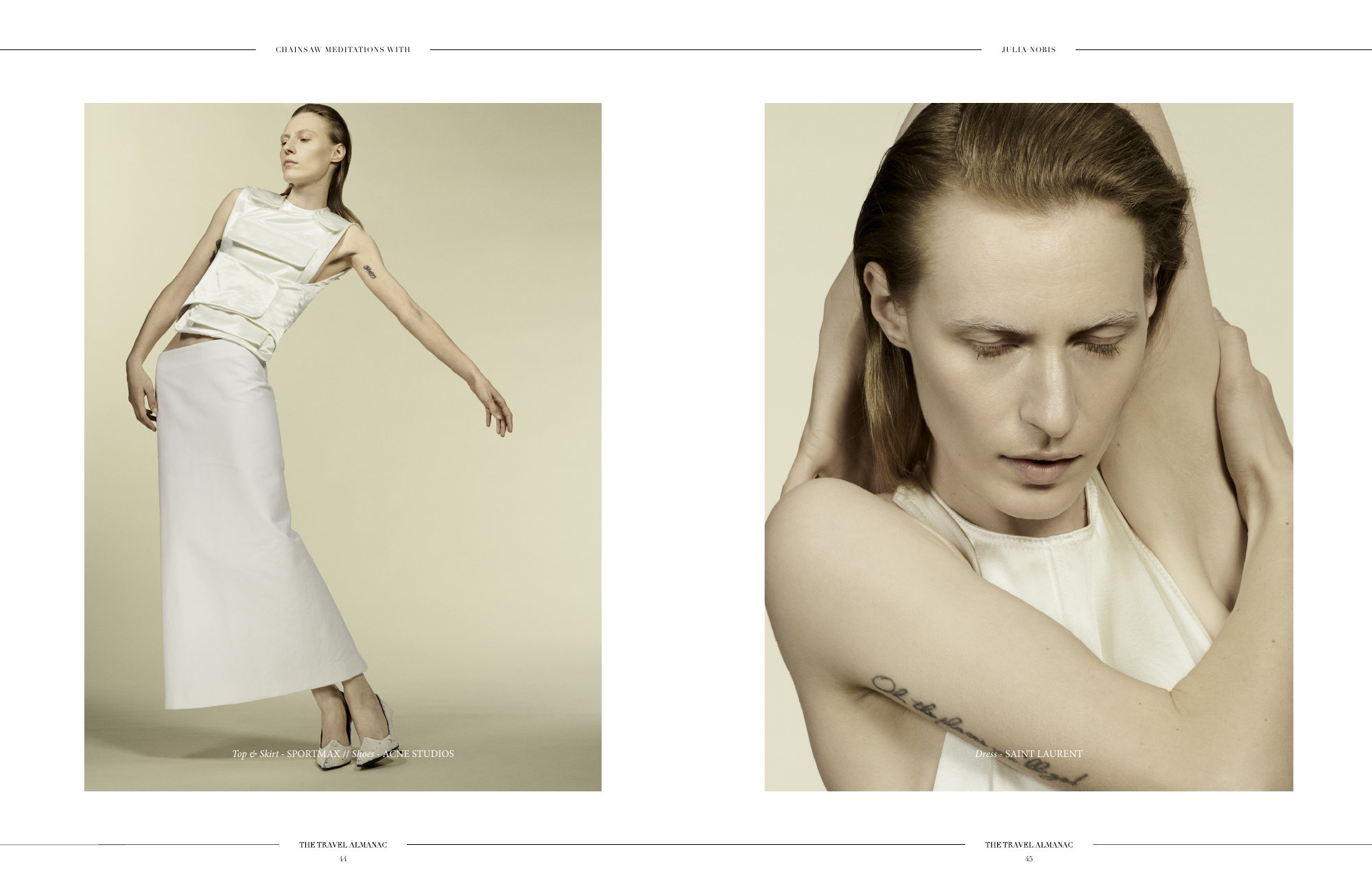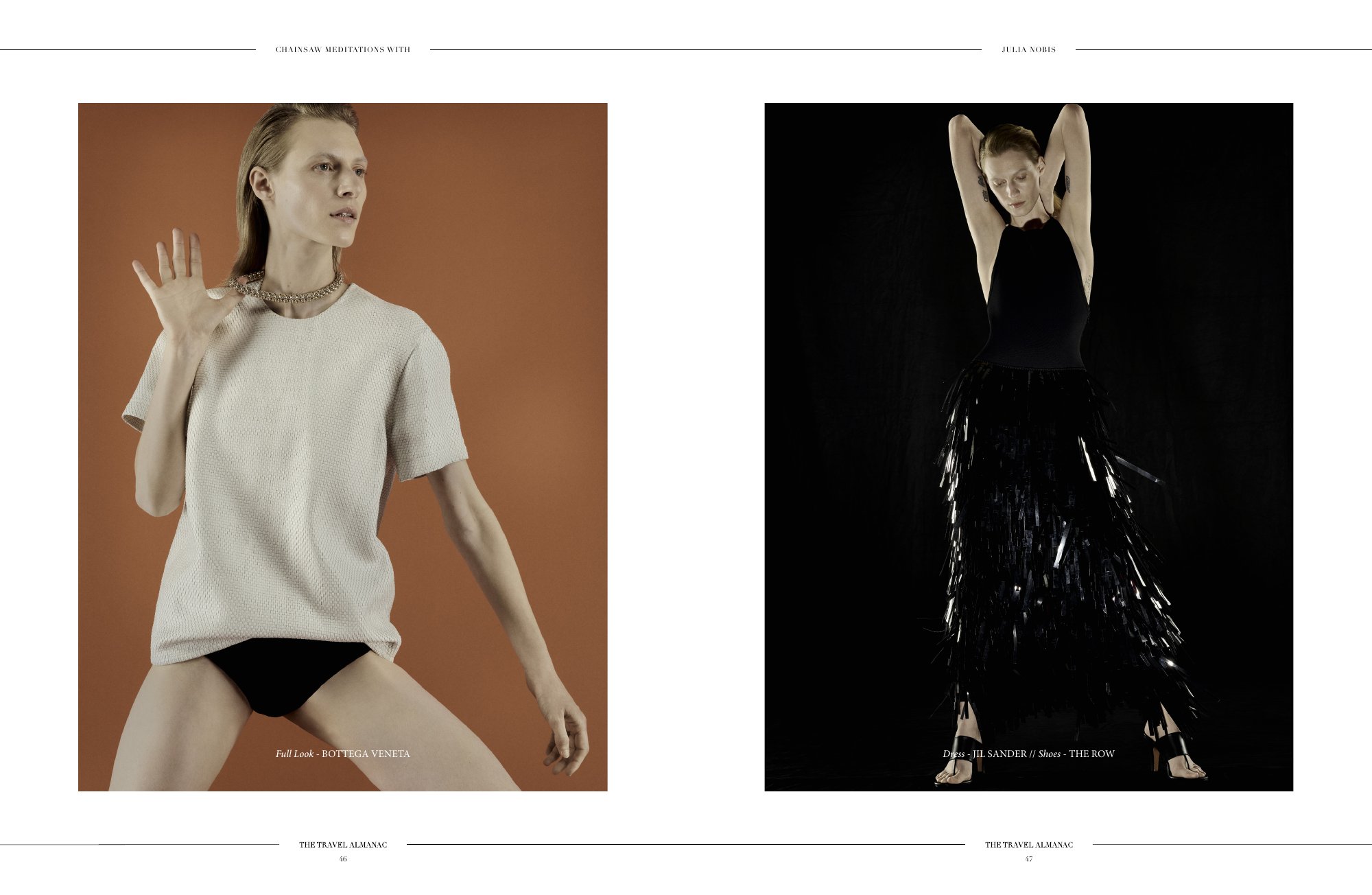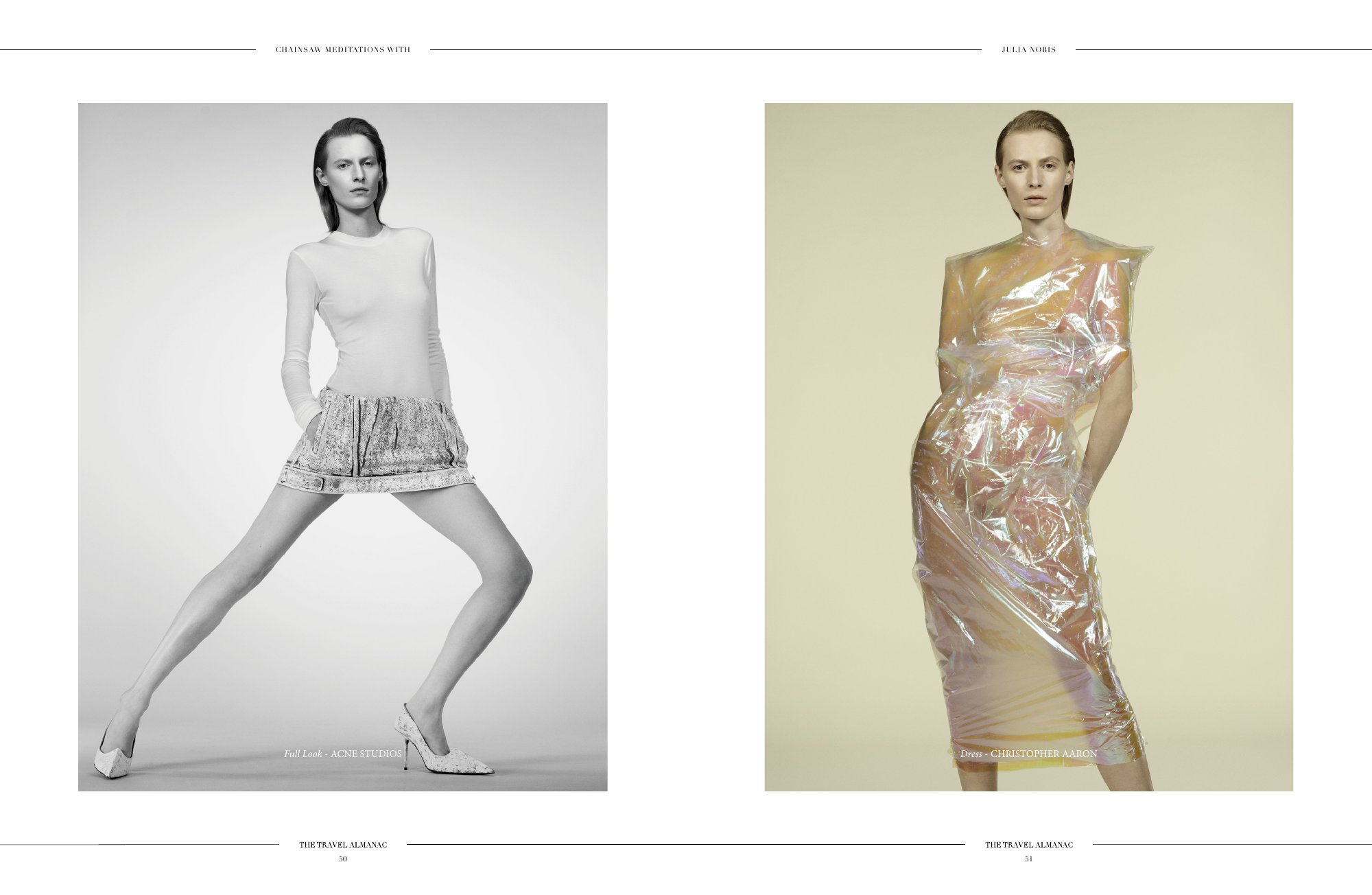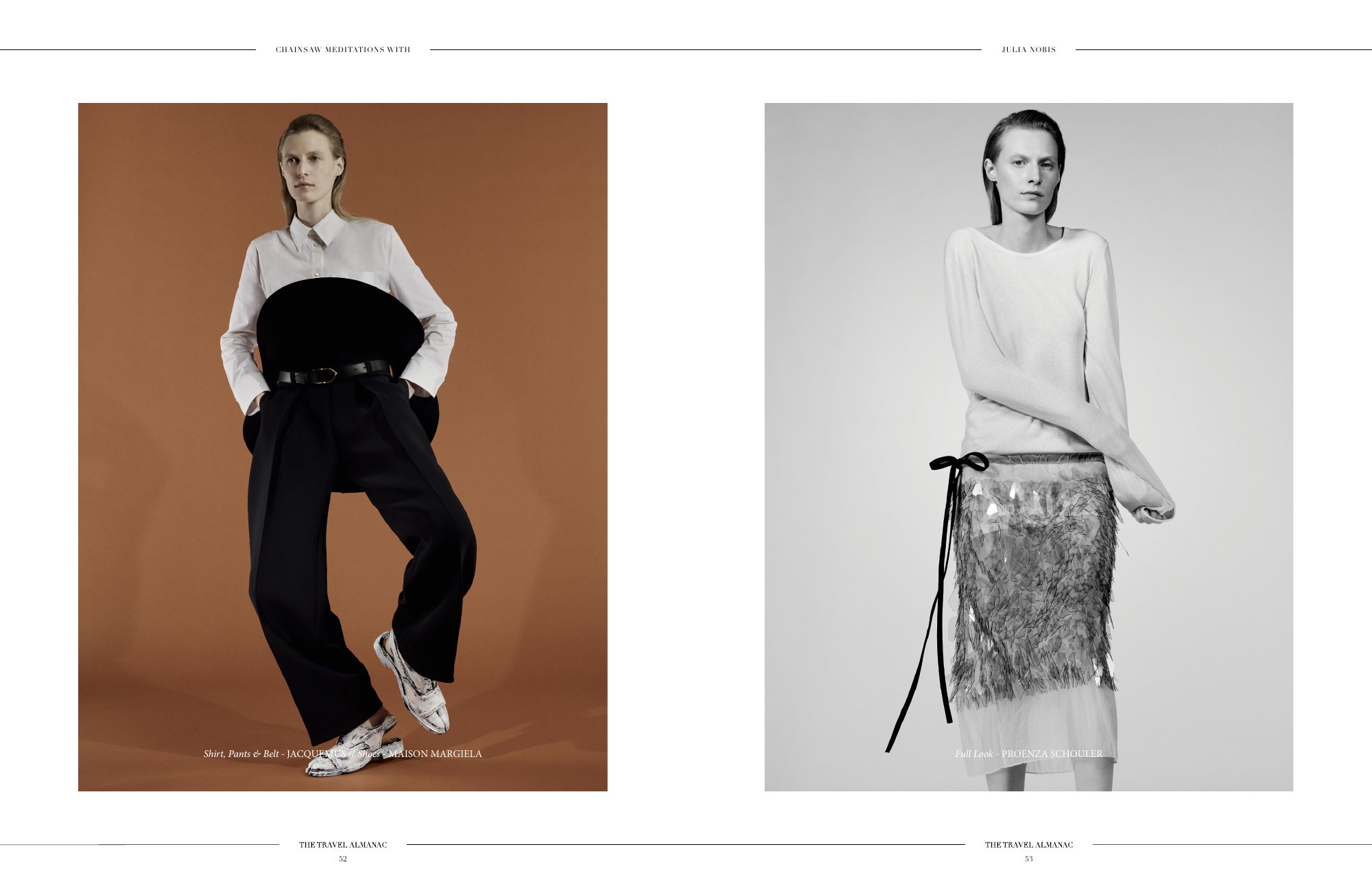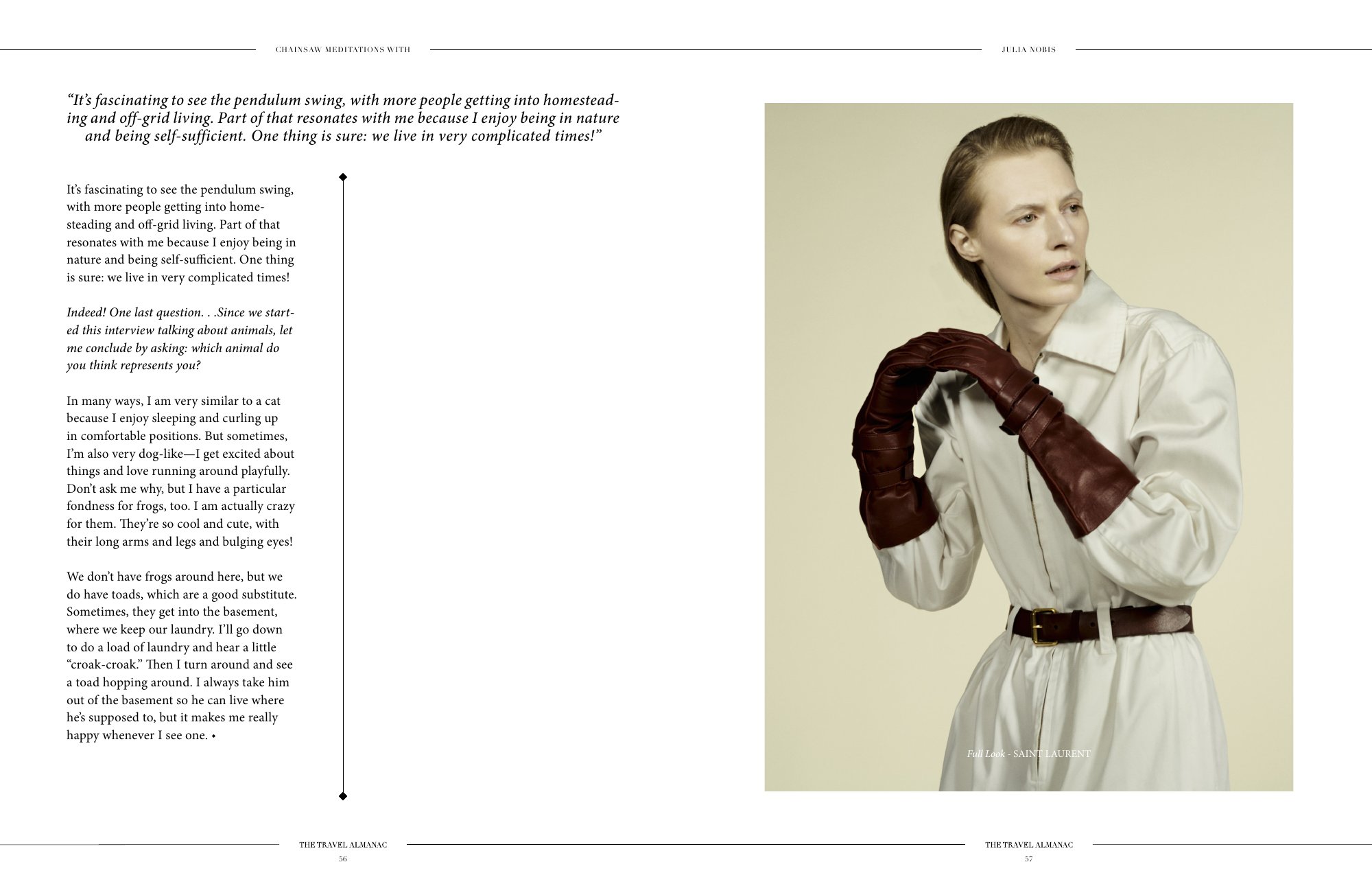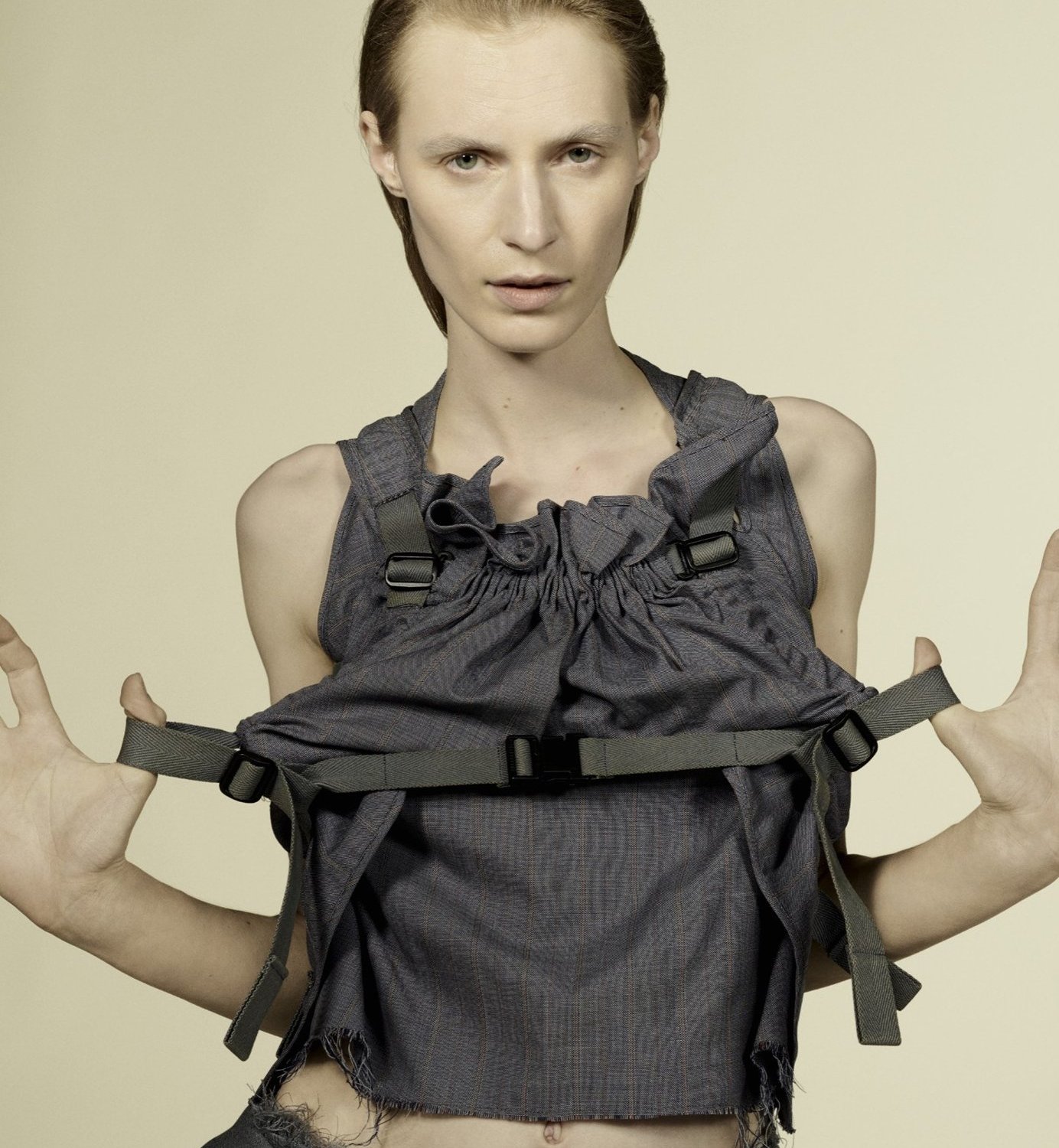
Born 27th June 1992 in Bondi, Sydney, Julia Nobis was first discovered in 2009 while wearing her school uniform in the Rose Bay area of her hometown. She made her debut as a Calvin Klein exclusive in 2010 and quickly rose to prominence, becoming a staple on the runways of major fashion houses such as Chanel, Dior, Burberry and Prada, frequently praised for her distinctive androgynous look and versatile presence. Labeled as an “Industry Icon’’ by models.com, Julia regularly walked between 60 and 70 shows during fashion week, with her success soon transferring over to editorial work. She first appeared on the cover of Vogue Australia in May 2011 and has since appeared on the cover of countless magazines, from i-D, Numéro and The New York Times T Magazine to W Korea, British Vogue and Love. She is one of the few models who can boast having been featured on the cover of Vogue Italia six times. Despite her fame in fashion, Julia has expressed that modeling was never her ultimate goal; she pursued a Bachelor of Science and Applied Science at RMIT, has recently completed paramedic training and plans to return to university to study microbiology. Connecting with The Travel Almanac by phone from her home in Connecticut, Julia gives voice to her many sides, discussing her rural lifestyle, her experiences with gardening and volunteering, and musing over the impacts of AI on the fashion industry. She also shares her passion for guitar, her journey of personal growth and self-acceptance throughout her modeling career, and some mixed feelings on the concept of genetic engineering.
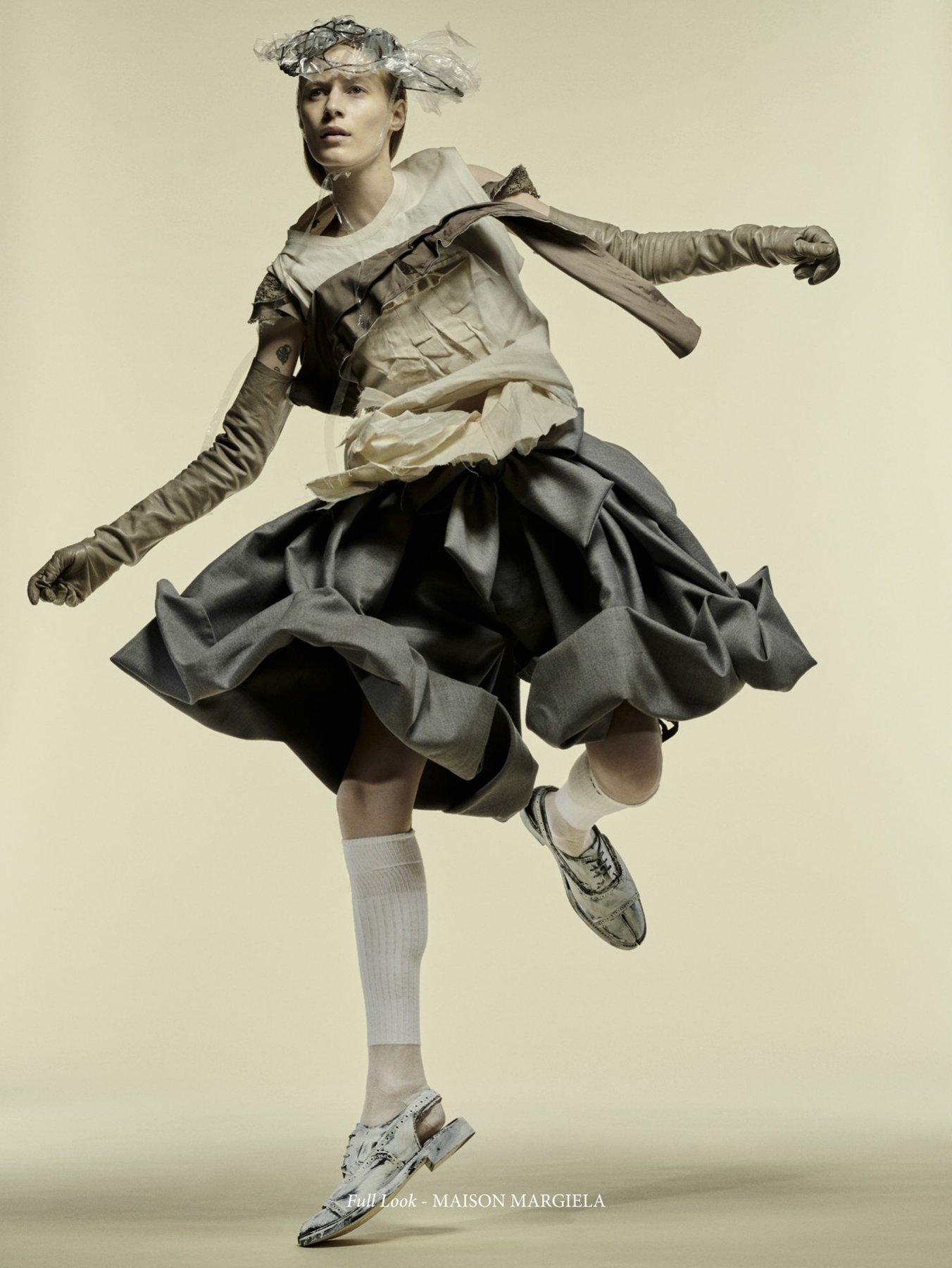
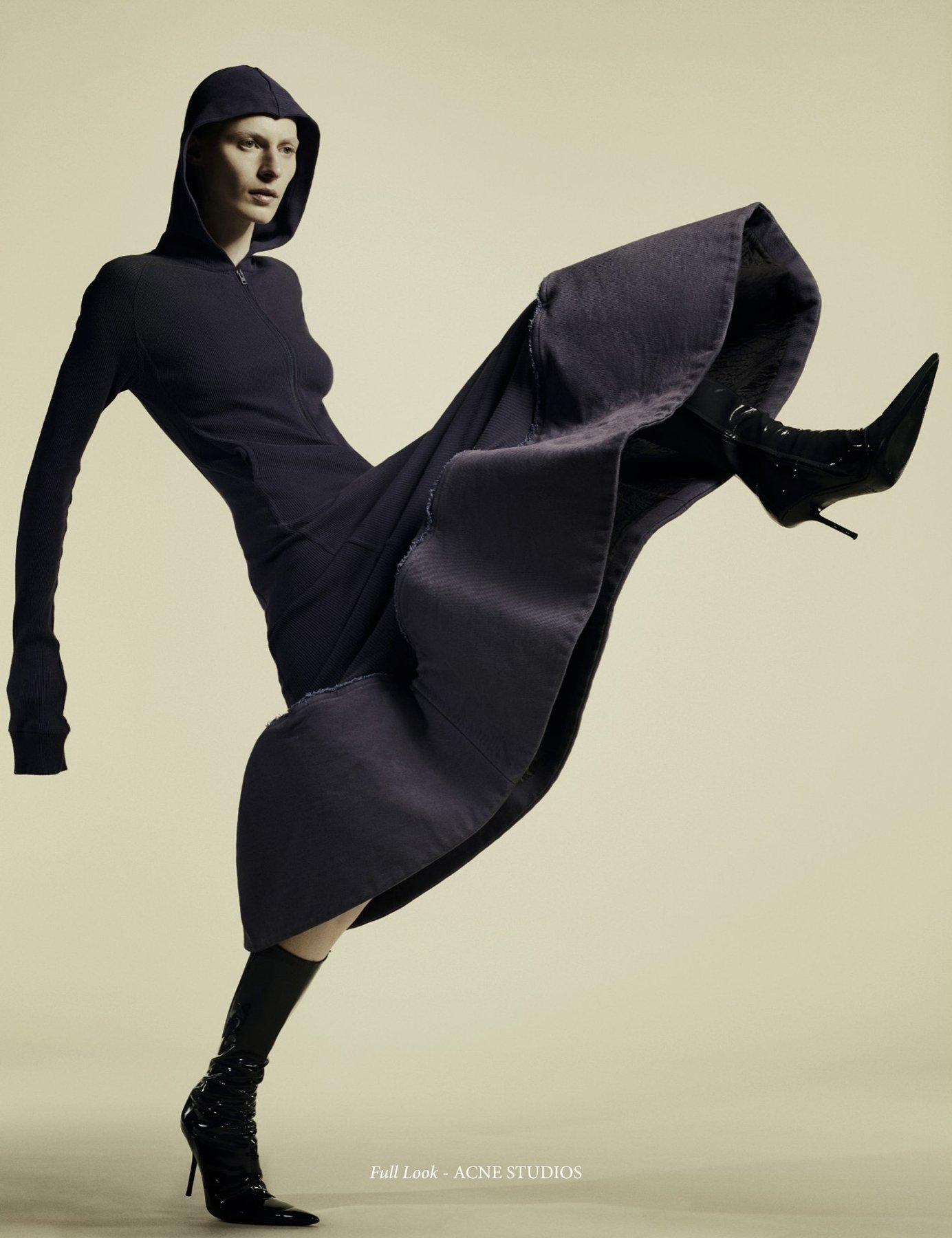
I just checked your Instagram stories a moment ago and saw a video you posted of a bear in front of your home window! Do you live in a forest, or somewhere secluded?
Crazy, right? I live in Connecticut, in a natural setting surrounded by forests. But it’s not that isolated. There’s a lot of farmland around where I live, too. Connecticut being a small state, you can never be too far from a city.
I’m curious to know what led you to live there because, you know, as a sought-after model who often works in fashion capitals, one would expect a more urban lifestyle.
We moved during the pandemic, like many others did. I was stuck in a very small apartment in New York, and I have always loved being out in nature. So, when the opportunity to buy a place in the country came up, we jumped at it. And we are still here now.
So, it was like a Covid project that turned out to be permanent. Can you describe your life there?
It’s a nice, quiet little life. I have a dog and a cat out here. The dog gets walked in the mornings. I wake up very early, usually with the sun, and go to bed early—I’m turning into a bit of an old grandma, and it’s nice.
How often do you have to leave your rural refuge for your modeling assignments?
I still travel almost once a week for my fashion assignments, mostly in New York and Europe. When I come home, I like to do as little as possible to enjoy the quiet time before I have to head out again.
Can you describe your routine day when you are in Connecticut?
My routine here changes with the period of the year, obviously. Right now, with the end of spring and the beginning of summer, there’s a lot of gardening and yard work to be done, but we also just spend quite a lot of time hanging out in nature. I’m quite a homebody, so I’m very comfortable just staying at home and doing nothing.
Gardening is indeed a very rewarding activity. In today’s increasingly chaotic and hard-to-understand world, activities like cooking and gardening provide us with a sense of agency and reassurance. Tell me more about your experiences with gardening.
Our gardening is definitely a work in progress. We try to plant mostly native species, though we occasionally include ornamentals if we really want them. We have a few fruit trees that pretty much take care of themselves. We just harvest the fruit when it’s ready. June is particularly challenging due to Japanese beetles, which destroy many crops. I’ve set up a lot of traps to mitigate the damage. Invasive species are a big issue here, so we’ve been curbing down invasive European maples and planting native ones. I’ve become quite handy with a chainsaw through this process!
That’s quite a strikingly different image of you from the one we receive from your fashion appearances!
[laughs] We also have several rose bushes currently under attack by insects, so we’re on high alert, spraying them with neem oil to keep things organic and environmentally friendly.
I have always found organic farming so fascinating. With a bit of inventiveness, there are many clever natural alternatives to pesticides and chemical fertilizers, like planting legumes to fix nitrogen in the soil or using beneficial insects to tackle invasive species.
It’s fascinating, indeed; there are so many alternative options available! To naturally fertilize the soil, we use a mix of mulch and compost that breaks down nicely, providing lots of nutrients. I used to have my own worm farm, but I need to replenish it since my worms didn’t survive the winter cold. Soil-regenerating worms are incredible; they can rejuvenate land exhausted from years of overproduction. They are so cool.
I confess, the last thing I expected from an interview with a fashion icon is that we’d end up talking about worms. [laughs] What are your other daily rituals in your countryside retreat?
Definitely coffee in the morning. While I’m not a huge coffee enthusiast, the ritual surrounding it really sets the tone for my morning. I don’t actually need coffee to wake up, but once I have it in my hand, I feel like the day has officially begun. Taking a shower before going to bed is my night-time ritual to close the day.
That’s a very Japanese habit.
I my case, it’s mainly related to my work. Growing up or as a teenager, I would always shower in the morning, get ready for school and go. However, with my job, so many products are used—gel and other stuff—that I don’t want to sleep with in my hair. So, I started showering at night instead. Now, I always have a shower before bed. There’s something nice about getting into bed sheets when you’re all clean; it is just lovely.
Sticking to the topic of retreats, just before the pandemic, you took a break from the frenzy of the fashion world in Peru. What were you doing there?
It was a very cool experience, although it was unfortunately cut short due to the pandemic. I had a really good time volunteering with a group called FIMRC, which primarily works with children and in various medical capacities. I helped out at a postnatal clinic: assisting with intake, measuring and weighing babies. We also did outreach with some indigenous communities.
One memorable day, we set up a stall in a small town plaza to provide sexual health education. We handed out condoms and answered questions about safe sex, which led to an amusing encounter with a nun who yelled at us. Despite that, it was a very rewarding experience with a lot of variety.
Do you still volunteer?
I did a lot of volunteering when I was still living in New York. It’s a bit more difficult out here in Connecticut.
What kind of volunteering activities did you do in New York?
There is an organization called New York Cares, which offers thousands of volunteer opportunities. You can simply visit their website and find something that suits your interests and schedule, which is perfect for someone with a crazy modeling agenda like me. For instance, you might see an opening at a soup kitchen needing help from 5 PM to 9 PM on a Wednesday, and if you’re free, you can volunteer. I particularly enjoyed working with children and teaching. I assisted teachers, tutored high school students, and provided homework help. I also participated in yoga and martial arts classes as an extra instructor. Additionally, I worked with differently-abled adults, teaching them hobbies like knitting and crocheting. Another rewarding experience was helping adults who hadn’t finished high school to get their GED, which improved their job prospects.
That’s inspiring. Is there a story or person from your volunteering experiences that has particularly left an impression on you?
There was one kid who was selectively mute and didn’t talk to anybody. During a martial arts class, he decided to try a backward roll. You could tell he was very anxious, so I gently helped push his feet over. When he finally did it, the whole class—fourth graders around 10 years old—clapped and cheered for him. Sometimes, kids that age can be unkind—even cruel—with each other. This time, everyone was truly happy for him. You should have seen the big smile on his face. I’ll never forget that moment.
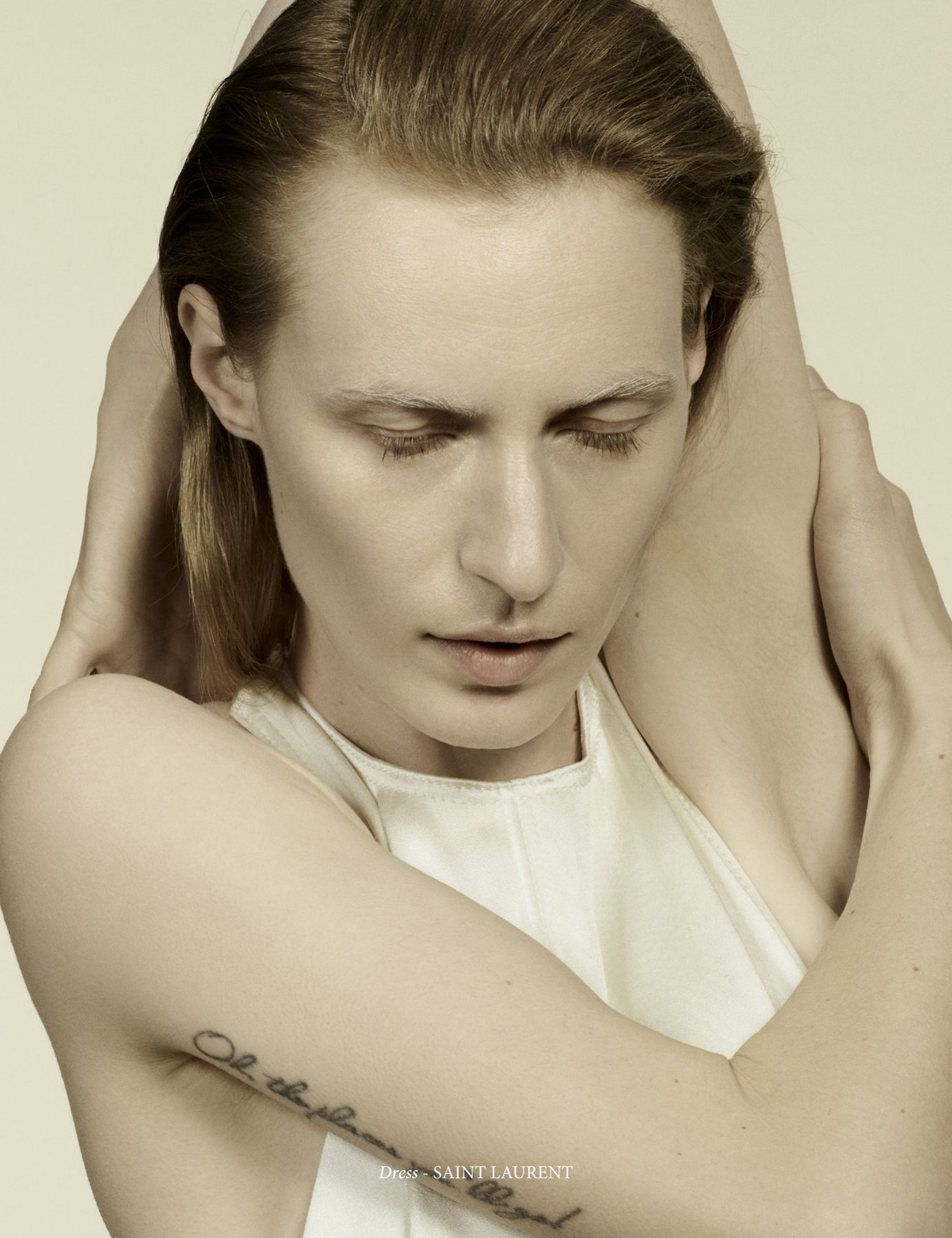
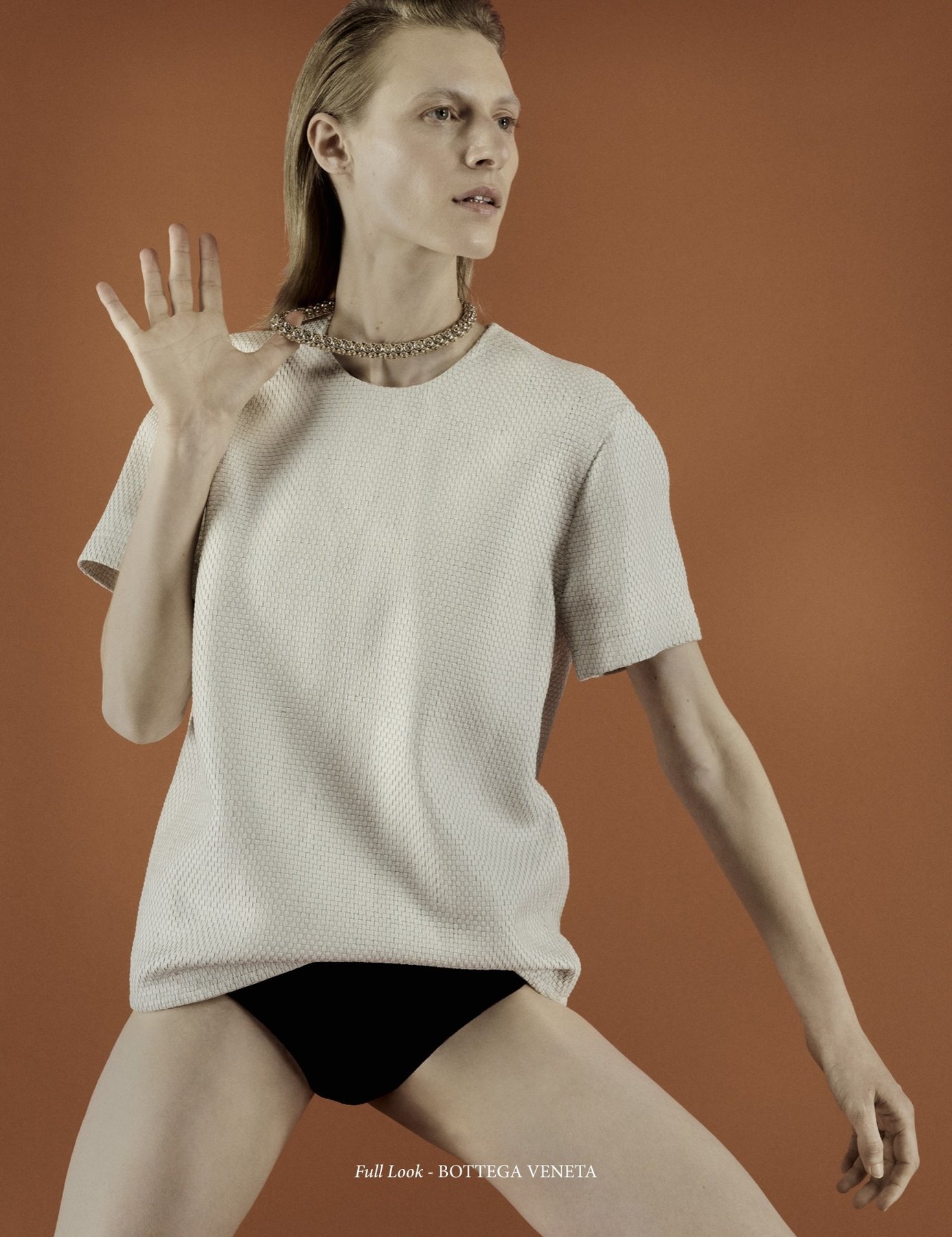
As humans, we possess both kindness and brutality within us. I believe that kindness and the spirit of collaboration can be taught and nurtured from a young age by showing children the powerful energy that is released when we help each other and create things together.
Absolutely. Everyone has the potential for kindness, but it needs to be fostered. Sometimes, it requires a bit of guidance, as it’s not always a focus or emphasis in our society. However, we can cultivate a more compassionate and collaborative world with the right encouragement and environment.
Remaining on the topic of personal growth, what aspects of your persona today do you think you owe to your modeling career? How do you compare to the person you were 15 years ago?
This might sound like a double-edged sword, but my modeling career has definitely given me a thick skin. It’s not because the industry is especially abusive, but because it’s very cut and dry. You can’t take things personally, otherwise you would go absolutely mad. For instance, if a job isn’t looking for a blonde, it doesn’t mean I’m bad for being blonde; it’s just not what they need for that particular job. Or if my look isn’t right for a gig, it doesn’t mean I’m ugly; it’s just not what they are seeking in that moment. It’s very easy to take these things personally and feel like you’re doing something wrong, but it’s really out of your hands.
From what you’ve said, it’s clear that modeling isn’t necessarily the ego-boosting job one might think. You probably face more rejection than acceptance. How has this affected your ego?
I think I have a healthy balance. I’m not the most secure person in the world, but I’m not particularly insecure either. I can generally take things at face value. Success in this industry can certainly inflate your ego when things are going really well, but then all of a sudden, if the work slows down for any reason, it can be a huge blow to your self-esteem. You always have to be a little on guard. It’s this constant balancing act that keeps my ego in check.
Are there one or two designers with whom you’ve particularly created a bond or felt a deep understanding?
I’ve been working with Raf Simons for ages, and we’ve become quite close. I am also friends with Jack and Lazaro from Proenza Schouler. They are not only fun guys to be around, but also people I’ve developed a strong personal bond with. I think I owe them the lesson I mentioned earlier of not taking rejections too personally. Early in my career, I had the chance to closely observe the preparation for one of their shows, including the model-selection process. Watching them put together the casting list, I realized how decisions were made purely based on fit and style, not personal preference. For example, they might say someone’s athletic body wasn’t right for a particular look, but it was never about disliking the person. I remember them asking me, “Is this weird for you to see?” I responded, “No, it’s actually nice and reassuring.”
Your beauty has often been described as androgynous. How do you relate to that? Have you embraced it, or was it something you initially felt uncomfortable with?
Growing up, I was always a tomboy, so looking quite boyish feels natural to me. I often get mistaken for a guy because I wear men’s clothes. Paris is particularly challenging in this regard; the city seems unable to comprehend a woman wearing men’s clothes. When I’m out with my wife—who is petite, has long hair and is more traditionally feminine—people tend to default to assuming she’s the girl, which automatically makes me the guy in their eyes. But honestly, I don’t care. What I find interesting about my appearance is the flexibility it gives me. I can easily swing between masculine and feminine looks or stay in the middle with an androgynous style. Throughout my career, I’ve embraced very feminine roles, very masculine ones and everything in between. I think it’s a really fun and versatile place to be.
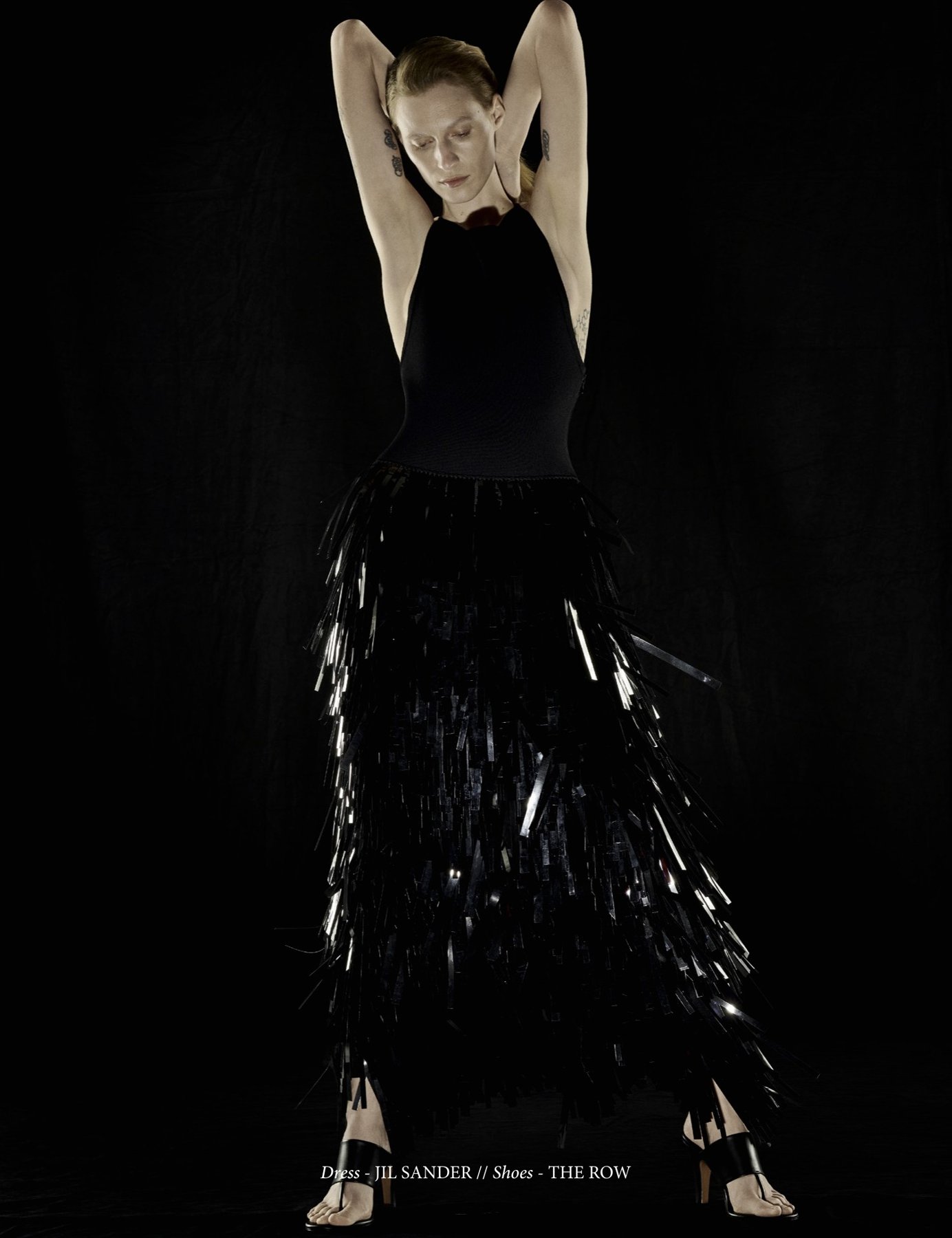
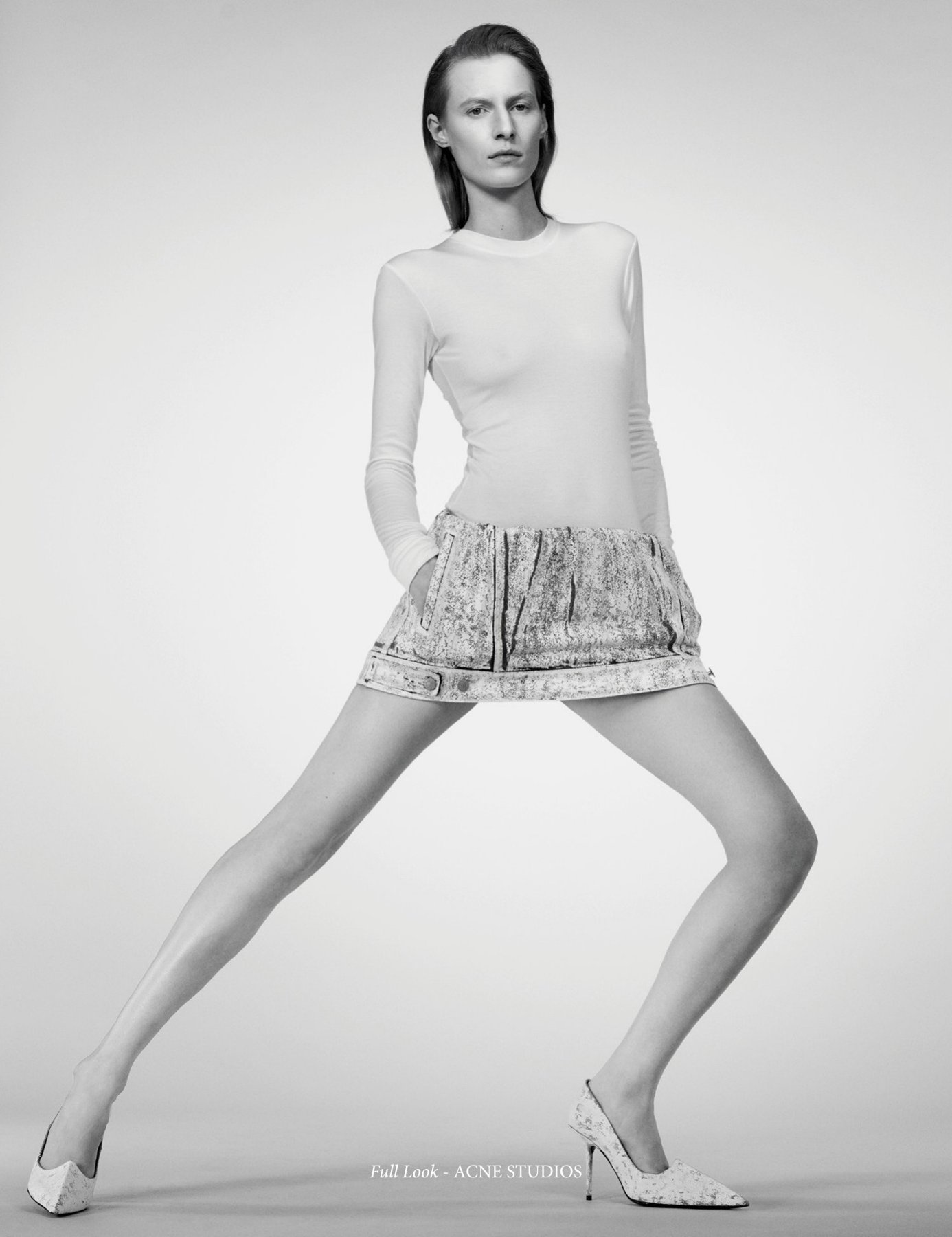
Considering that you brought this androgynous style into the fashion world, it has undoubtedly had some political impact. Your contribution has helped to promote the acceptance of people with blurred gender identities, challenging the notion that we must necessarily identify as 100% male or 100% female.
Growing up, people would tell me, “Oh, you should be a model.” I knew I was tall and skinny, but I didn’t see myself fitting the model mould because I wasn’t traditionally feminine. The fashion presented to me in Australia was all about hyper-femininity—big boobs, big hips, like Elle Macpherson. It’s been 15 years now, and it was definitely a learning curve. I had to come to terms with the idea that my androgynous look could be considered beautiful and desirable, and that being different could be an asset rather than a hindrance.
Our industry is finally celebrating diversity and physical imperfections, which is undoubtedly a positive change. Are there other trends in the current fashion world that you see as positive improvements?
When I started, there were plenty of 15-year-old girls entering the industry. Now, most models begin at 17 or 18. While 18 is still young, it’s a bit more mature than 16, which helps them advocate for themselves better. It’s nice to see the new models coming in a bit more confident and able to stand up for themselves.
Do you have a funny anecdote related to your modelling career?
I can share one of the many wild ones if you like! Once, I did a show where we all had to travel—I won’t mention which one it was—but a lot of the girls came down with a stomach bug. It was a norovirus, so the backstage area was a disaster zone. If you’ve ever dealt with a norovirus, you know there’s no warning. One moment you’re fine, the next you’re very much not fine, and you’ll stay that way for 24 to 48 hours. It was pure chaos right before the show. Luckily, I didn’t get sick and ended up taking care of girls who were.
I know you were a passionate guitar player. Do you still play, or is the guitar hanging on a nail?
I still play! I have two guitars downstairs, as well as a ukulele and a piano.
A ukulele?
Traveling with a ukulele is easier than with a guitar.
It’s an instrument that fits better with a fashion icon’s lifestyle.
Exactly! [laughs] Airlines have become stricter about carrying guitars on flights. They don’t always allow them as carry-on items anymore, and I don’t like checking them in because I’m worried they might get damaged. So, I stopped traveling with my guitar. However, I’m lucky that I have guitars at my place in Sydney. When I’m in Paris, my friends sometimes let me borrow their guitars if I really feel the need to play.
Is there a song you kind of always play?
I have a repertoire, but it really depends on the day and my mood. Sometimes, I feel like playing flamenco guitar, other times a little pop song or just a riff. Occasionally, I play one of the songs I’ve made up myself. It’s very dependent on how I’m feeling in the moment.
Speaking of music, I listened to a song by Billie Eilish sung by Madonna a few days ago. It was an AI simulating Madonna’s voice incredibly well. I’m curious, how do you feel about this cataclysmic technological advancement called AI? Has it impacted your life already? Does it scare you, or are you excited about the possibilities it offers?
I see the potential for a lot of good, but I think I have a healthy dose of scepticism. In your example of the song, it feels a bit weird to use someone’s complete likeness. While it can be incredibly flattering for someone to impersonate you, for the most part, I think stealing someone’s essence or character and putting it into something else is quite unsettling.
Scarlett Johansson recently declined an invitation from OpenAI—the company that created ChatGPT—to use her voice. I understand her decision. It must be unsettling to not have control over how your voice and other personal features are used.
Not that I am in full control of my image now—what is out there isn’t always up to me. I don’t get to choose which photos get published. They take all the pictures, and someone else selects which ones to put forward. So, to a degree, I already have a detachment from my image. However, I still feel pretty concerned about what comes through not being a too one-sided representation of me. I have many sides, and I would like to give voice to all of them, although one has to come to terms with the fact that your representation is never going to be complete.
There are predictions that AI will generate lots of fashion editorials with virtual models, thereby stealing plenty of modeling jobs in the next few years. AI can generate countless realistic faces, put them in clothes, and retouch everything perfectly. How do you feel about that?
Who knows, it could also have the positive effect of encouraging models to express their personality. In the ’80s and ’90s, it was all about big personalities; it was hard to separate the model and their persona. In the early 2000s, we still had supermodels, but after the 2008 financial crash, budgets were cut, and we saw a shift more towards the “faceless” approach, where many models were used primarily for their body types to fit clothes and walk runways.
However, the trend is now shifting back towards personality, especially with the influence of social media. Models are entering the industry with strong personal brands. With AI, this trend could push even further towards emphasizing personality. The body itself might become less important, and the unique persona could be what stands out—something AI can’t easily replicate—although AI could theoretically create a whole personality as well.
Predicting the future is difficult, and the industry could go in many different directions. However, the growing emphasis on personality might help balance the impact of AI on job opportunities for models.
For many years, you nurtured the dream of becoming an ER doctor. This isn’t just any medical professional role; it’s akin to being a soldier in the trenches, dealing with urgent situations and making critical decisions under pressure. Do you consider yourself one of those people who crave adrenaline in life?
It’s not so much about adrenaline, though I don’t mind that—I’ve gone skydiving before. It’s more that I don’t like monotony; I thrive in environments where things are constantly changing. Modeling suits me well in that regard because every day is different. You’re always working with different people, and things are always changing so fast, with decisions needing to be made quickly. If you put me in a desk job where I do the same thing every day, I’d go crazy. I also have difficulty planning and thinking far into the future. I’m much better at addressing things in the present moment. That’s why I think being an ER doctor appealed to me.
I know that being an ER doctor is no longer part of your future plans. What else is on the horizon besides your modeling career?
Last year, I obtained my EMT license to work as an ambulance paramedic, but I am still waiting for the documents to arrive, so I can’t work yet. In rural areas of the US, like my town, all fire and ambulance services are volunteer-based. It’s not a paid position—they might have one paid administrator, but the rest are volunteers. Once my license arrives, I plan to sign up with the local ambulance company. Even though it’s a slow-paced area with a population of just 2,000, and we’re lucky to get one ambulance call per day, I’m still eager to be involved.
I am also toying with the idea of going back to study.
Which subject?
I’m considering getting my master’s in microbiology. My undergraduate degree was in biotechnology, where I focused on microbiology, genetics and recombinant genetics. It was a fascinating field of study. When Covid happened—though the pandemic itself was obviously not cool—the fast development of mRNA vaccines was fascinating to watch. I finished my degree in 2018, and back then we were discussing the potential of mRNA vaccines, though they seemed far off. Most research was focused on DNA vaccines, which hadn’t been very successful. Witnessing the rapid adoption and success of mRNA vaccines—seeing a concept we had studied in theory become a reality—it was incredible.
Since this issue also explores the boundaries between human and non-human, and you are familiar with genetics, how do you view genetic modification? What are your thoughts on using CRISPR technology to modify human DNA?
Oh, it’s such a tricky subject. I’m not religious, but I still feel like we shouldn’t play God too much. On one hand, if something goes wrong, like someone losing their eyesight, then absolutely, using genetics to restore vision is great. But enhancing vision beyond normal feels a bit strange, though, also really cool.
It raises the question—does feeling weird about it mean that it’s wrong? Technically, there’s nothing inherently wrong or immoral with it, yet it still feels strange. Why is that so? I find this question very interesting. The truth is, humans are far from perfect, and there are many areas where we could improve ourselves.
There’s a Greek word—hubris—which refers to excessive pride or self-confidence, often leading to retribution from the Gods.
Exactly, we don’t need our own Icarus moment. The same applies to AI—how much of a good thing is too much?
My prediction is that we’ll end up deifying it all. . .
I wouldn’t be so sure. In reaction to these incredible technological leaps forward, we’ve also seen a swing in the opposite direction in recent years, with many people rejecting technology and leaning towards a more natural lifestyle. This isn’t always better, and it partly explains how vaccine misinformation spreads—people are scared of technology because it is scary. It’s fascinating to see the pendulum swing, with more people getting into homesteading and off-grid living. Part of that resonates with me because I enjoy being in nature and being self-sufficient. One thing is sure: we live in very complicated times!
Indeed! One last question. . .Since we started this interview talking about animals, let me conclude by asking: which animal do you think represents you?
In many ways, I am very similar to a cat because I enjoy sleeping and curling up in comfortable positions. But sometimes, I’m also very dog-like—I get excited about things and love running around playfully. Don’t ask me why, but I have a particular fondness for frogs, too. I am actually crazy for them. They’re so cool and cute, with their long arms and legs and bulging eyes!
We don’t have frogs around here, but we do have toads, which are a good substitute. Sometimes, they get into the basement, where we keep our laundry. I’ll go down to do a load of laundry and hear a little “croak-croak.” Then I turn around and see a toad hopping around. I always take him out of the basement so he can live where he’s supposed to, but it makes me really happy whenever I see one.
Interview Michele Fossi · Photography Craig McDean · Styling Clare Byrne · Hair Orlando Pita · Makeup Francelle Daly · Casting Bert Martirosyan
By Michele Fossi
Published in The Travel Almanac #24