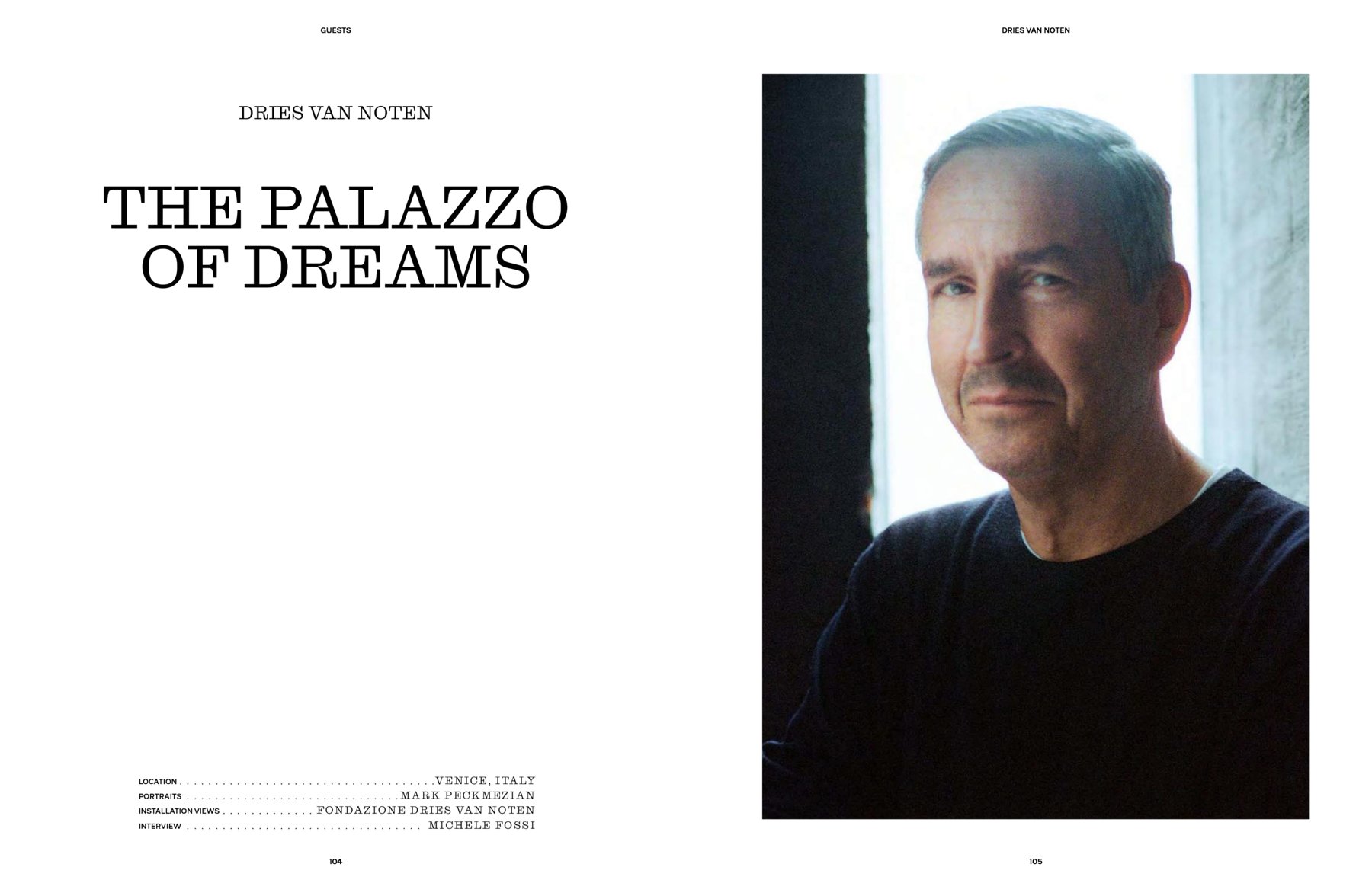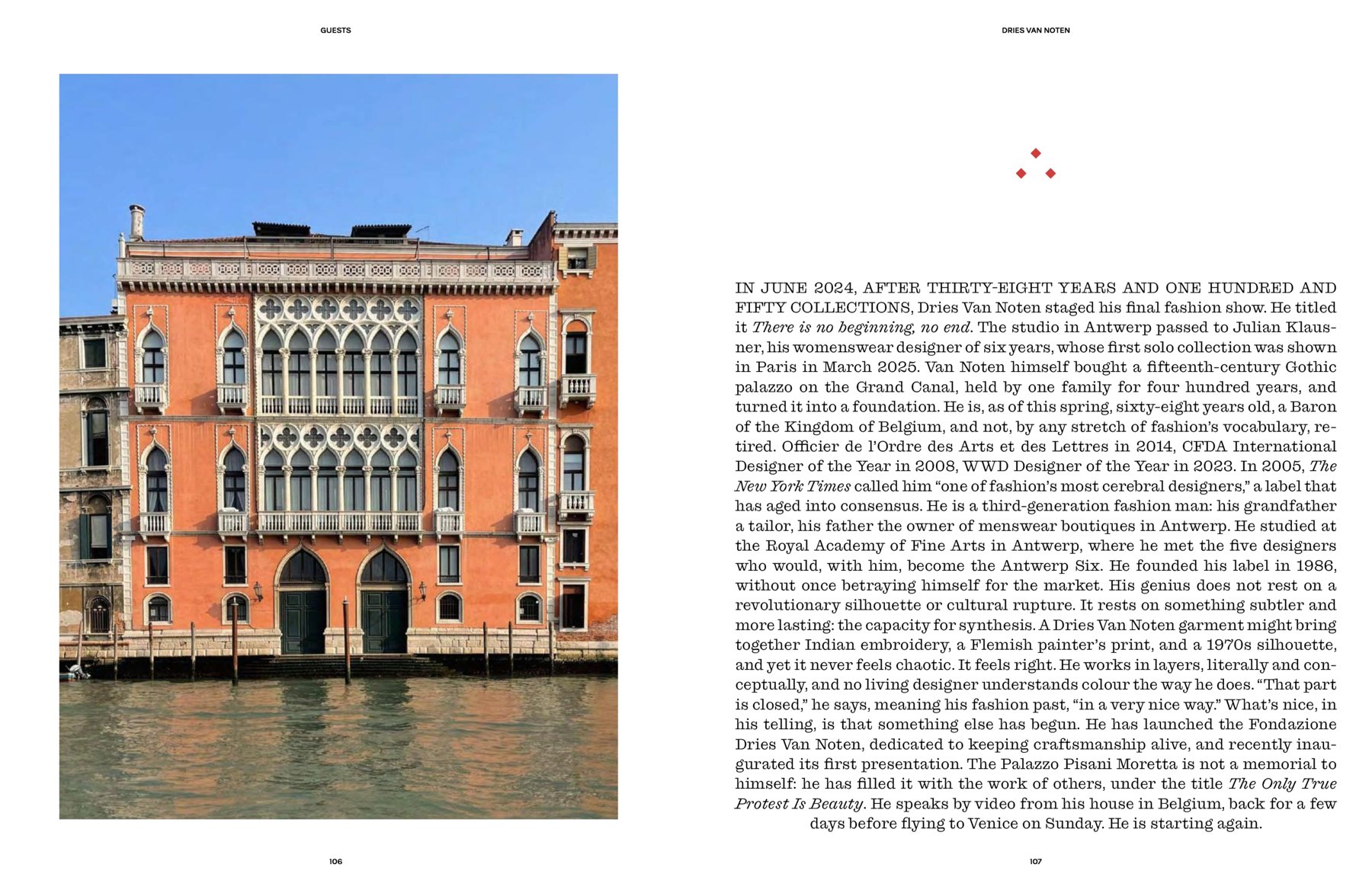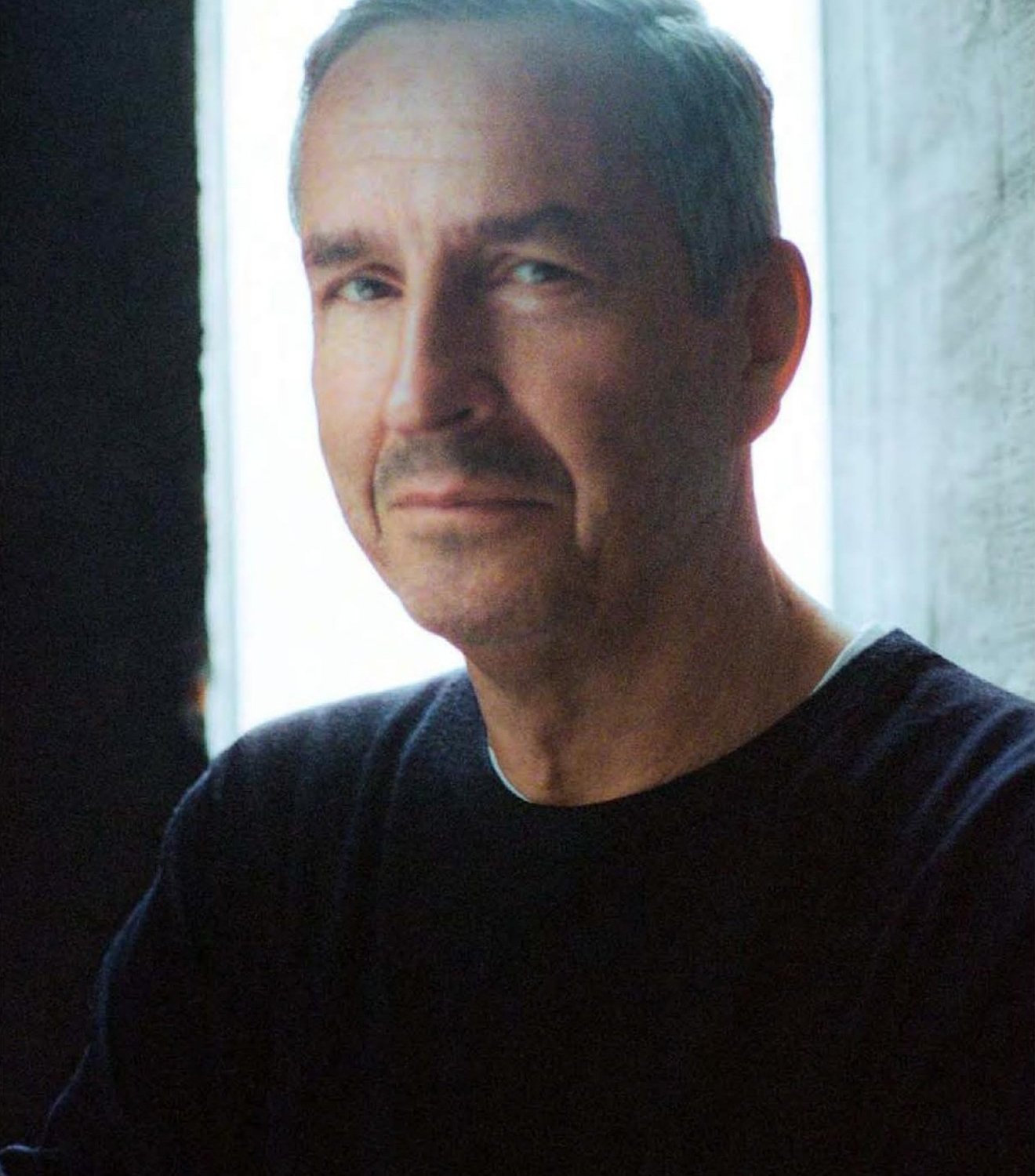
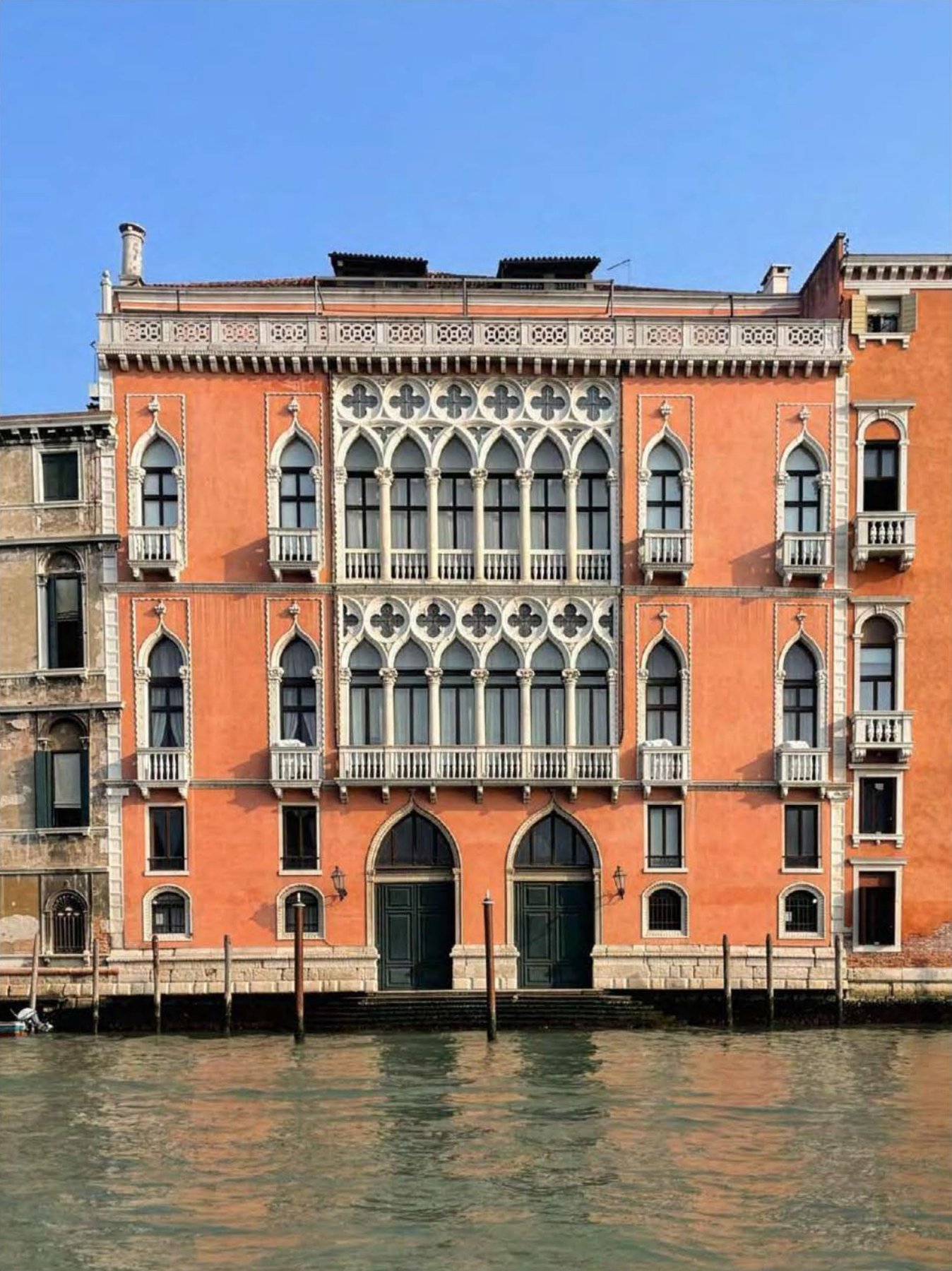
In June 2024, after thirty-eight years and one hundred and fifty collections, Dries Van Noten staged his final fashion show. He titled it There is no beginning, no end. The studio in Antwerp passed to Julian Klausner, his womenswear designer of six years, whose first solo collection was shown in Paris in March 2025. Van Noten himself bought a fifteenth-century Gothic palazzo on the Grand Canal, held by one family for four hundred years, and turned it into a foundation. He is, as of this spring, sixty-eight years old, a Baron of the Kingdom of Belgium, and not, by any stretch of fashion’s vocabulary, retired. Officier de l’Ordre des Arts et des Lettres in 2014, CFDA International Designer of the Year in 2008, WWD Designer of the Year in 2023. In 2005, The New York Times called him “one of fashion’s most cerebral designers,” a label that has aged into consensus. He is a third-generation fashion man: his grandfather a tailor, his father the owner of menswear boutiques in Antwerp. He studied at the Royal Academy of Fine Arts in Antwerp, where he met the five designers who would, with him, become the Antwerp Six. He founded his label in 1986, without once betraying himself for the market. His genius does not rest on a revolutionary silhouette or cultural rupture. It rests on something subtler and more lasting: the capacity for synthesis. A Dries Van Noten garment might bring together Indian embroidery, a Flemish painter’s print, and a 1970s silhouette, and yet it never feels chaotic. It feels right. He works in layers, literally and conceptually, and no living designer understands colour the way he does. “That part is closed,” he says, meaning his fashion past, “in a very nice way.” What’s nice, in his telling, is that something else has begun. He has launched the Fondazione Dries Van Noten, dedicated to keeping craftsmanship alive, and recently inaugurated its first presentation. The Palazzo Pisani Moretta is not a memorial to himself: he has filled it with the work of others, under the title The Only True Protest Is Beauty. He speaks by video from his house in Belgium, back for a few days before flying to Venice on Sunday. He is starting again.
A month since the Foundation opened, your first season in Venice as a Venetian. Why Venice—a city that is, by definition, half in the realm of dream?
It’s a coincidence. Like so many things in life are coincidental. Coincidence for me is always very important in the creative process—you have to be alert constantly, to look around and notice interesting coincidences. When my partner and I decided to stop designing for the brand, it was for a reason. We still wanted to do something else in our lives—not to settle down and do nothing anymore. That’s why we said we want to create a Fondazione focusing on craftsmanship, because it has given us a lot. First, we wanted to do it in Belgium. Then I said: No, I like Italy too much, so we’ll do it in Italy. We started investigating Rome and Florence, which we visited extensively. But then, by coincidence, we ended up in Venice. We could stay at a friend’s apartment, and we were surprised: it’s really a lively city with a lot of young people and many very good schools. They stay in Venice. They don’t leave immediately for Rome or Milan, which became even more expensive than Venice itself. There is really something bubbling.
And the no-traffic-lights thing.
OK, it’s a super cliché. But the fact that there are no cars, no traffic lights saying what you have to do: everything you do is your own decision. That gives you headspace, a space in your mind that you would not have if living in a different city. We thought: maybe this is the perfect place. And here we are.
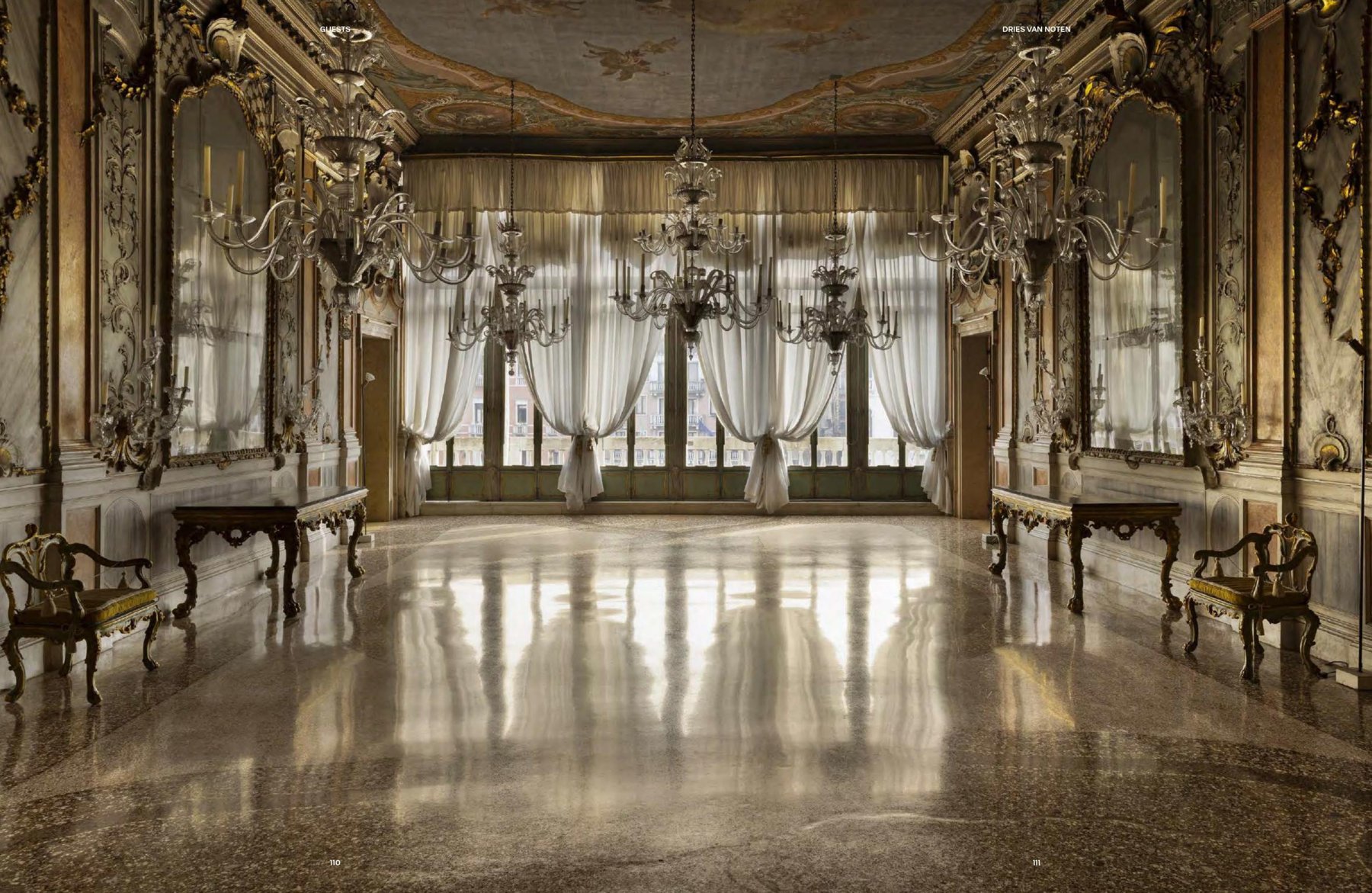
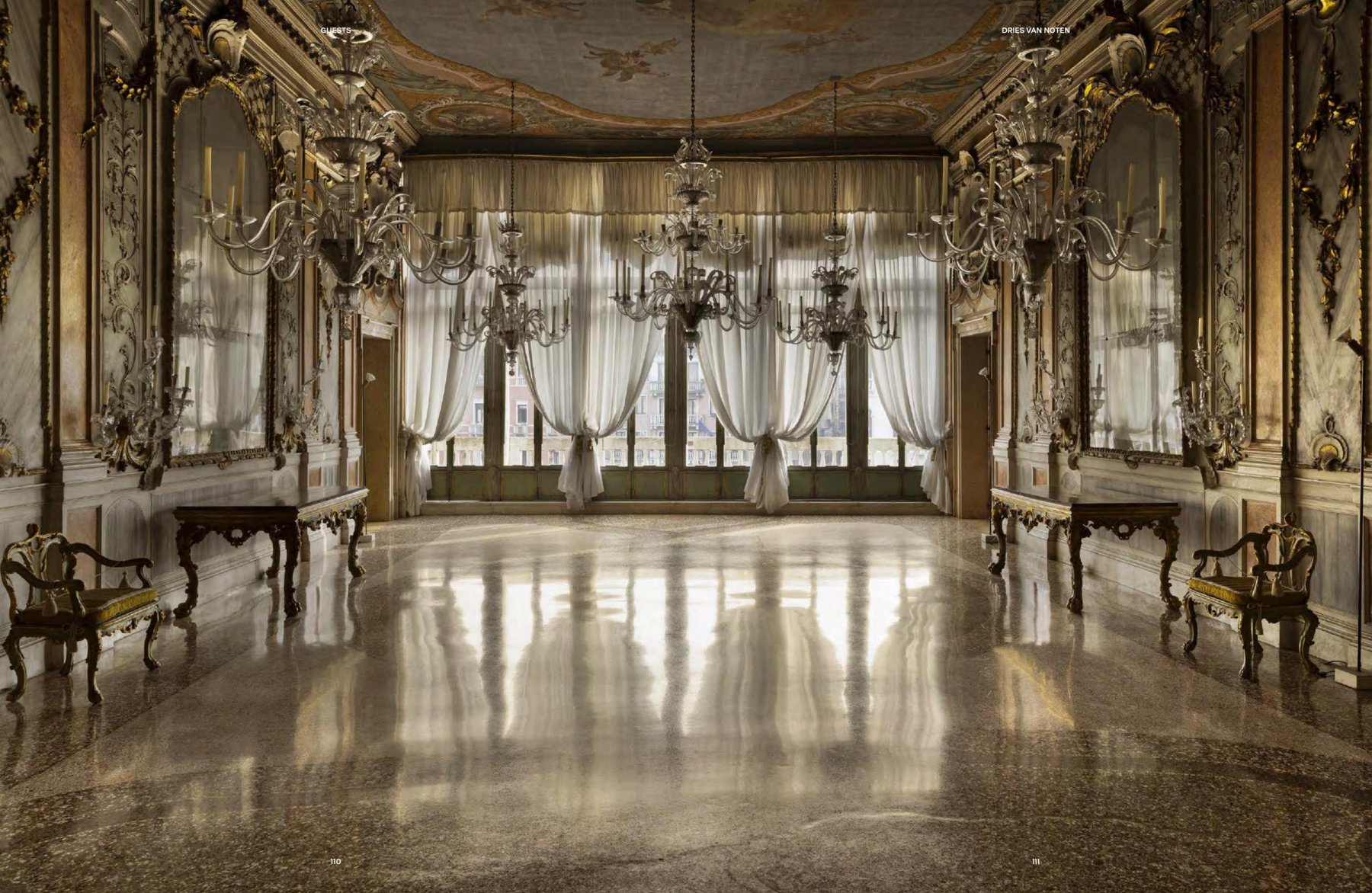
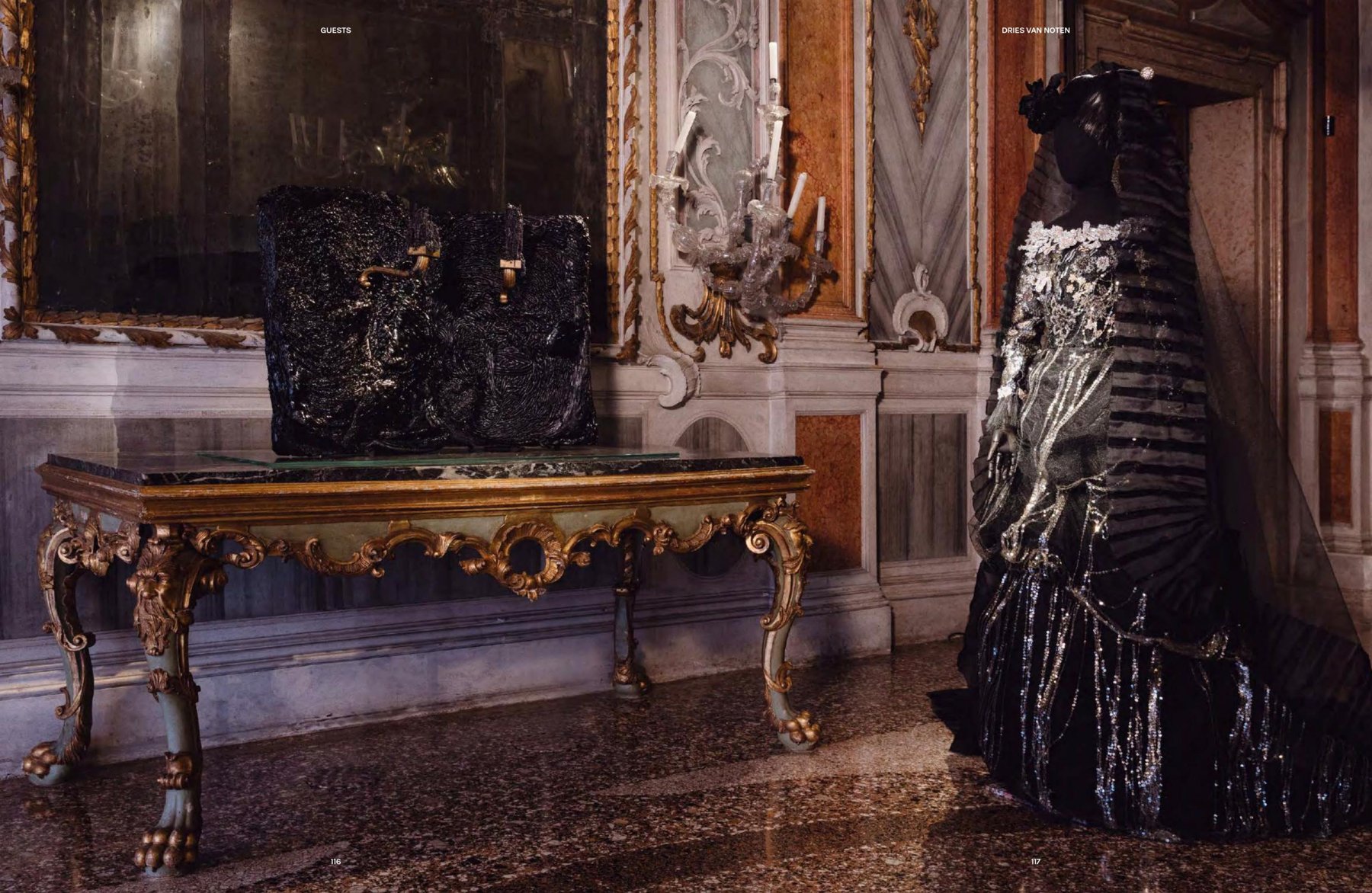
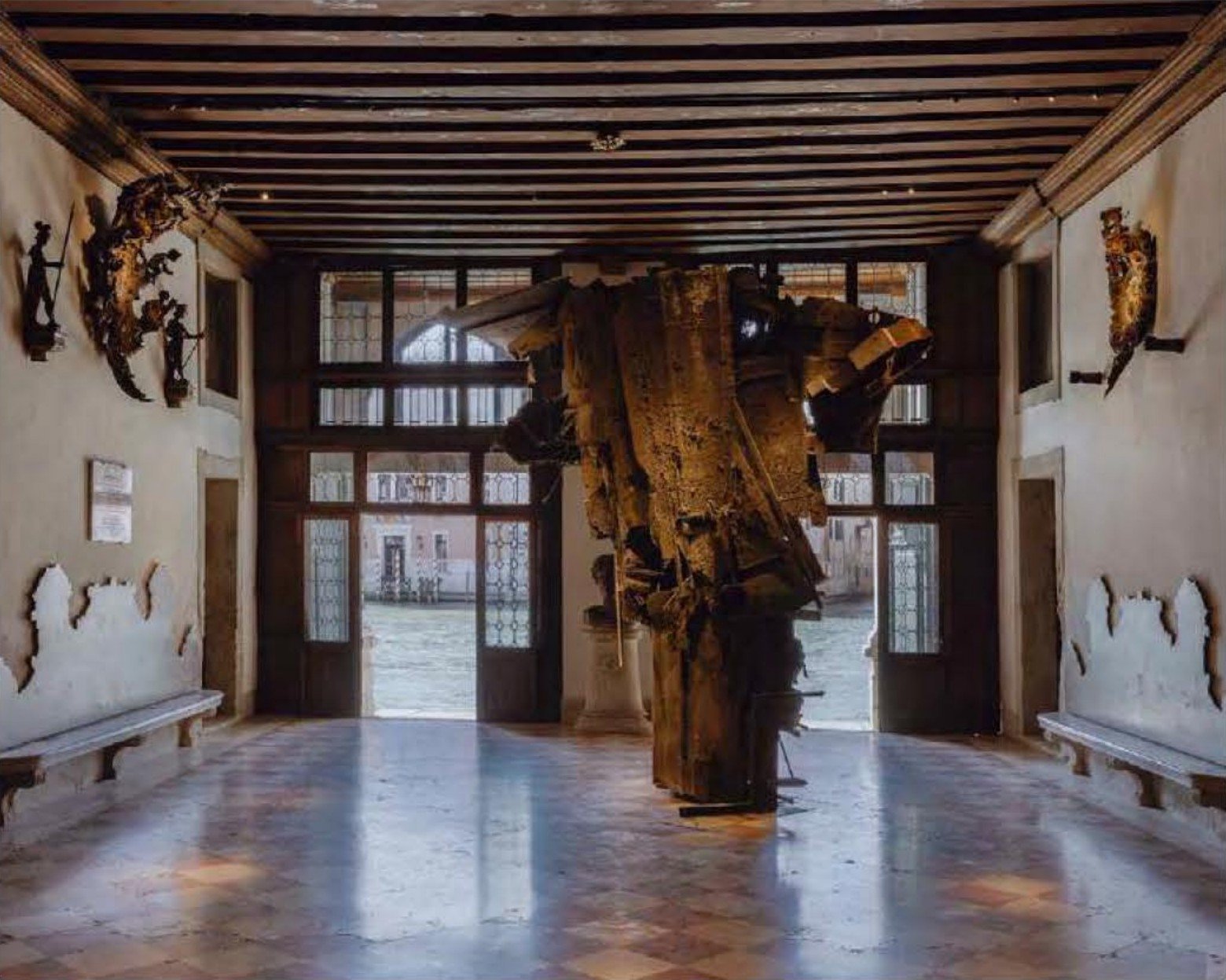
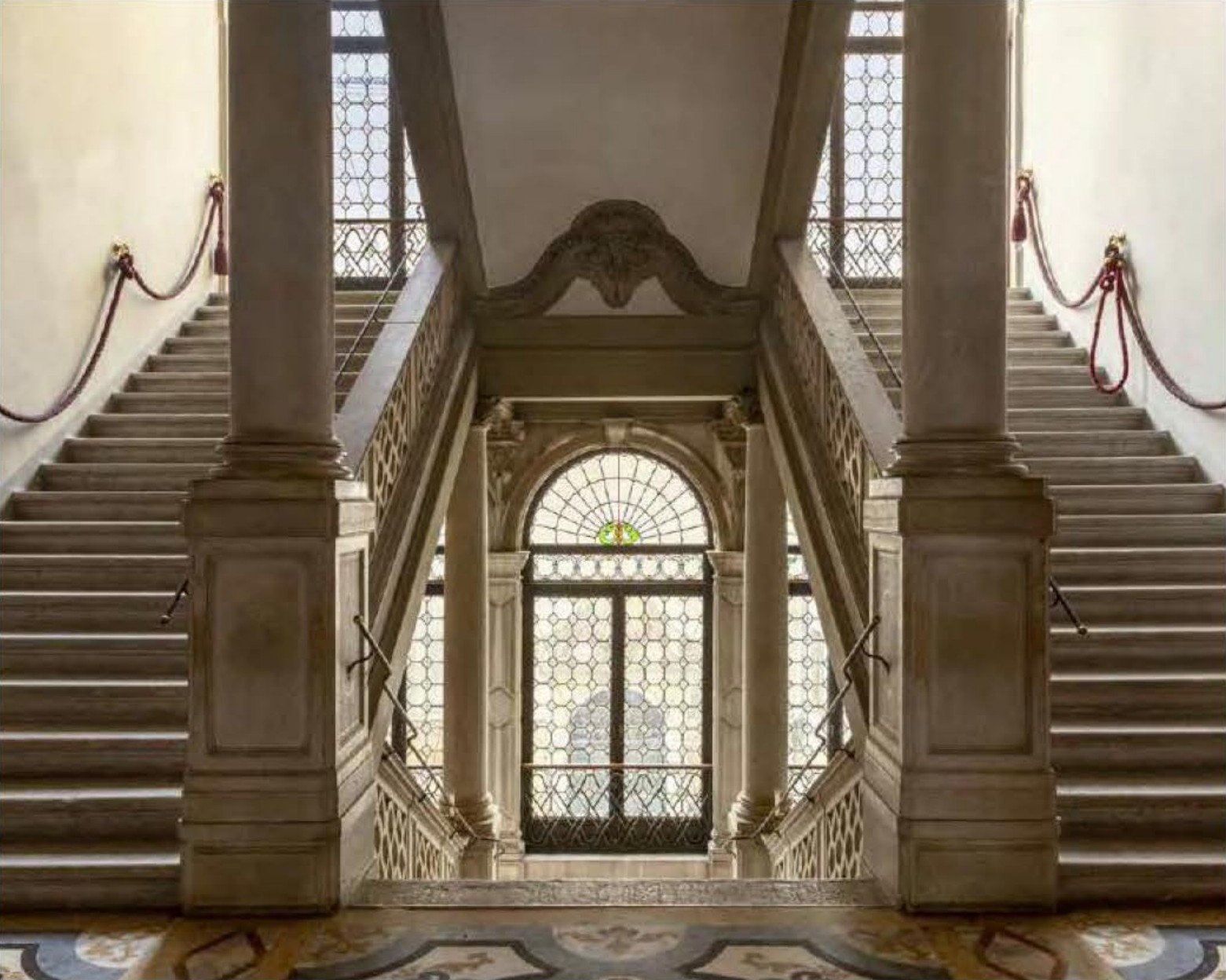
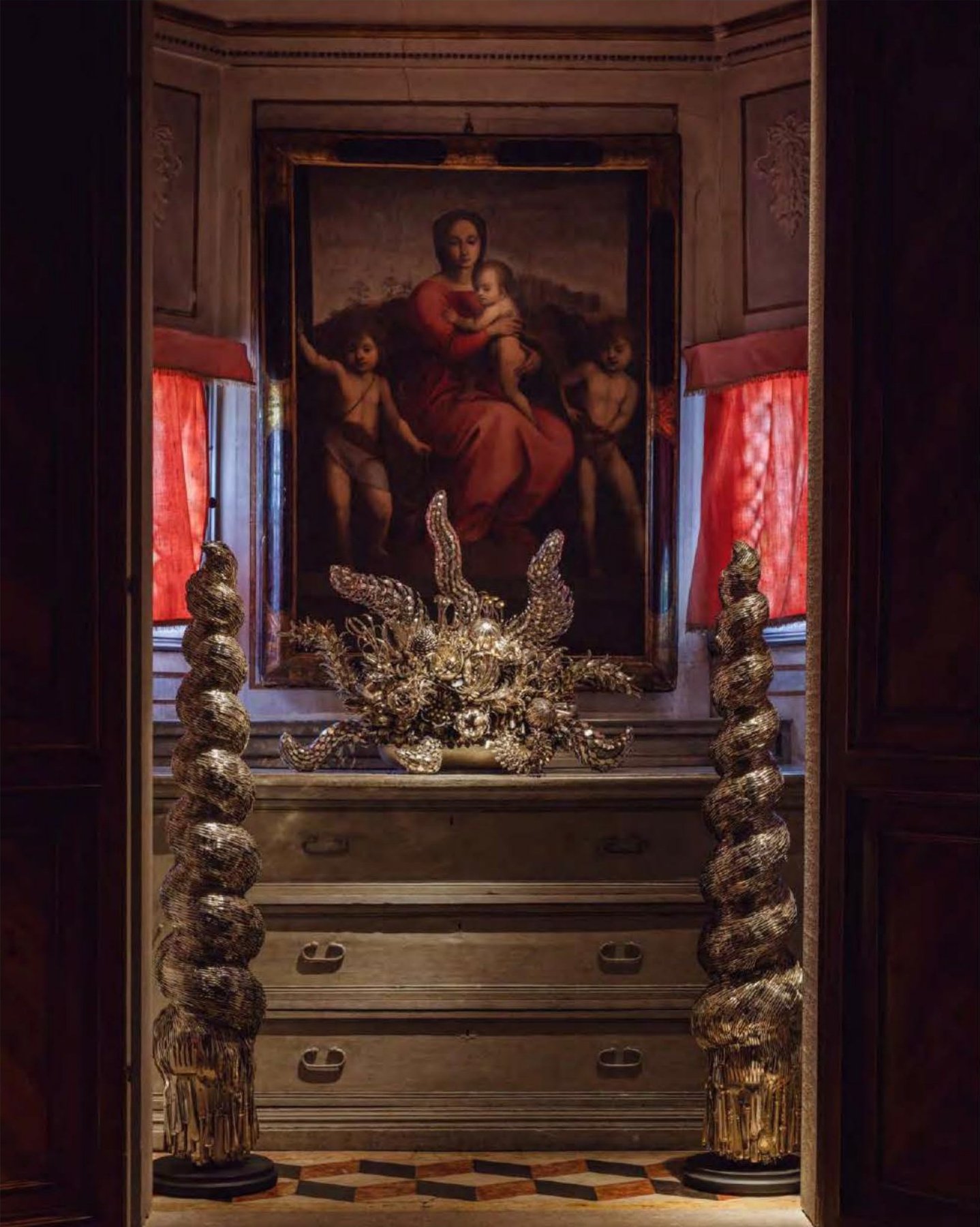
And then you bought Palazzo Pisani Moretta—redecorated starting in the 1730s by the young Chiara Pisani, who commissioned Tiepolo for the ceilings, and untouched since: the original furniture, the engraved drinking glasses with the family crest. It’s as much a monument as a house.
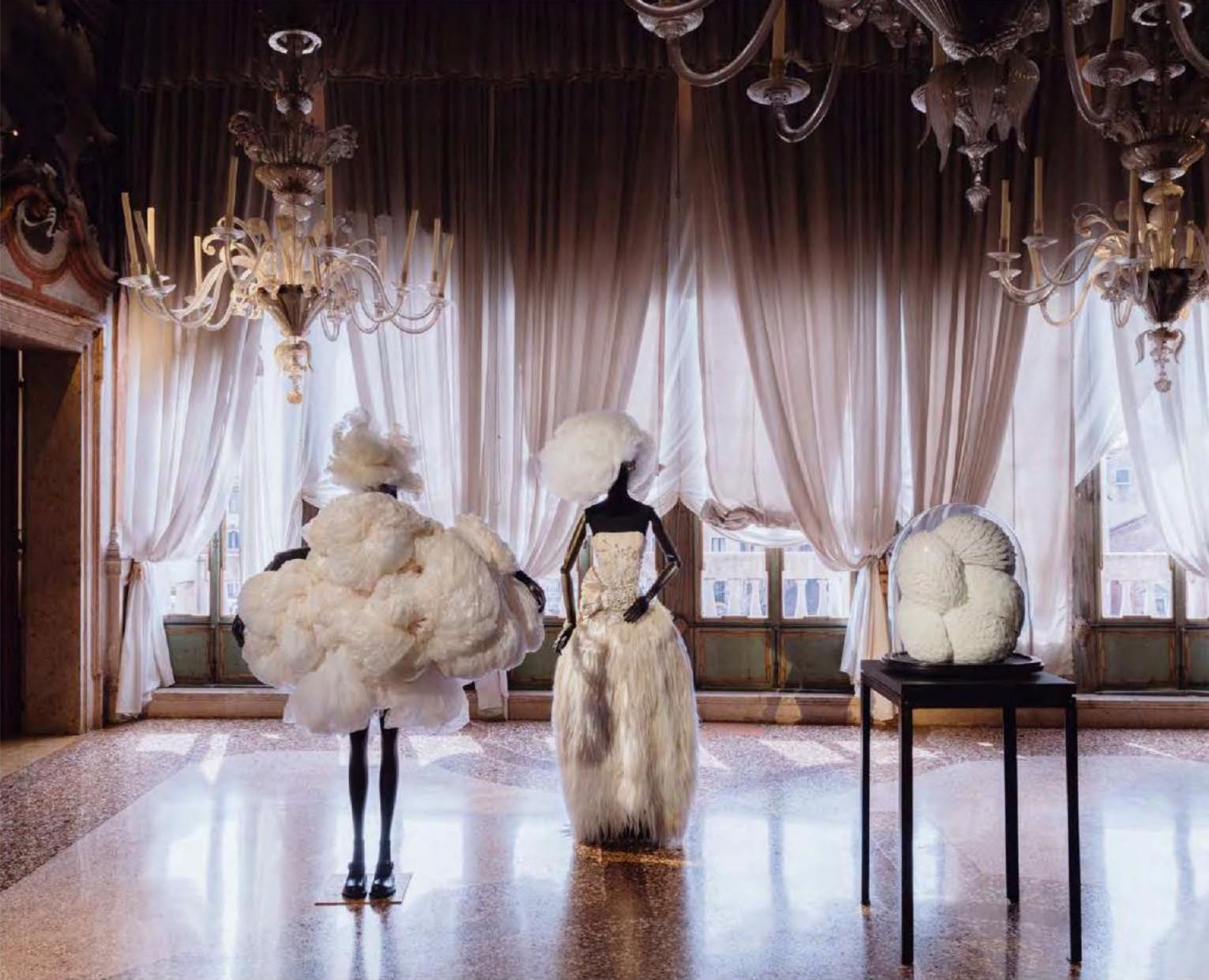
It was an adventure, but also well considered. We always say it was a decision made both with our brain and our heart—although our brain said “don’t do it” more often and our heart said “do it, do it”. It is a responsibility. It’s a kind of monument in Venice. And it’s exceptional that it’s not only beautiful from the outside: the inside is still completely intact since 1730—even the glasses of the palazzo, like you said, engraved with the family crest, are still there. Originally, we were looking for something not so decorated, not so complicated, especially not so big. But then we said we cannot imagine a better place if you want to set up a Fondazione for craftsmanship. It is really a temple of craftsmanship, what you see there. So, in the end, it became quite clear that we had to do it.
The Foundation’s stated mission is to keep craftsmanship “alive”—and you chose that verb, not “preserved” or “documented”. What’s the difference, for you?
It’s really about bringing it to life. And about raising the distinction people make between art and craftsmanship. The last years, there have been a lot of discussions: what is art, what is craftsmanship, where does one stop, where does the other start. For me, it’s absolutely unnecessary to make any difference between them. I consider both equally important, equally interesting, and equally necessary for the future. The difference I make is between everything which is made by men—with your brain, with your hands, with your soul—and things which are made by computer machines, AI, ChatGPT. There, I see a bigger difference. When it’s made by men, you leave space for intuition, for creativity, for coincidence—all things a computer never will be able to do.
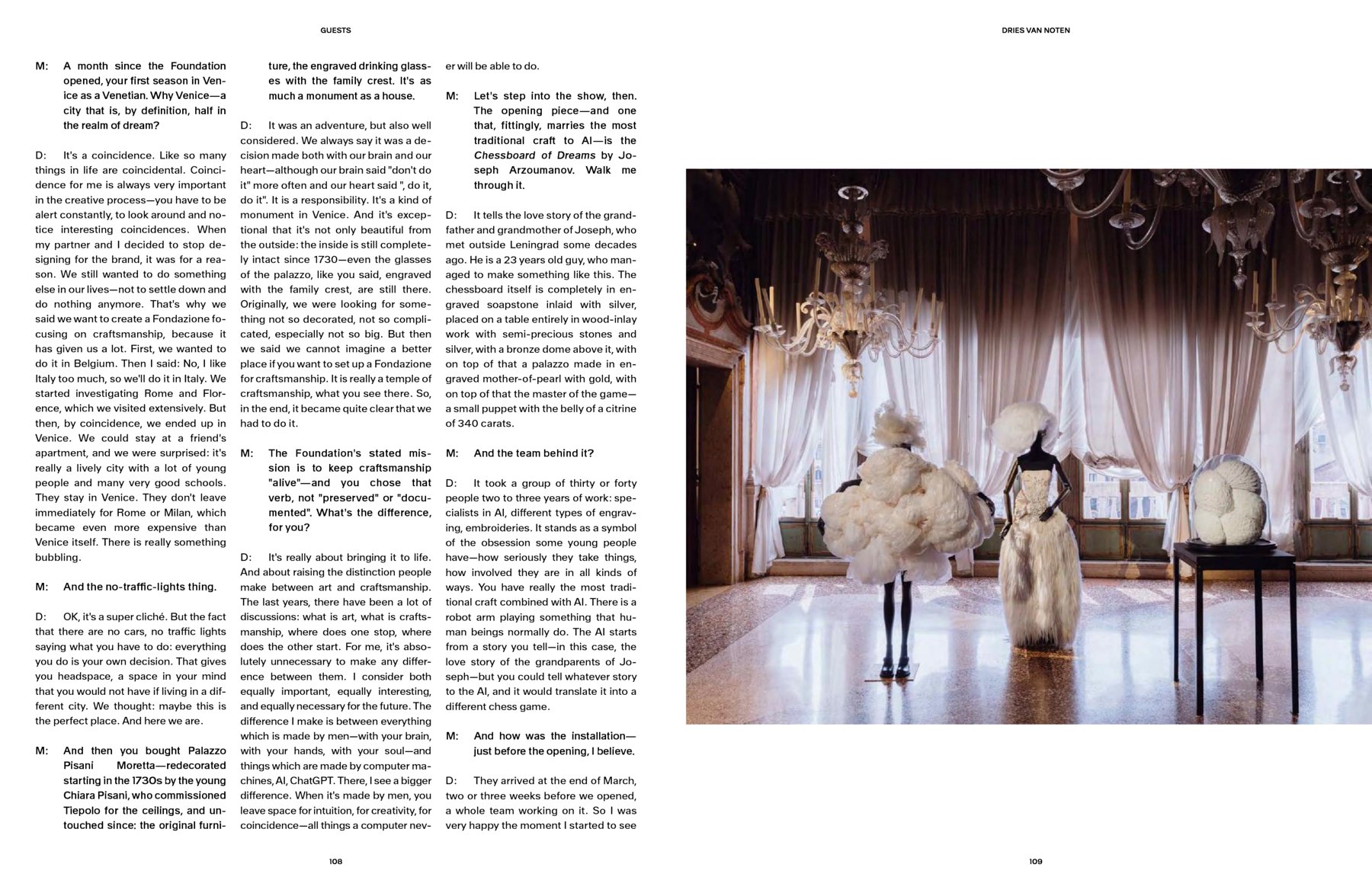
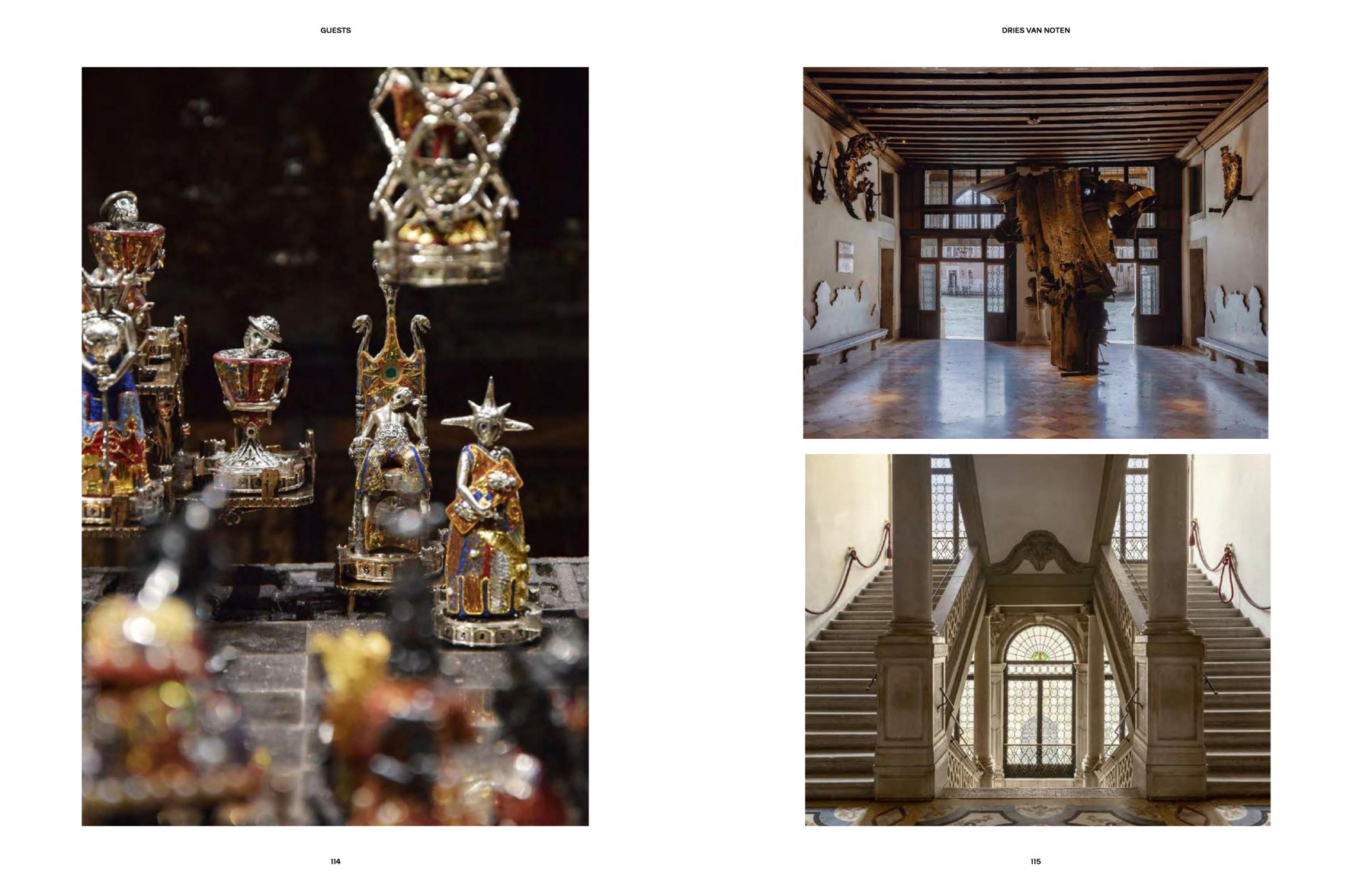
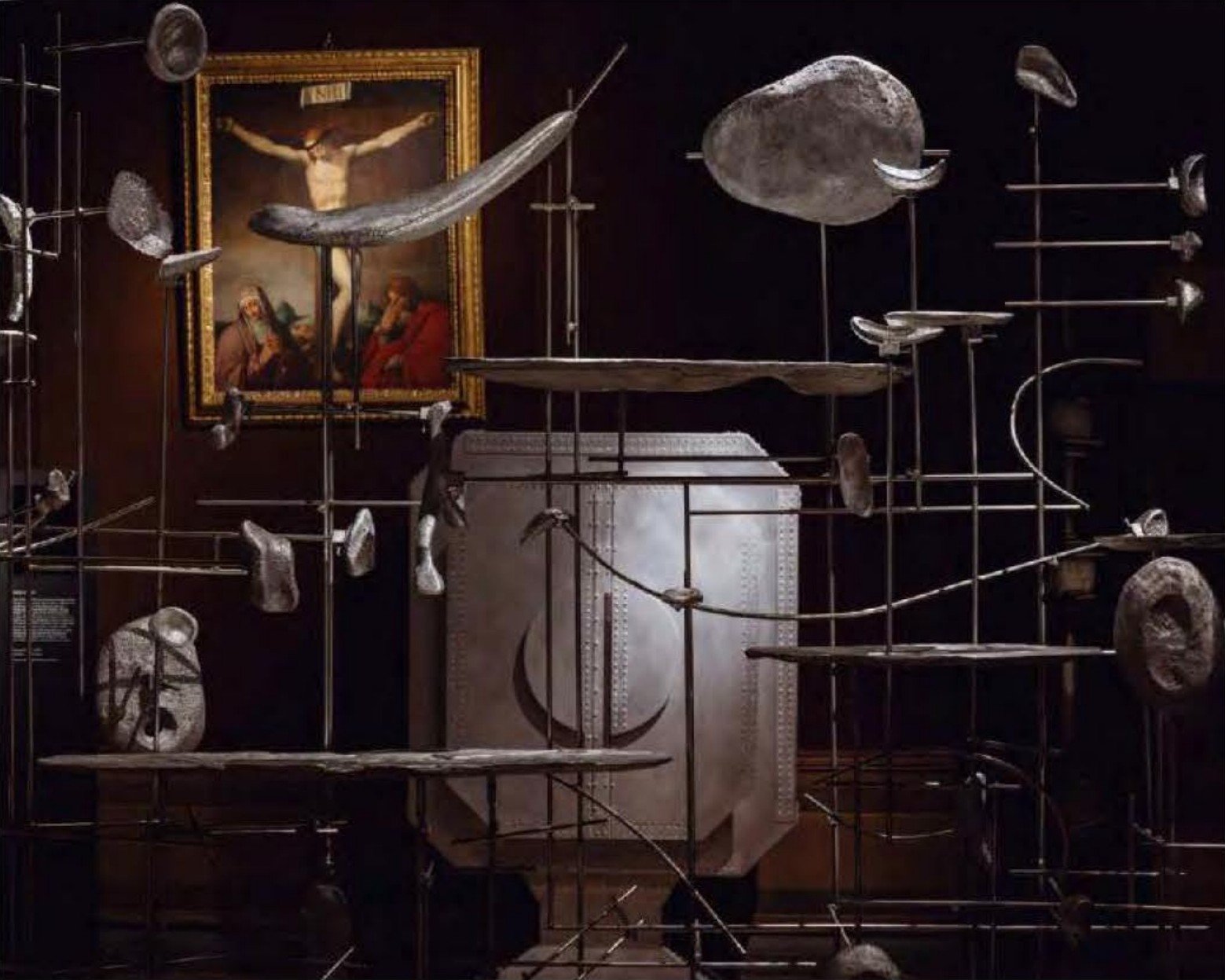
Let’s step into the show, then. The opening piece—and one that, fittingly, marries the most traditional craft to AI—is the Chessboard of Dreams by Joseph Arzoumanov. Walk me through it.
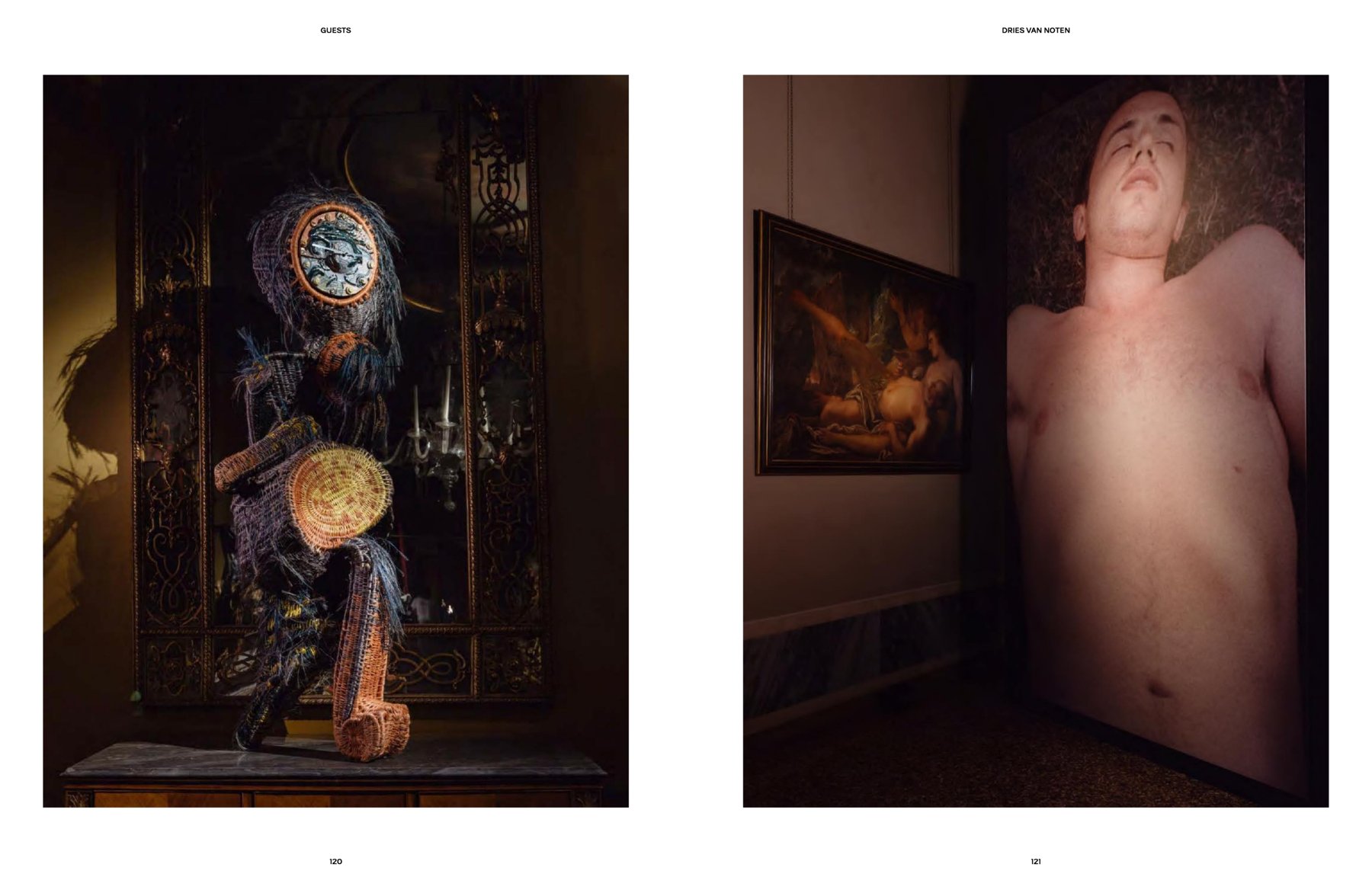
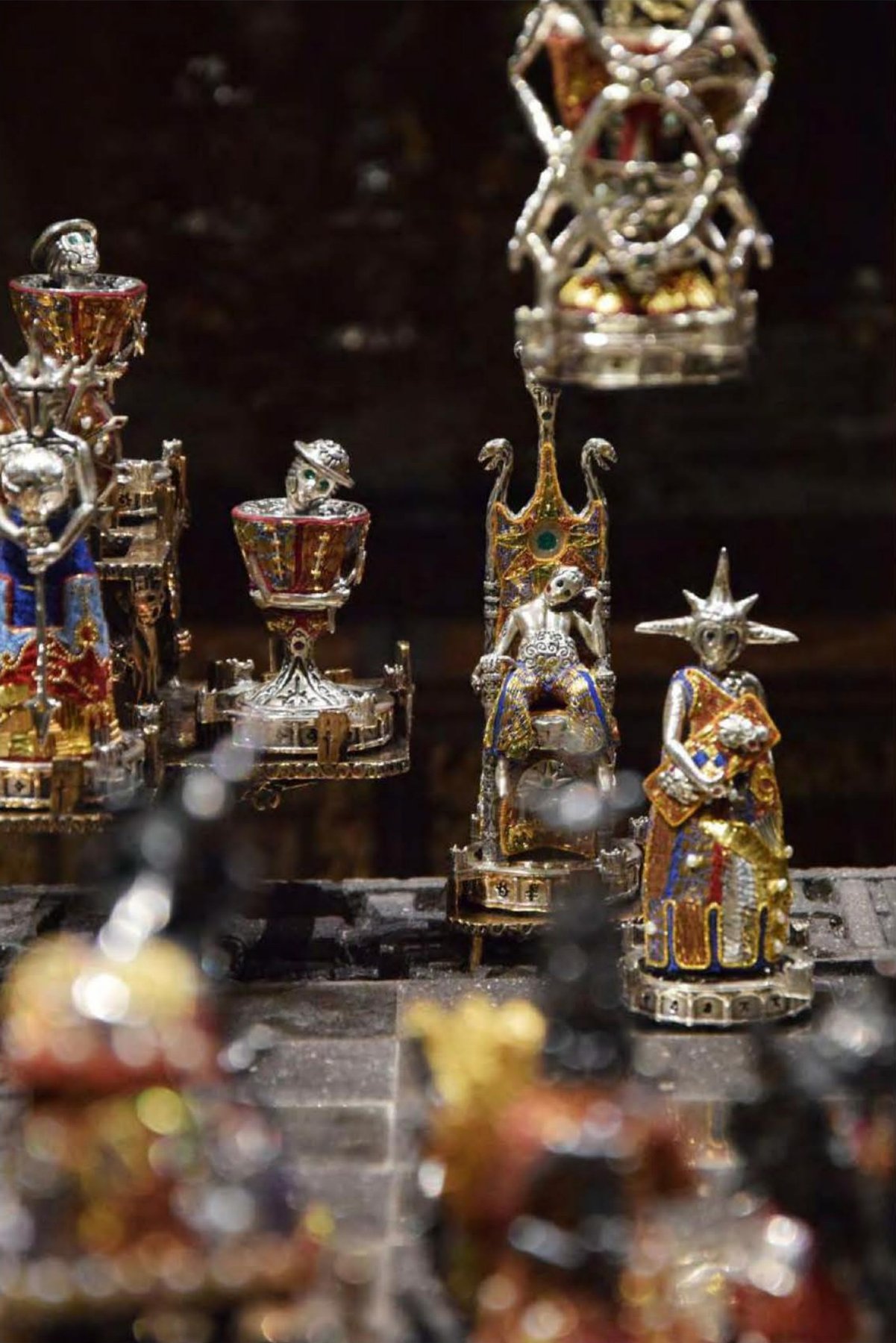
It tells the love story of the grandfather and grandmother of Joseph, who met outside Leningrad some decades ago. He is a 23 years old guy, who managed to make something like this. The chessboard itself is completely in engraved soapstone inlaid with silver, placed on a table entirely in wood-inlay work with semi-precious stones and silver, with a bronze dome above it, with on top of that a palazzo made in engraved mother-of-pearl with gold, with on top of that the master of the game—a small puppet with the belly of a citrine of 340 carats.
And the team behind it?
It took a group of thirty or forty people two to three years of work: specialists in AI, different types of engraving, embroideries. It stands as a symbol of the obsession some young people have—how seriously they take things, how involved they are in all kinds of ways. You have really the most traditional craft combined with AI. There is a robot arm playing something that human beings normally do. The AI starts from a story you tell—in this case, the love story of the grandparents of Joseph—but you could tell whatever story to the AI, and it would translate it into a different chess game.
And how was the installation—just before the opening, I believe.
They arrived at the end of March, two or three weeks before we opened, a whole team working on it. So I was very happy the moment I started to see it coming together. Very emotional for everybody. There were a lot of tears at that moment. It is really beautiful that I can still share those emotions, and that those young guys were open to sharing them with me. That gives me the energy to continue, because that is what I was especially looking for.
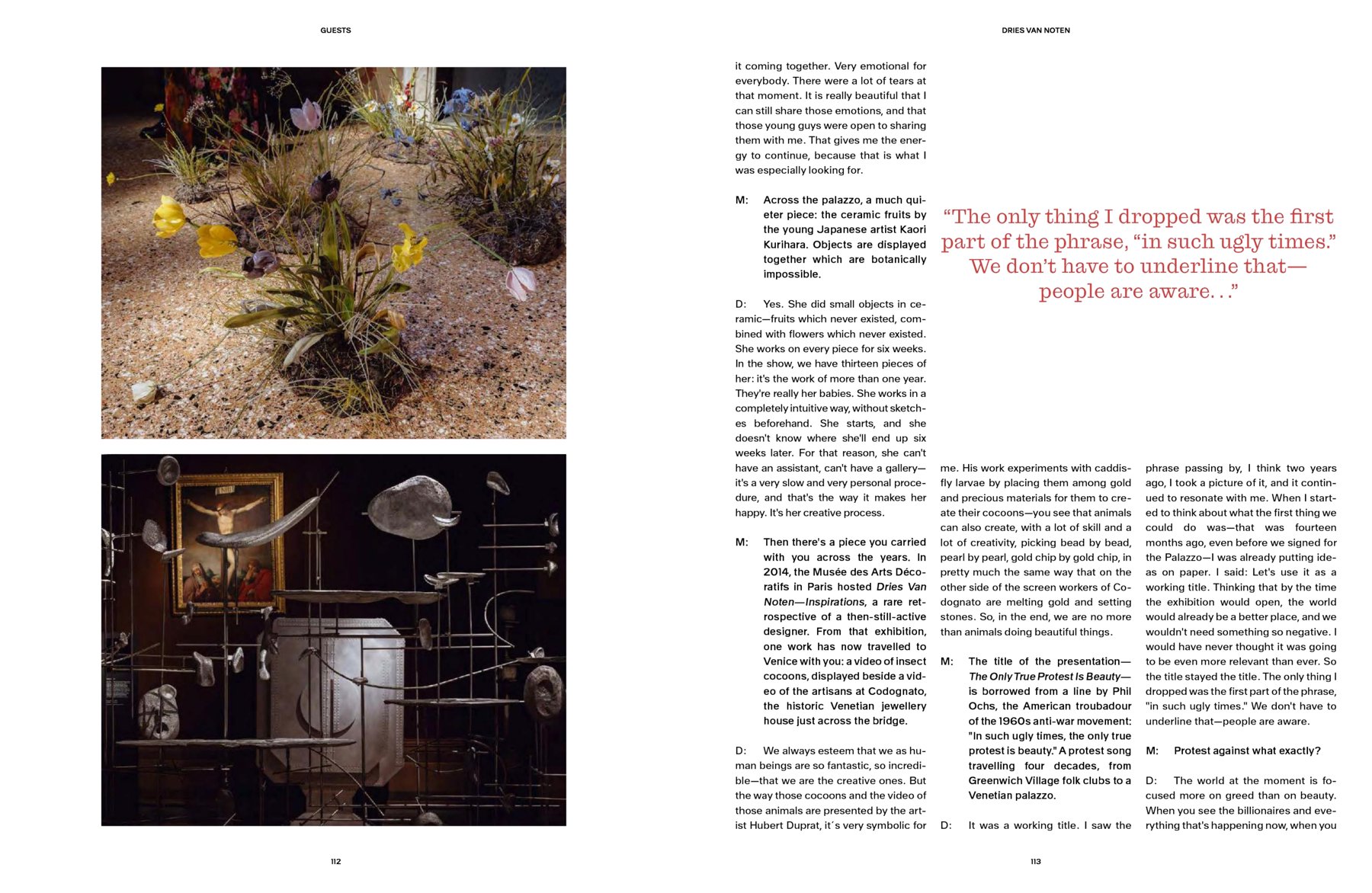
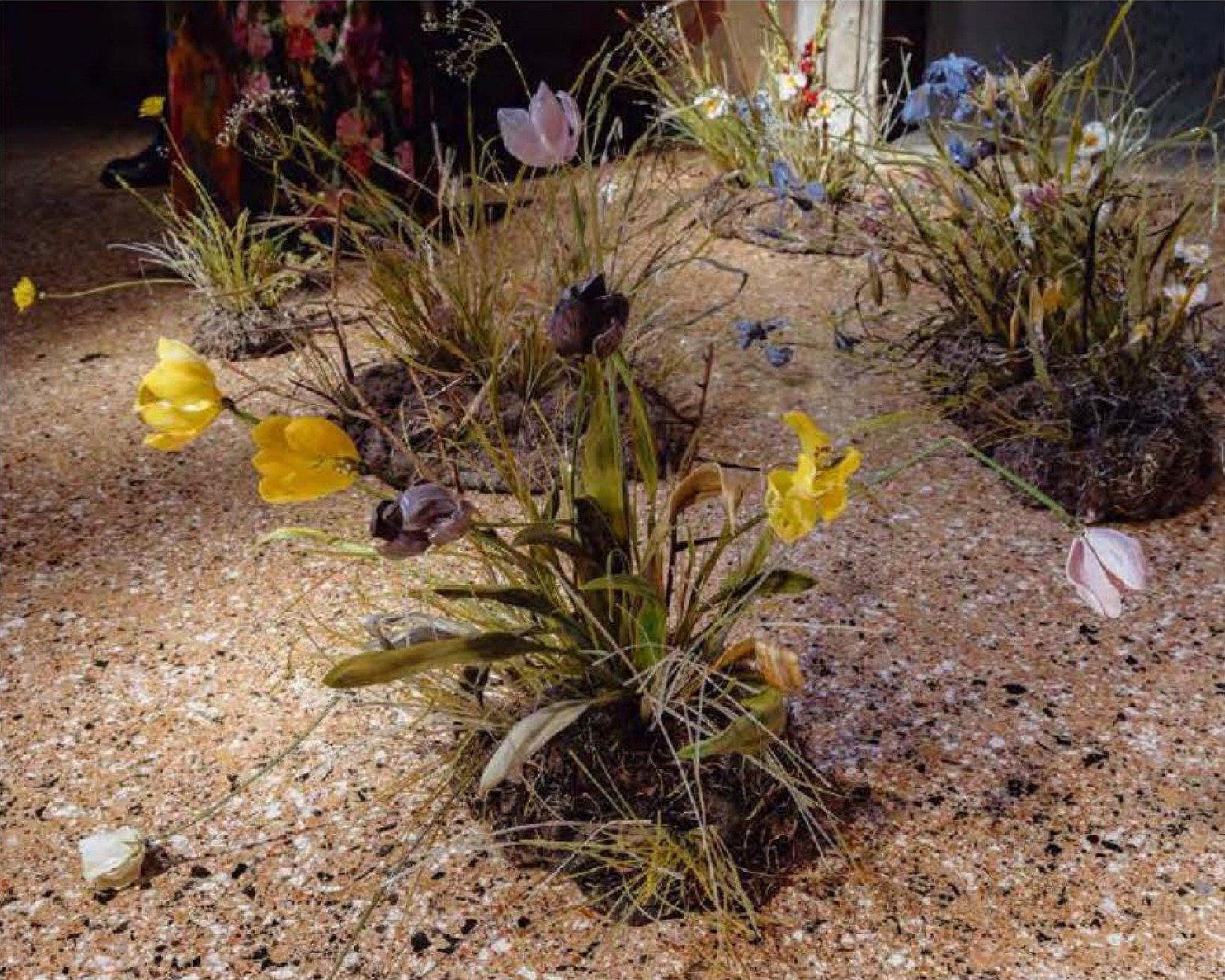
Across the palazzo, a much quieter piece: the ceramic fruits by the young Japanese artist Kaori Kurihara. Objects are displayed together which are botanically impossible.
Yes. She did small objects in ceramic—fruits which never existed, combined with flowers which never existed. She works on every piece for six weeks. In the show, we have thirteen pieces of her: it’s the work of more than one year. They’re really her babies. She works in a completely intuitive way, without sketches beforehand. She starts, and she doesn’t know where she’ll end up six weeks later. For that reason, she can’t have an assistant, can’t have a gallery—it’s a very slow and very personal procedure, and that’s the way it makes her happy. It’s her creative process.
Then there’s a piece you carried with you across the years. In 2014, the Musée des Arts Décoratifs in Paris hosted Dries Van Noten—Inspirations, a rare retrospective of a then-still-active designer. From that exhibition, one work has now travelled to Venice with you: a video of insect cocoons, displayed beside a video of the artisans at Codognato, the historic Venetian jewellery house just across the bridge.
We always esteem that we as human beings are so fantastic, so incredible—that we are the creative ones. But the way those cocoons and the video of those animals are presented by the artist Hubert Duprat, it’s very symbolic for me. His work experiments with caddisfly larvae by placing them among gold and precious materials for them to create their cocoons—you see that animals can also create, with a lot of skill and a lot of creativity, picking bead by bead, pearl by pearl, gold chip by gold chip, in pretty much the same way that on the other side of the screen workers of Codognato are melting gold and setting stones. So, in the end, we are no more than animals doing beautiful things.
The title of the presentation—The Only True Protest Is Beauty—is borrowed from a line by Phil Ochs, the American troubadour of the 1960s anti-war movement: “In such ugly times, the only true protest is beauty.” A protest song travelling four decades, from Greenwich Village folk clubs to a Venetian palazzo.
It was a working title. I saw the phrase passing by, I think two years ago, I took a picture of it, and it continued to resonate with me. When I started to think about what the first thing we could do was—that was—fourteen months ago, even before we signed for the Palazzo—I was already putting ideas on paper. I said: Let’s use it as a working title. Thinking that by the time the exhibition would open, the world would already be a better place, and we wouldn’t need something so negative. I would have never thought it was going to be even more relevant than ever. So the title stayed the title. The only thing I dropped was the first part of the phrase, “in such ugly times.” We don’t have to underline that—people are aware.
Protest against what exactly?
The world at the moment is focused more on greed than on beauty. When you see the billionaires and everything that’s happening now, when you read the news constantly—you see what’s happening to the world. You have to find ways to survive this. Unfortunately, I rely on my phone and communication. But the whole influence of algorithms on everything you do is so strong that once in a while, you have to be able to stand with both of your feet on the ground and think in your own way, and not be guided by what the algorithm says you should think. Everybody needs beauty in their daily lives. But beauty can be so many things. It’s not about opening your phone and looking at what an influencer says is beautiful. It’s much wider than that, and much more needed than that, to survive.
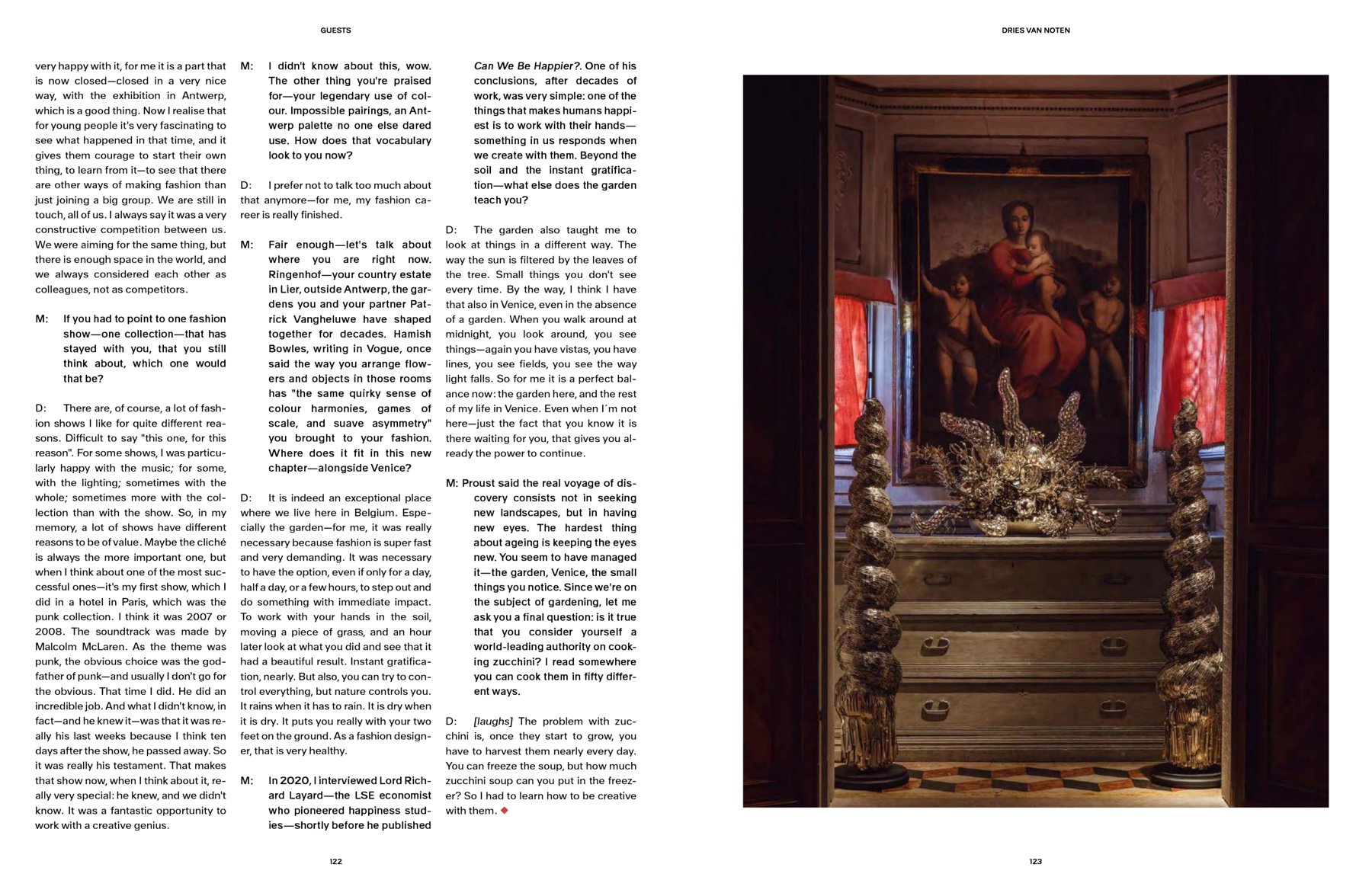
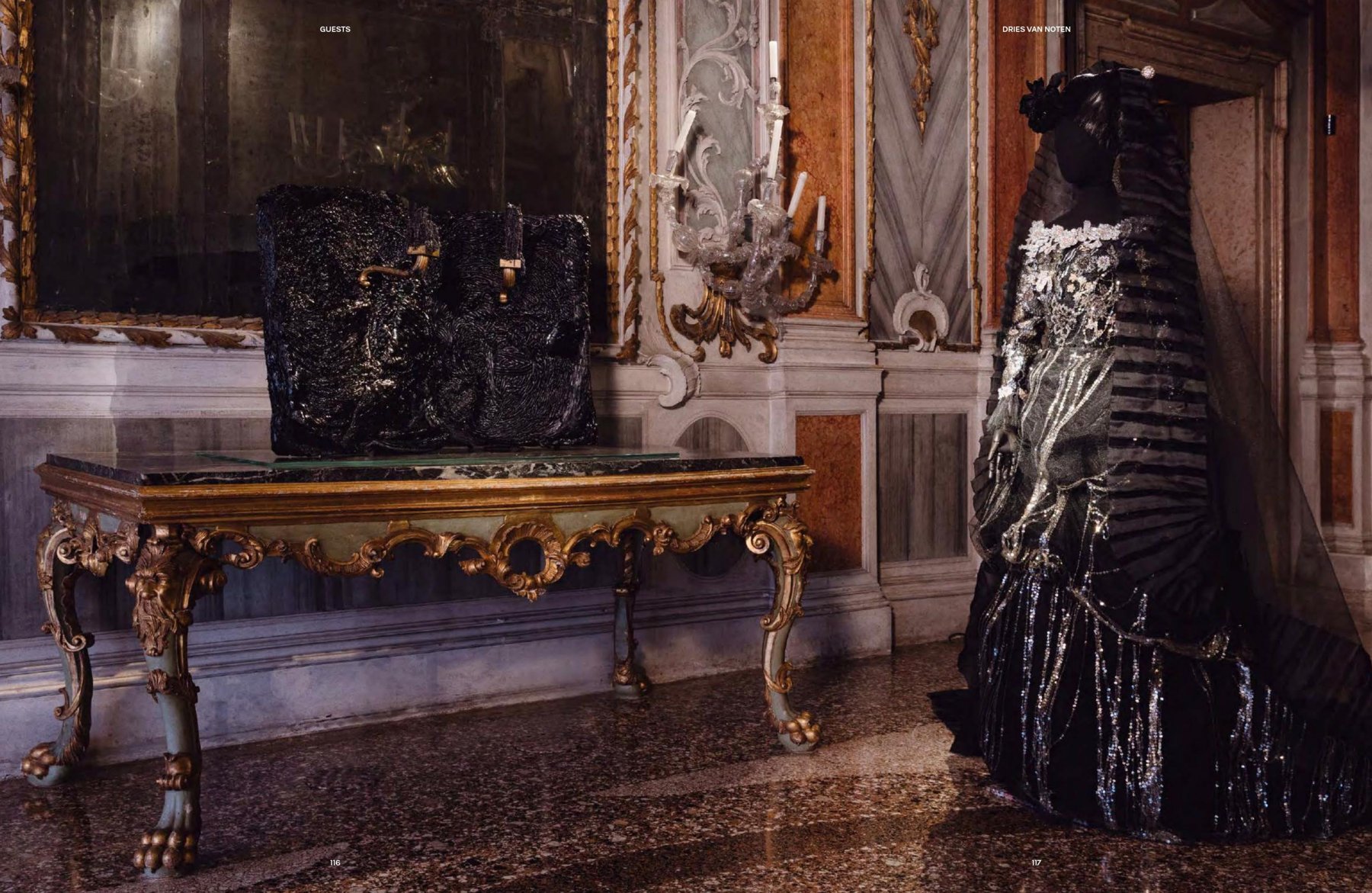
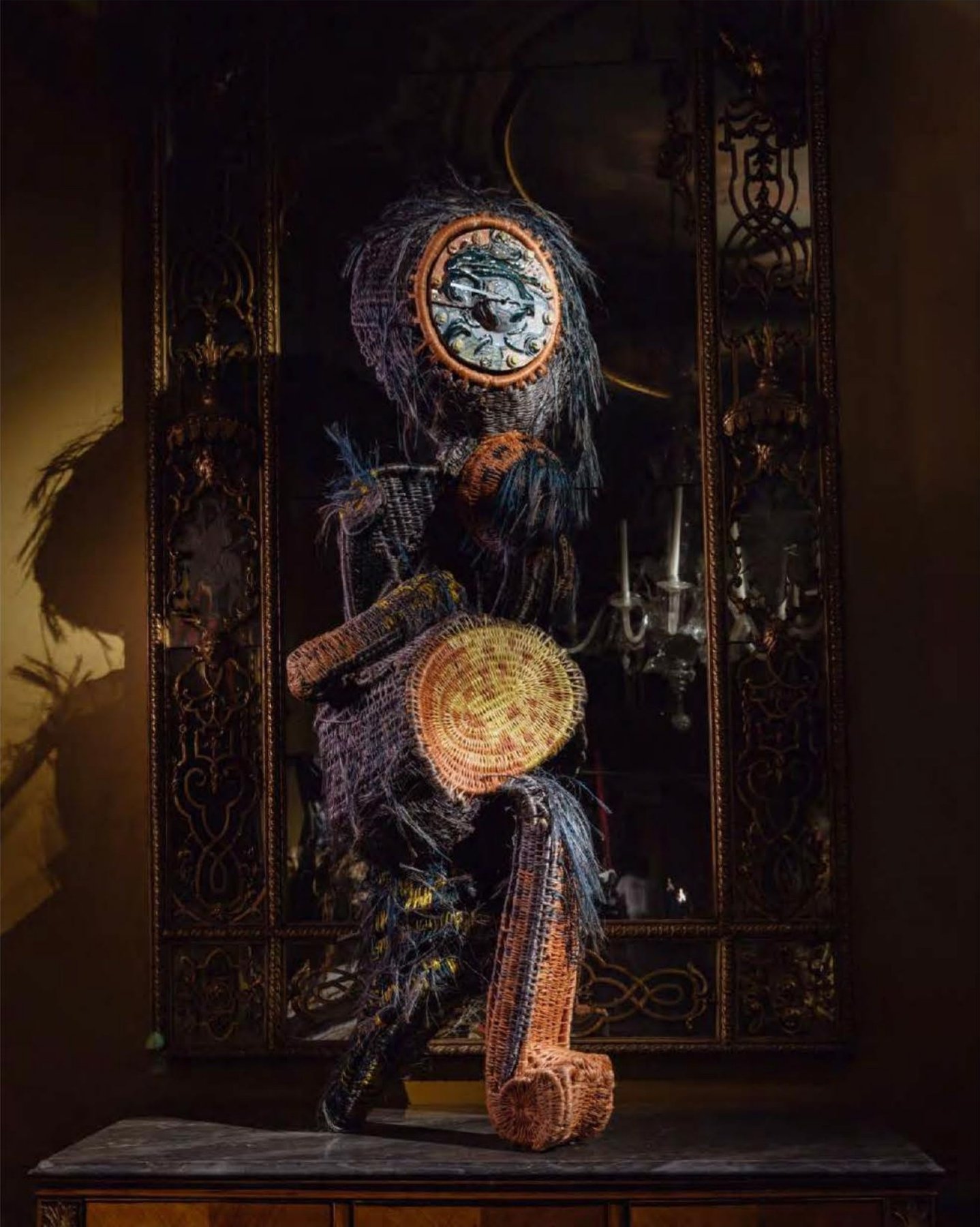
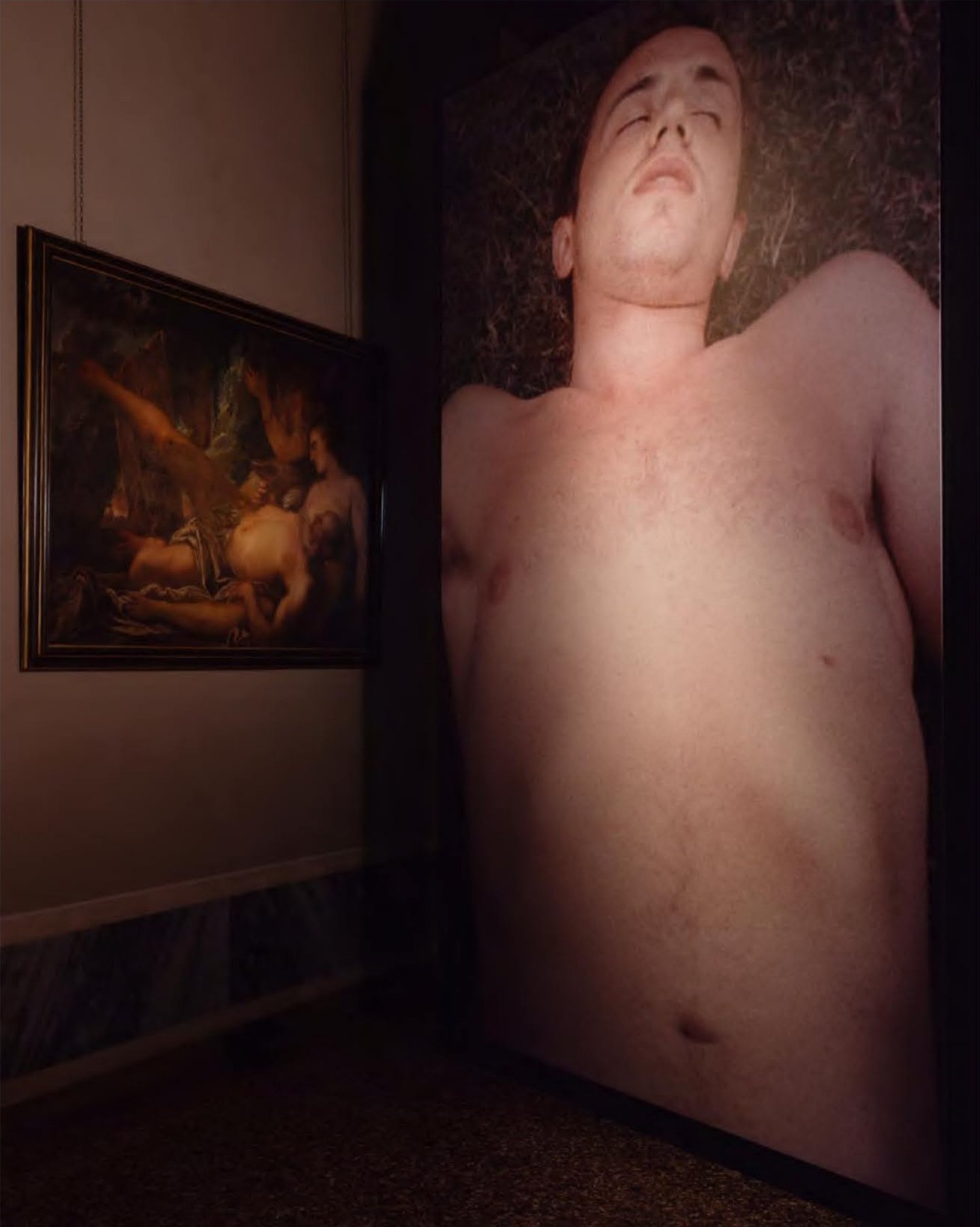
Influence—the word that gives this issue half its title—has come to mean something specific in the dictionary of the platforms: the capacity to shape what you find desirable before you’ve quite thought about it. Each of us is being gently persuaded into a dream not of our own making. The protest your title proposes, then, is also a protest against a particular kind of dream. And in your show that protest takes forms anything but peaceful: Peter Buggenhout’s grotesque dust-covered sculptures; Rei Kawakubo speaking, through Comme des Garçons, of a beauty that disturbs; the first photograph the visitor encounters, Steven Shearer’s portrait of a sleeping girl, Teresa’s Trip—an unsettling image of a figure who could be sleeping or could be dead.
There is also beauty in that. Buggenhout says clearly: I’m not interested in beauty, I want to make revolting things. And there is beauty there. Comme des Garçons—there is beauty which hurts. The Shearer, that one really hurts. It is a kind of modern Pietà. So there are many different aspects of beauty we want to highlight in this exhibition. And then you have to see what beauty can do for you as a human being. It can do a lot, and we need it. That is also one of the things I tried to show in the exhibition: there is a lot of surprising beauty—things you don’t realise at first sight. Because beauty is something so completely individual. What is beautiful for me is not beautiful for you. It is not something that follows rules.
Beauty as something you have to learn to see—an alphabet you acquire over time.
It’s like learning to eat olives: the first one, you might not like, the second one is already better; the third one, you might find delicious. The first time you see something—oh, I really don’t like it, it’s not my taste. But once somebody explains to you the how and the why, and you start to connect with it, you start to see beauty. That’s also our role. Beauty is not a fixed thing. It is something that evolves. We have to push beauty forward.
Pushing beauty forward as a kind of lifelong protest—in your case, it isn’t new. In 1986, the six of you—Walter Van Beirendonck, Ann Demeulemeester, Dirk Bikkembergs among them—rented a van, drove to London, and showed at the British Designer Show. The press needed a label; “the Antwerp Six” has held for forty years, and the fashion map had to be redrawn outside Paris for the first time in a generation. A retrospective dedicated to that moment is on now in Antwerp. What survives of that group, for you?
I prefer not to talk too much about that. It’s really my past. Although I am very happy with it, for me it is a part that is now closed—closed in a very nice way, with the exhibition in Antwerp, which is a good thing. Now I realise that for young people it’s very fascinating to see what happened in that time, and it gives them courage to start their own thing, to learn from it—to see that there are other ways of making fashion than just joining a big group. We are still in touch, all of us. I always say it was a very constructive competition between us. We were aiming for the same thing, but there is enough space in the world, and we always considered each other as colleagues, not as competitors.
If you had to point to one fashion show—one collection—that has stayed with you, that you still think about, which one would that be?
There are, of course, a lot of fashion shows I like for quite different reasons. Difficult to say “this one, for this reason”. For some shows, I was particularly happy with the music; for some, with the lighting; sometimes with the whole; sometimes more with the collection than with the show. So, in my memory, a lot of shows have different reasons to be of value. Maybe the cliché is always the more important one, but when I think about one of the most successful ones—it’s my first show, which I did in a hotel in Paris, which was the punk collection. I think it was 2007 or 2008. The soundtrack was made by Malcolm McLaren. As the theme was punk, the obvious choice was the godfather of punk—and usually I don’t go for the obvious. That time I did. He did an incredible job. And what I didn’t know, in fact—and he knew it—was that it was really his last weeks because I think ten days after the show, he passed away. So it was really his testament. That makes that show now, when I think about it, really very special: he knew, and we didn’t know. It was a fantastic opportunity to work with a creative genius.
I didn’t know about this, wow. The other thing you’re praised for—your legendary use of colour. Impossible pairings, an Antwerp palette no one else dared use. How does that vocabulary look to you now?
I prefer not to talk too much about that anymore—for me, my fashion career is really finished.
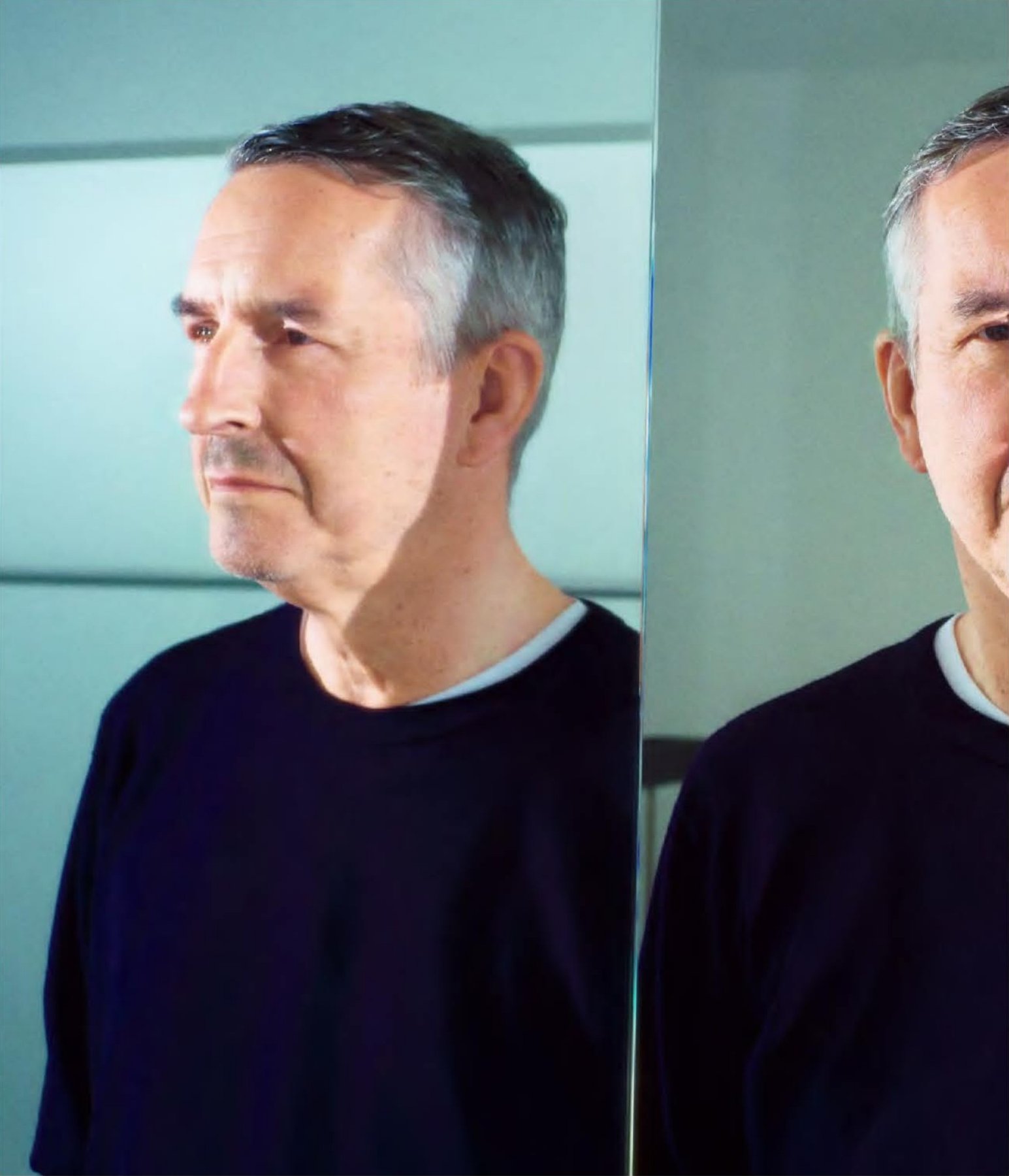
Fair enough—let’s talk about where you are right now. Ringenhof—your country estate in Lier, outside Antwerp, the gardens you and your partner Patrick Vangheluwe have shaped together for decades. Hamish Bowles, writing in Vogue, once said the way you arrange flowers and objects in those rooms has “the same quirky sense of colour harmonies, games of scale, and suave asymmetry” you brought to your fashion. Where does it fit in this new chapter—alongside Venice?
It is indeed an exceptional place where we live here in Belgium. Especially the garden—for me, it was really necessary because fashion is super fast and very demanding. It was necessary to have the option, even if only for a day, half a day, or a few hours, to step out and do something with immediate impact. To work with your hands in the soil, moving a piece of grass, and an hour later look at what you did and see that it had a beautiful result. Instant gratification, nearly. But also, you can try to control everything, but nature controls you. It rains when it has to rain. It is dry when it is dry. It puts you really with your two feet on the ground. As a fashion designer, that is very healthy.
In 2020, I interviewed Lord Richard Layard—the LSE economist who pioneered happiness studies—shortly before he published Can We Be Happier?. One of his conclusions, after decades of work, was very simple: one of the things that makes humans happiest is to work with their hands—something in us responds when we create with them. Beyond the soil and the instant gratification—what else does the garden teach you?
The garden also taught me to look at things in a different way. The way the sun is filtered by the leaves of the tree. Small things you don’t see every time. By the way, I think I have that also in Venice, even in the absence of a garden. When you walk around at midnight, you look around, you see things—again you have vistas, you have lines, you see fields, you see the way light falls. So for me it is a perfect balance now: the garden here, and the rest of my life in Venice. Even when I’m not here—just the fact that you know it is there waiting for you, that gives you already the power to continue.
Proust said the real voyage of discovery consists not in seeking new landscapes, but in having new eyes. The hardest thing about ageing is keeping the eyes new. You seem to have managed it—the garden, Venice, the small things you notice. Since we’re on the subject of gardening, let me ask you a final question: is it true that you consider yourself a world-leading authority on cooking zucchini? I read somewhere you can cook them in fifty different ways.
[laughs] The problem with zucchini is, once they start to grow, you have to harvest them nearly every day. You can freeze the soup, but how much zucchini soup can you put in the freezer? So I had to learn how to be creative with them.
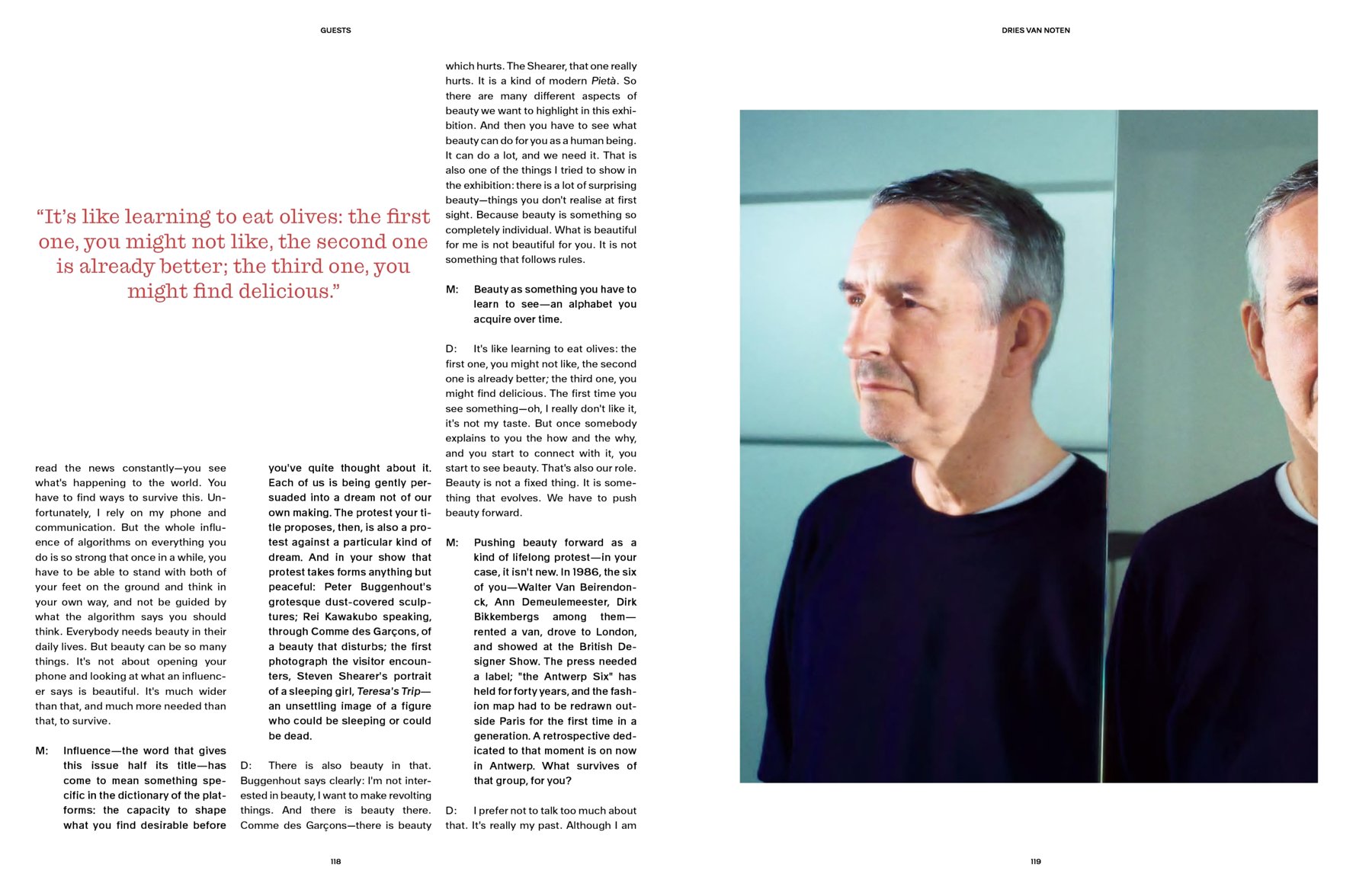
Location Venice, Italy. Portraits Mark Peckmezian. Installation views Fondazione Dries Van Noten.
Interview by Michele Fossi
Published in The Travel Almanac #28, 2026