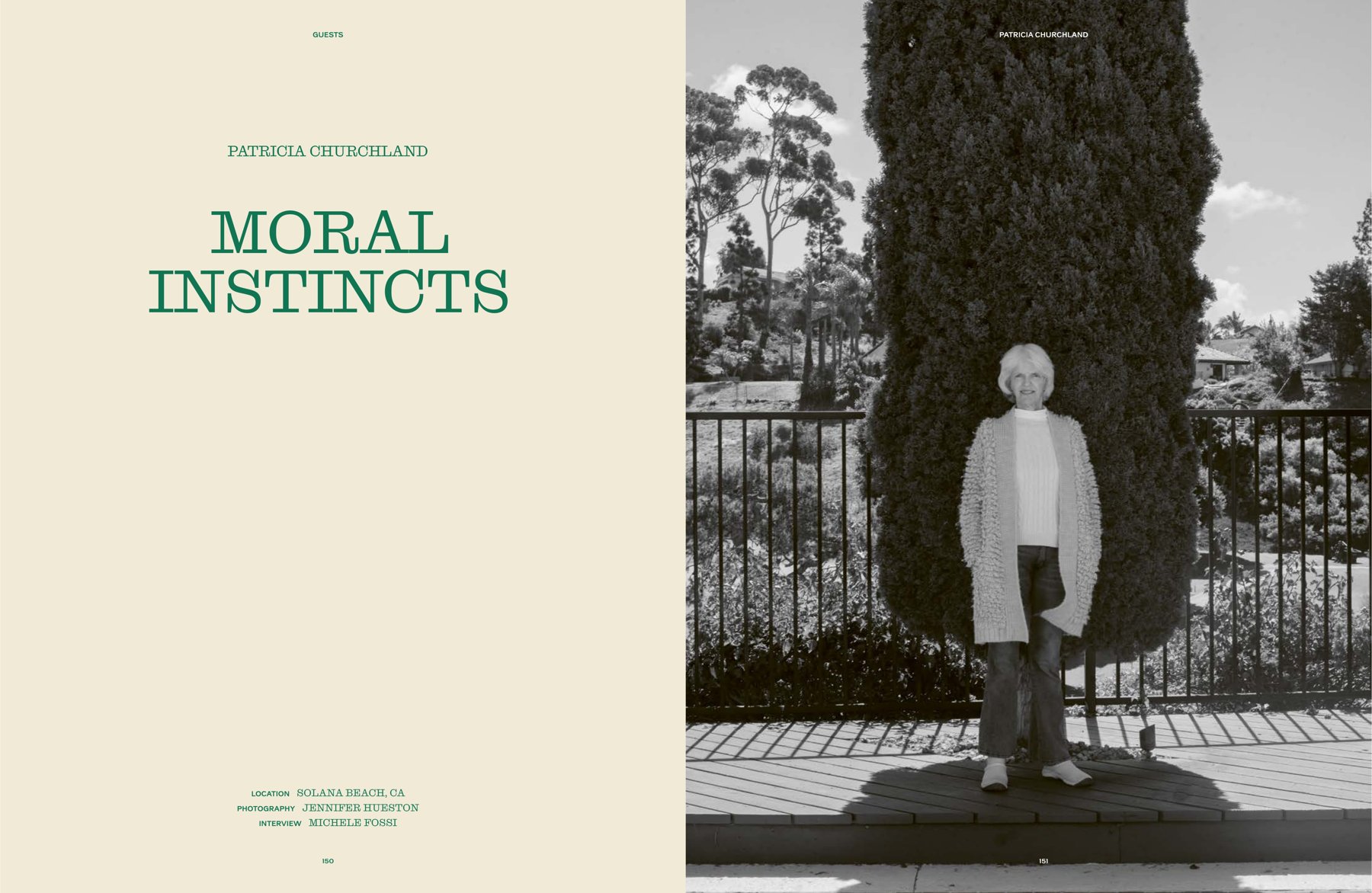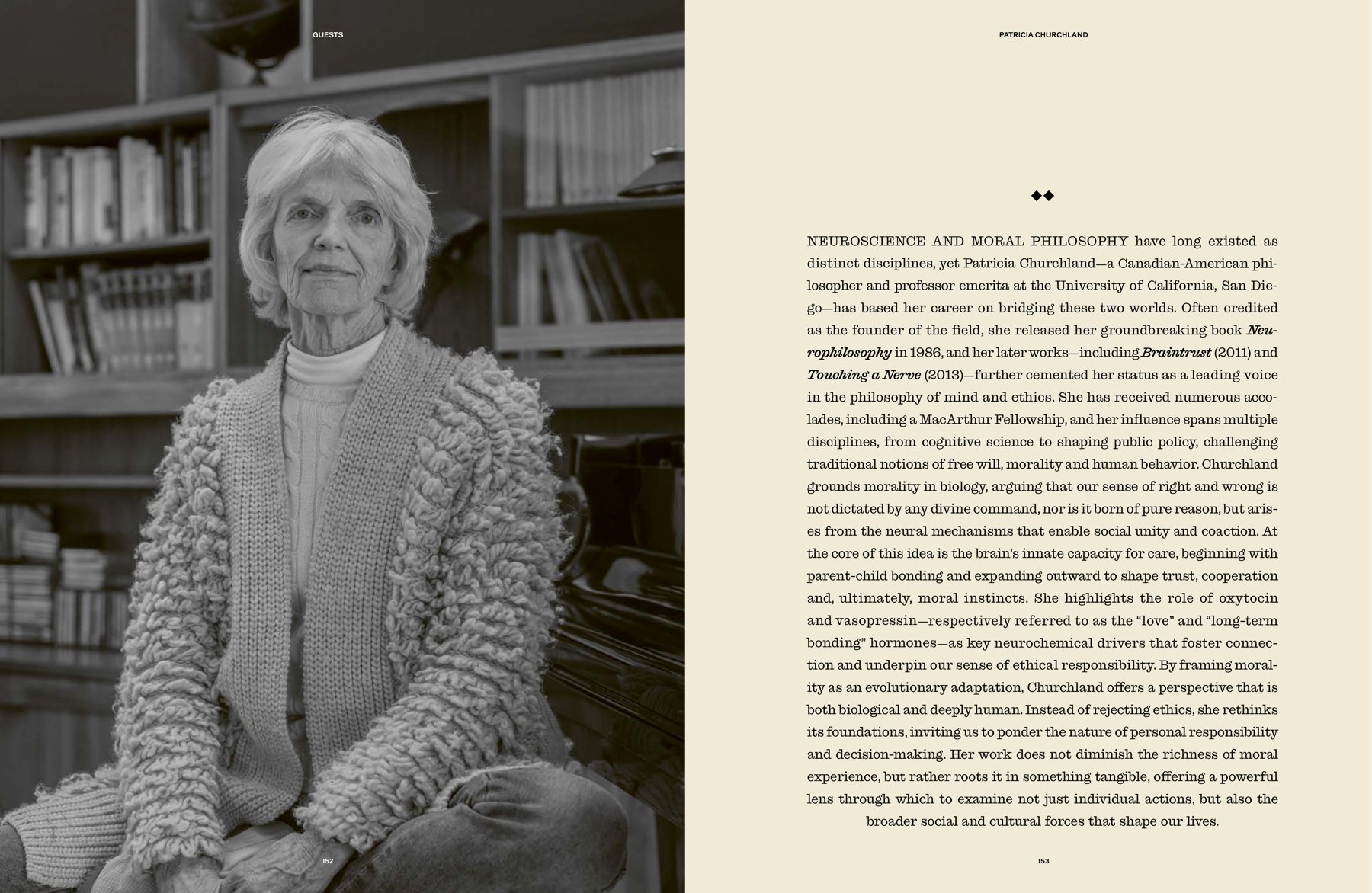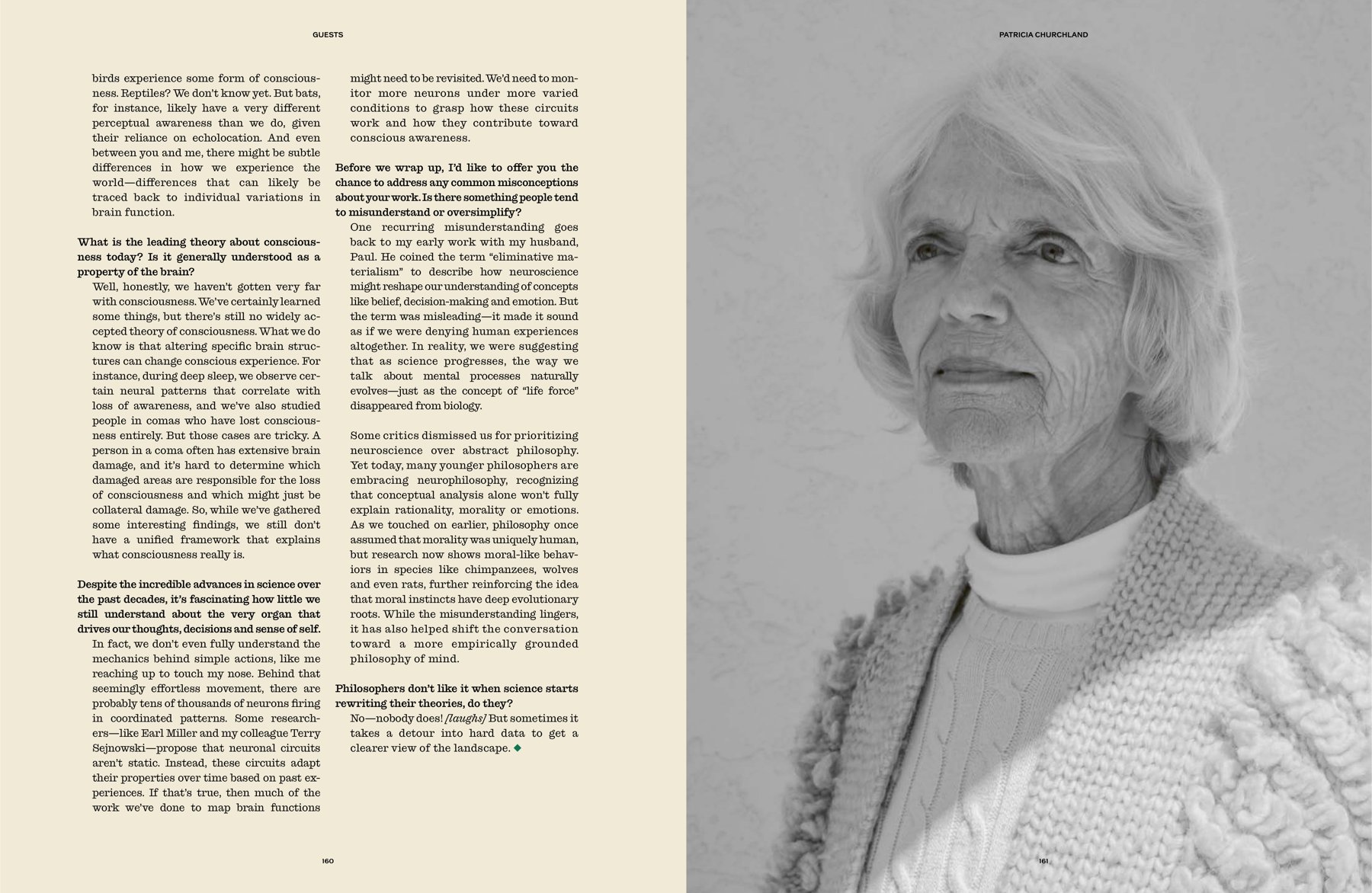
Neuroscience and moral philosophy have long existed as distinct disciplines, yet Patricia Churchland—a Canadian-American philosopher and professor emerita at the University of California, San Diego—has based her career on bridging these two worlds. Often credited as the founder of the field, she released her groundbreaking book Neurophilosophy in 1986, and her later works—including Braintrust (2011) and Touching a Nerve (2013)—further cemented her status as a leading voice in the philosophy of mind and ethics. She has received numerous accolades, including a MacArthur Fellowship, and her influence spans multiple disciplines, from cognitive science to shaping public policy, challenging traditional notions of free will, morality and human behavior. Churchland grounds morality in biology, arguing that our sense of right and wrong is not dictated by any divine command, nor is it born of pure reason, but arises from the neural mechanisms that enable social unity and coaction. At the core of this idea is the brain’s innate capacity for care, beginning with parent-child bonding and expanding outward to shape trust, cooperation and, ultimately, moral instincts. She highlights the role of oxytocin and vasopressin—respectively referred to as the “love” and “long-term bonding” hormones—as key neurochemical drivers that foster connection and underpin our sense of ethical responsibility. By framing morality as an evolutionary adaptation, Churchland offers a perspective that is both biological and deeply human. Instead of rejecting ethics, she rethinks its foundations, inviting us to ponder the nature of personal responsibility and decision-making. Her work does not diminish the richness of moral experience, but rather roots it in something tangible, offering a powerful lens through which to examine not just individual actions, but also the broader social and cultural forces that shape our lives.


What to say? I’m really thrilled to speak with you—neurophilosophy is such an interesting topic, and you’re one of the few people who’ve brought real scientific depth to questions philosophers have debated for centuries.
Thank you. That’s very kind of you. It is a fascinating area. Though honestly, when I started out, I never imagined neuroscience would have anything to say about morality. I was happily focused on vision and motor control. . .and then everything shifted.
And now you’re reshaping the way we think about ethics.
It’s been exciting to watch science and philosophy finally start talking to each other. Even after all these years, it still feels just as thrilling.
Your work is particularly relevant to the free-will debate, as it considers how unconscious neural mechanisms influence conscious choices. Given this, do you believe free will to be an illusion, or is there still room for meaningful agency?
That’s a really big question, and I don’t think anyone fully knows the answer. But I do think that as long as the brain is what’s making decisions—whether consciously or unconsciously—those decisions are still caused by something. The brain doesn’t act outside of causality. Every thought, impulse or decision comes from somewhere, whether that be our past experiences, our biology or external influences around us. At the same time, in primates—especially humans—and in mammals more generally, the complexity of the cortex allows for a certain level of flexibility in decision-making. An animal can be predisposed to take a certain action, but if there’s enough time, it can think it over, reconsider and even change its mind. This is particularly true for humans.
Now, some would argue that if our decisions are the result of causation, then no one should be held responsible for anything.
But that doesn’t quite follow. Take the example of Bernie Madoff, who ran a Ponzi scheme for 20 years. He was incredibly smart. He carefully hid what he was doing, even from his own family. He made billions of dollars before everything collapsed. Now, does it make sense to say that, for 20 years, he had no free will? Of course not. It’s a complex issue, and we shouldn’t jump to extremes—either believing that we have absolute free will or none at all. For example, when you’re very young, you do things that you later regret. By the time you’re 25, you might look back and wish you had acted differently. That kind of reflection shows that decision-making is not just about immediate impulses but also learning, reconsidering and adjusting over time.
What does that mean for concepts like moral and legal responsibility? Should society rethink how we assign blame and punishment?
Even if we acknowledge that all human actions have underlying causes, we still have to be realistic. Cause and effect don’t negate the need for accountability, especially in a society where certain behaviors, if unchecked, can spread. So while neuroscience helps us better understand human decision-making, legal and social systems must still function in ways that maintain order and justice. In California, for instance, a law was passed that decriminalized shoplifting unless the value of stolen goods exceeded a thousand dollars. And what happened? Groups of people started walking into drugstores and grabbing items by the bagful, ensuring they stayed just under that threshold, because they knew there would be no legal consequences.
Benjamin Libet’s famous experiments on neural “readiness potential” have often been used to argue against free will. In these studies, participants were asked to make spontaneous movements, such as flexing a wrist while noting the exact moment they became aware of their decision to act. Libet found that brain activity occurred milliseconds before participants reported consciously deciding to move. This has led some to claim that our decisions are made unconsciously before we are even aware of them. . .
There is much more nuance to this—it’s far more complicated than it first appears. One of the key issues with Libet’s experiment is that he didn’t account for readiness potentials that were not followed by any action. Subsequent research has shown that while we do see them before voluntary movements, we also observe similar neural waveforms that don’t result in any action at all. So, we still don’t fully understand what these signals represent.


Another important factor is the method of measurement. When you record brain activity from the scalp, as Libet did, you’re picking up signals that have already passed through multiple layers—the skull, cerebrospinal fluid and other tissue. This means you’re not recording from individual neurons, or even specific brain regions, with high precision. The data is more of a generalized signal, making it difficult to draw firm conclusions about causality. Some studies on epilepsy patients undergoing surgery allow for more direct brain recordings, but even those are not precise enough to track the activity of the individual neurons responsible for decision-making. That said, I do think that many of our actions originate non-consciously. One of the most obvious examples is speech. When we talk, we don’t consciously construct every sentence in advance—we have a general idea of what we want to say, and the words simply flow. In that sense, nonconscious processing plays a crucial role in human behavior. But as for whether Libet’s findings disprove free will? I think we need much more research before making such a claim.
I guess it is beneficial for the species that we don’t have to make every decision consciously. In situations of danger, for instance, or just in daily life, it seems helpful to have a sort of autopilot.
Yes, but of course there are times when we really need to slow down, weigh our options carefully, maybe even write the problem down or ask others for advice. So sometimes we rely on unconscious processes, and sometimes it requires conscious effort.
Do we understand how the brain makes that distinction?
Not yet. We just don’t have the technology to fully grasp how the brain switches between conscious and unconscious decision-making. To really understand it, we’d need to remove the skull and place thousands of electrodes directly onto the brain’s surface. Right now, that level of precision simply isn’t possible.
Some critics argue that reducing human behavior to neural processes risks undermining the richness of subjective experience. How do you respond to concerns that neurophilosophy strips away personal meaning from our actions?
I don’t really see why that would be unsettling. Of course, we all respond to things differently. Unlike most people, I love being out in a thunderstorm—it’s exhilarating for me. Unless, of course, I’m in a canoe on a river that’s getting dangerously rough, then I might feel quite differently. We all have unique sensitivities, preferences and aversions, but I don’t find it troubling at all to know that, as I’m speaking to you now, my non-conscious brain is doing a tremendous amount of work to form these sentences. I don’t see that as a problem. On the contrary, I find it fascinating. The reality is that much of our experience is shaped by non-conscious processes. Take sexuality, for example. When I was 10 or 11, I thought boys were absolutely ridiculous—they smelled bad, looked funny and just seemed silly. But by 14, suddenly they seemed kind of cute. What changed? Hormones. That shift was largely biological. But did that knowledge make my experience feel any less real? Not at all. It’s simply part of being human.
In your book Braintrust, you argue that morality originates in the brain’s capacity to care for others, initially driven by parent-child bonding and later extending to wider social interactions. How do you see this process unfolding in evolutionary terms?
The ability to care for others, which underlies morality, likely evolved from thermoregulation and parental care. Early proto-mammals developed the ability to generate body heat, allowing them to survive in colder climates. However, this adaptation required higher energy demands, making infant survival more dependent on maternal care. As mammals evolved larger, learning-oriented brains, their young had to be born in a state of dependency to allow for postnatal learning. This required strong parent-child bonding, driven by neurochemicals like oxytocin and vasopressin, which encouraged mothers to nurture and protect their offspring. Over time, these same bonding mechanisms extended to wider social groups, promoting cooperation and social cohesion.
Could you briefly explain the functions of the two chemicals you mentioned and how they influence moral behavior?
Oxytocin and vasopressin are crucial neurochemicals for social bonding and caregiving. Evolution favoured these mechanisms because mammalian survival depends on strong parental attachment. Initially driving maternal care, they later extended to social cohesion, promoting trust and cooperation within groups. While we understand where these chemicals are produced and how they affect brain structures linked to bonding, human research remains limited due to ethical constraints. Nonetheless, the evolutionary link is clear—these biological processes shape the social instincts that underpin empathy, cooperation and moral decision-making.
If neural mechanisms shape moral decision-making, does it follow that certain ethical principles are biologically hardwired, forming a universal foundation that transcends cultural differences?
Yes, but what is biologically innate does not constitute specific moral rules, but rather fundamental dispositions, such as cooperation and empathy. These interact with cultural and environmental factors to shape societal norms. For example, in Inuit hunter-gatherer communities, maintaining social cohesion was critical for survival. To resolve conflicts, such as competition between two men for the same woman, they engaged in song-and-dance contests rather than violence, with the community selecting the winner. If the loser refused to accept the outcome and resorted to aggression, he risked exile—effectively a death sentence in the Arctic. Though this practice may seem unfamiliar to outsiders, it served a crucial function: preventing internal conflict and preserving group stability. In larger and more complex societies, different mechanisms evolved.


Many introduced the concept of a transcendent moral authority—such as gods who enforce moral laws. Religions like Christianity and Judaism developed systems where morality was reinforced by belief in divine oversight, fostering social conformity and cohesion. Despite these cultural differences, the underlying biological drive remains the same: ensuring trust, cooperation and order within a group.
Your work suggests that social cooperation is part of our biological evolution rather than being a purely philosophical construct. Is morality a uniquely human trait, or do its foundations exist in other species as well?
Traditionally, many philosophers insisted that morality is a uniquely human trait. But when you observe various animal species—rats, wolves, chimpanzees, marmosets—you start to see patterns that closely resemble what we would call moral conduct. Take consolation gestures, for example. When a chimpanzee notices a distressed friend, it’s not unusual for them to approach and put an arm around the troubled individual—a clear sign of comfort and reassurance. Food-sharing is another striking example. Marmosets, for instance, routinely share their meals, and wolves distribute food within their pack, even when resources are scarce. Then there’s the matter of social discipline, which exists in nearly all cooperative species. When an individual disrupts group harmony—whether by being overly aggressive or violating social norms— they often face consequences. This kind of regulation helps maintain stability, much like the moral codes we see in human communities.
Beyond maintaining group cohesion, are animals ever capable of true altruism—acts of self-sacrifice without personal gain, which humans often regard as one of the highest moral virtues?
Perhaps the most striking example of what we might call altruistic, self-sacrificial instincts are found in chimpanzees. Frans de Waal, the ethologist who extensively studied chimpanzees in the wild, documented several cases of adult males adopting orphaned infants. In at least five recorded instances, a male took in a baby after its mother had died—letting the infant ride on his back, teaching it how to find food and even sharing his own meals.
When sceptics suggested the males were simply caring for their own offspring, de Waal and his colleagues were prepared. They had already collected urine samples for DNA testing, and in none of these five cases was the adopting male genetically related to the orphan. This is a remarkable display of selflessness without biological self-interest—an act many philosophers would recognize as a fundamental component of morality.
While human ethics are undeniably more complex—shaped by culture, language and formalized systems—the biological roots of moral conduct appear across multiple species. Social cooperation, empathy, fairness and altruism aren’t exclusive to humans— they arise naturally when group survival depends on individuals looking after one another. There are also numerous accounts from Indigenous communities in Canada of wolves helping humans.
It’s so fascinating to consider these interspecies expressions of empathy! Wolves, in particular, have long been demonized, especially in popular culture.
Absolutely. They’ve been vilified for centuries. Yet, in reality, wolves are highly complex and deeply social animals, much like us. Their behaviors—cooperation, bonding and even what we might call empathy—are far more sophisticated than people often assume.
Many great thinkers have highlighted rationality as the cornerstone of ethical decision-making, yet neuroscience suggests that emotions play a far greater role than we once believed. Should we rethink the idea that morality is—or should be—a purely rational enterprise?
Neuroscience shows that emotions play a fundamental role in decision-making, even in non-human animals. Research on rats, wolves and primates suggests that emotional states influence choice in ways we don’t yet fully understand. Philosophers have long emphasized rationality in ethics, but in reality, we rarely operate in a way that formal logic might dictate. Take modus ponens—if “p”, then “q”; “p” therefore “q”. We learn these principles, but how often do we consciously apply them in real life? Moral decisions— like whether to forgive someone or stand up for fairness—don’t come from cold, logical deduction. They’re shaped by emotional responses, social context and experience. Even in everyday life, we recognize that rationality is not enough. We instinctively avoid making big decisions when we’re emotionally compromised—when we’re sick, grieving or overwhelmed. This tells us something: emotions are not obstacles to rationality, but an essential part of decision-making. So, while we can identify some of the brain circuits involved in emotion and cognition, the deep mechanisms behind real-world rationality—especially in moral reasoning—remain a mystery. What we do know is that morality is not a purely logical exercise; it is deeply intertwined with our emotions, our past experiences and our neurobiology.
In Touching a Nerve, you explore the idea that our sense of consciousness and morality are entirely rooted in the physical brain. The book challenges traditional dualistic views, arguing that neural processes can fully explain our thoughts, emotions and decisions. Given this perspective, do you believe our sense of self is solely a product of brain activity, or could there be something beyond the physical brain that contributes to who we are?
Well, when you say “solely a product of the brain,” it might sound reductive, but the reality is that the brain is constantly being shaped by its interactions with the environment. It learns, adapts and responds to social experiences and external stimuli. So, it’s not just the brain in isolation—our identities emerge from this dynamic interplay between biology and experience. The problem with the idea of a transcendent, immaterial spirit influencing the brain is that we have no plausible explanation for how that interaction would work. Historically, some philosophers suggested that the brain and mind simply run in parallel, like synchronized clocks. But then you have to ask: What keeps them in sync? And if something non-physical could influence the physical brain, we’d need measurable evidence of causal interaction— something that, so far, we haven’t found.
Philosopher David Chalmers, known for his work on the “hard problem of consciousness,” argues that subjective experience cannot be fully explained by physical processes alone and may require a non-material component. How do you respond to this perspective?
Physics, as we currently understand it, leaves no room for such a mechanism. We don’t see any unexplained subatomic phenomena that could account for a non-material spirit influencing neural activity, and we have pretty robust models explaining how neurons generate thoughts, sensations and behaviors without invoking anything beyond the physical brain. Of course, we can’t be absolutely certain there’s nothing more. Science has surprised us before, and it may surprise us again. But given the evidence we have today, the most probable hypothesis is that consciousness arises from the brain’s structure and activity alone.
If we assume, as a hypothesis, that consciousness arises solely from brain activity, would you consider it uniquely human, or is it likely present in other species as well?
I’m convinced that consciousness isn’t uniquely human. Based on current research, it’s quite plausible that all mammals and birds experience some form of consciousness. Reptiles? We don’t know yet. But bats, for instance, likely have a very different perceptual awareness than we do, given their reliance on echolocation. And even between you and me, there might be subtle differences in how we experience the world—differences that can likely be traced back to individual variations in brain function.
What is the leading theory about consciousness today? Is it generally understood as a property of the brain?
Well, honestly, we haven’t gotten very far with consciousness. We’ve certainly learned some things, but there’s still no widely accepted theory of consciousness. What we do know is that altering specific brain structures can change conscious experience. For instance, during deep sleep, we observe certain neural patterns that correlate with loss of awareness, and we’ve also studied people in comas who have lost consciousness entirely. But those cases are tricky. A person in a coma often has extensive brain damage, and it’s hard to determine which damaged areas are responsible for the loss of consciousness and which might just be collateral damage. So, while we’ve gathered some interesting findings, we still don’t have a unified framework that explains what consciousness really is.
Despite the incredible advances in science over the past decades, it’s fascinating how little we still understand about the very organ that drives our thoughts, decisions and sense of self.
In fact, we don’t even fully understand the mechanics behind simple actions, like me reaching up to touch my nose. Behind that seemingly effortless movement, there are probably tens of thousands of neurons firing in coordinated patterns. Some researchers—like Earl Miller and my colleague Terry Sejnowski—propose that neuronal circuits aren’t static. Instead, these circuits adapt their properties over time based on past experiences. If that’s true, then much of the work we’ve done to map brain functions might need to be revisited. We’d need to monitor more neurons under more varied conditions to grasp how these circuits work and how they contribute toward conscious awareness.
Before we wrap up, I’d like to offer you the chance to address any common misconceptions about your work. Is there something people tend to misunderstand or oversimplify?
One recurring misunderstanding goes back to my early work with my husband, Paul. He coined the term “eliminative materialism” to describe how neuroscience might reshape our understanding of concepts like belief, decision-making and emotion. But the term was misleading—it made it sound as if we were denying human experiences altogether. In reality, we were suggesting that as science progresses, the way we talk about mental processes naturally evolves—just as the concept of “life force” disappeared from biology.
Some critics dismissed us for prioritizing neuroscience over abstract philosophy. Yet today, many younger philosophers are embracing neurophilosophy, recognizing that conceptual analysis alone won’t fully explain rationality, morality or emotions. As we touched on earlier, philosophy once assumed that morality was uniquely human, but research now shows moral-like behaviors in species like chimpanzees, wolves and even rats, further reinforcing the idea that moral instincts have deep evolutionary roots. While the misunderstanding lingers, it has also helped shift the conversation toward a more empirically grounded philosophy of mind.
Philosophers don’t like it when science starts rewriting their theories, do they?
No—nobody does! [laughs] But sometimes it takes a detour into hard data to get a clearer view of the landscape.
Location Solana Beach, CA. Photography Jennifer Hueston.
Interview by Michele Fossi
Published in The Travel Almanac #26 «Free Will», 2025