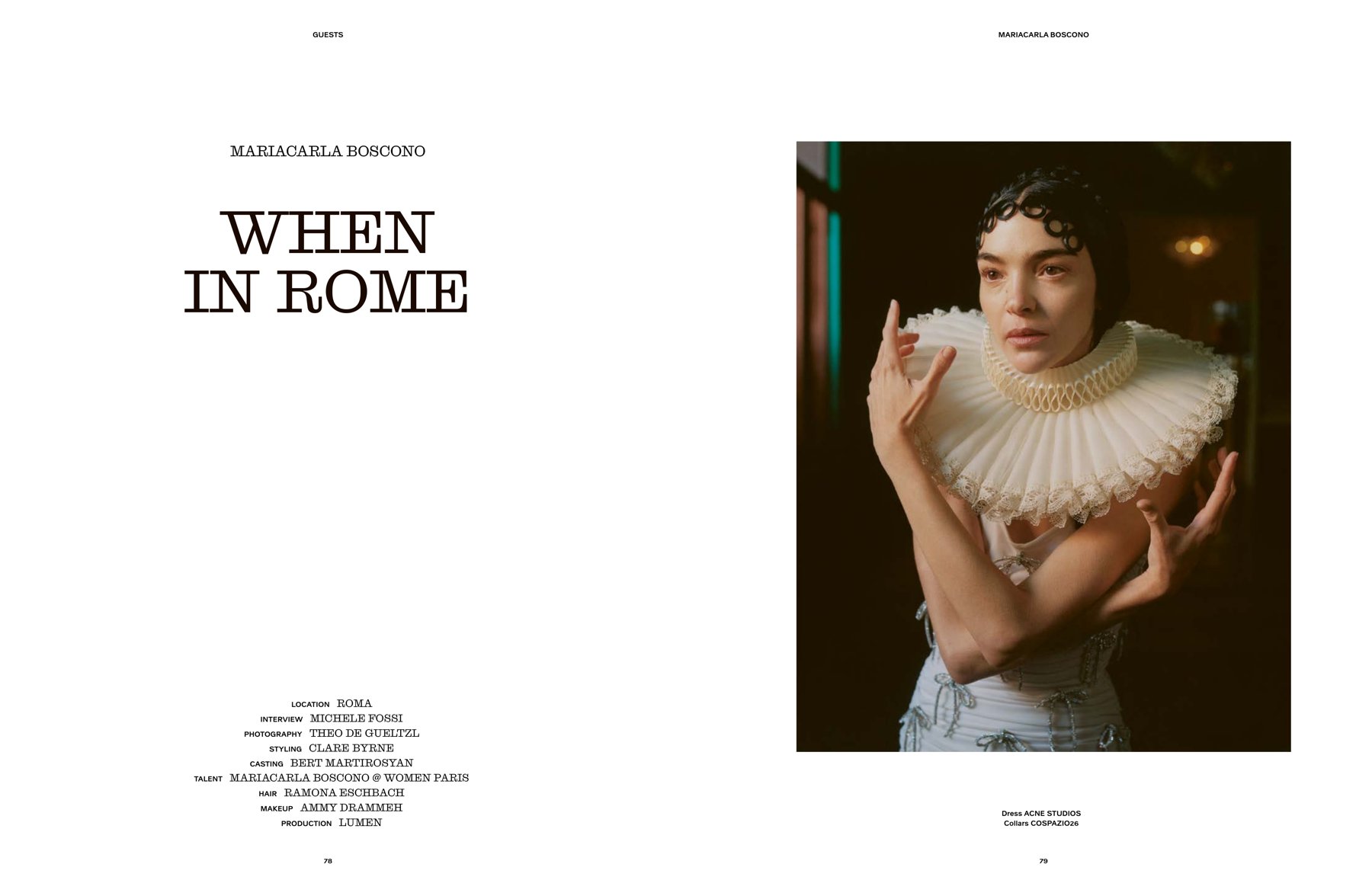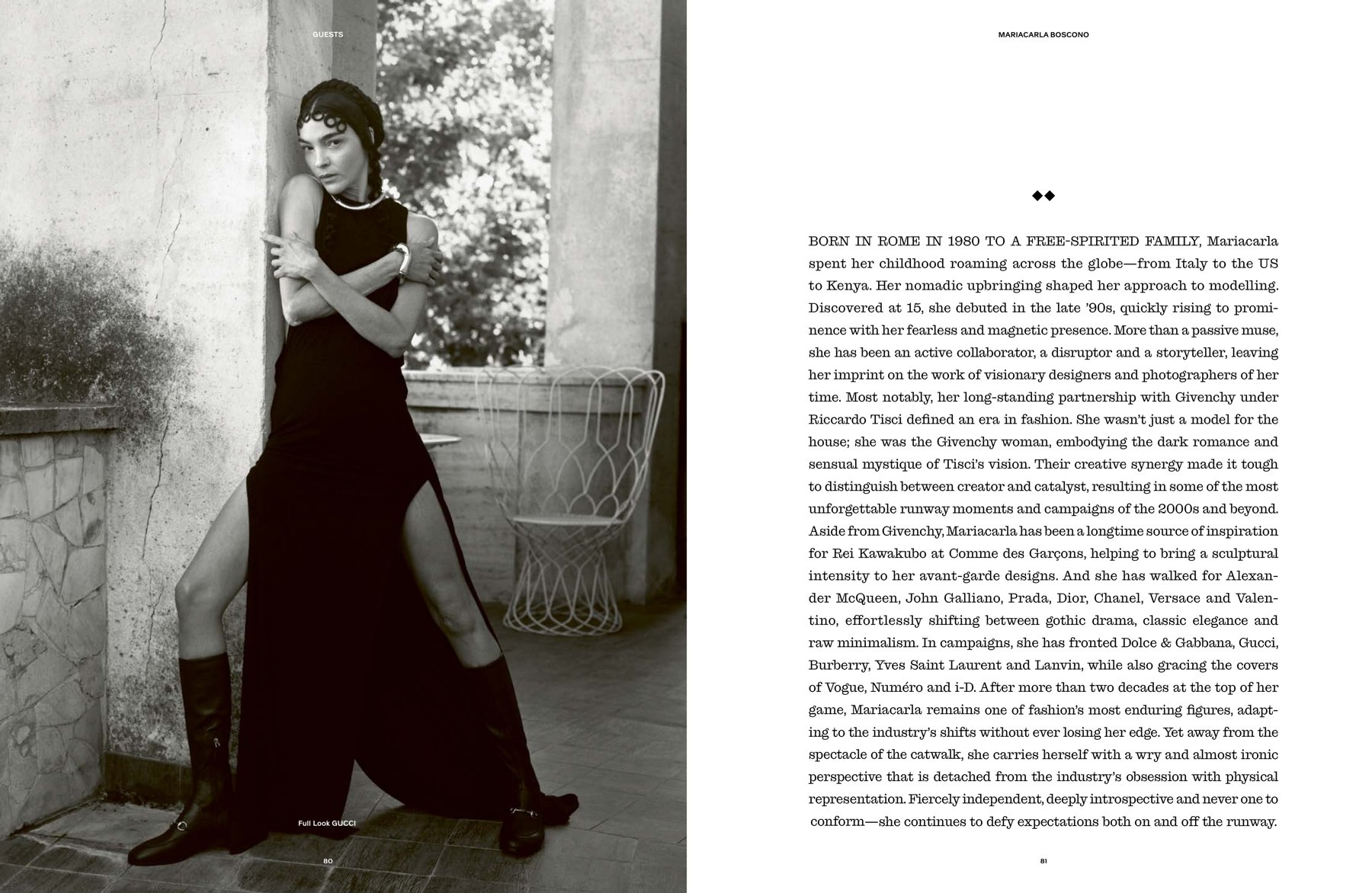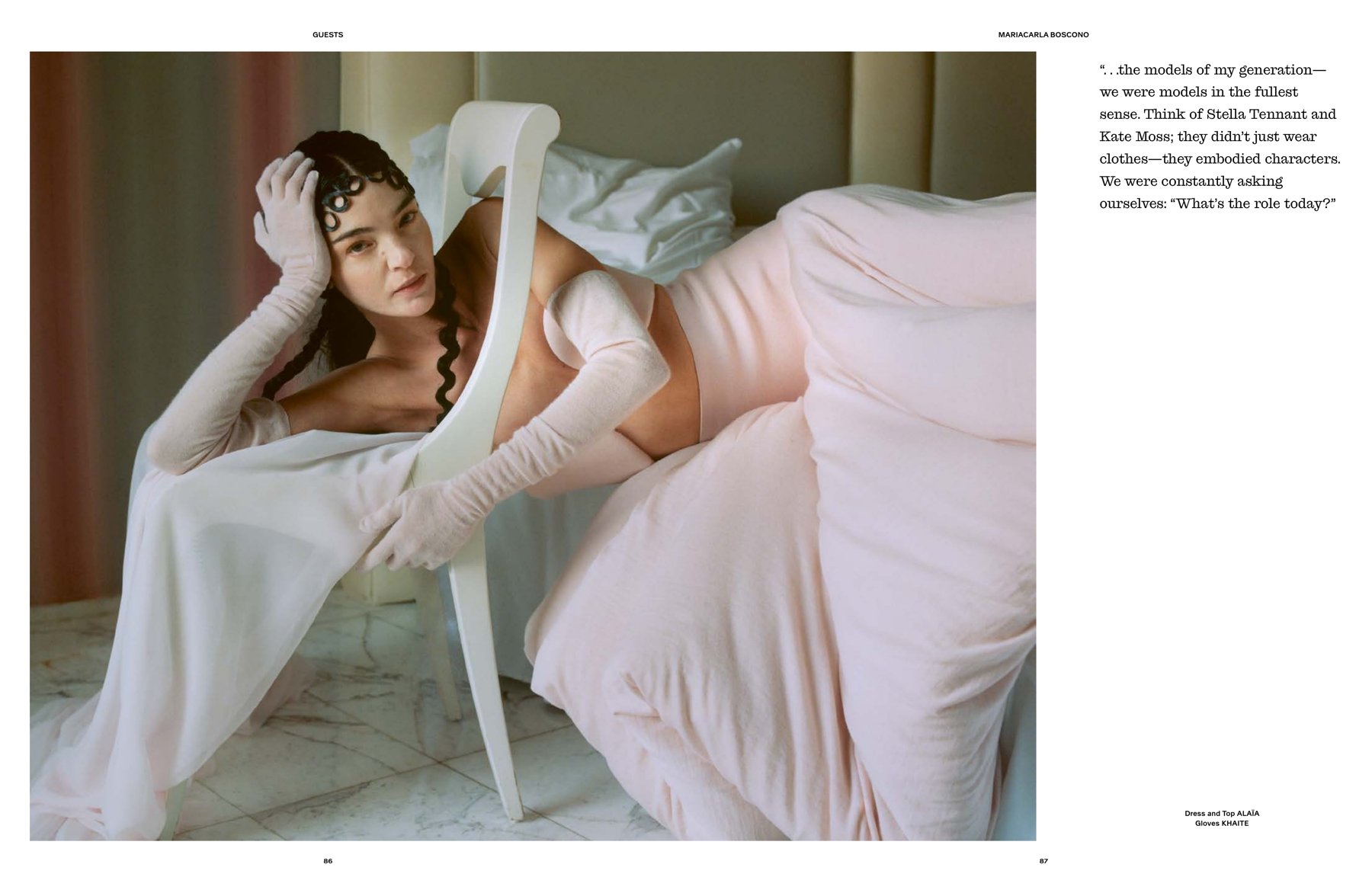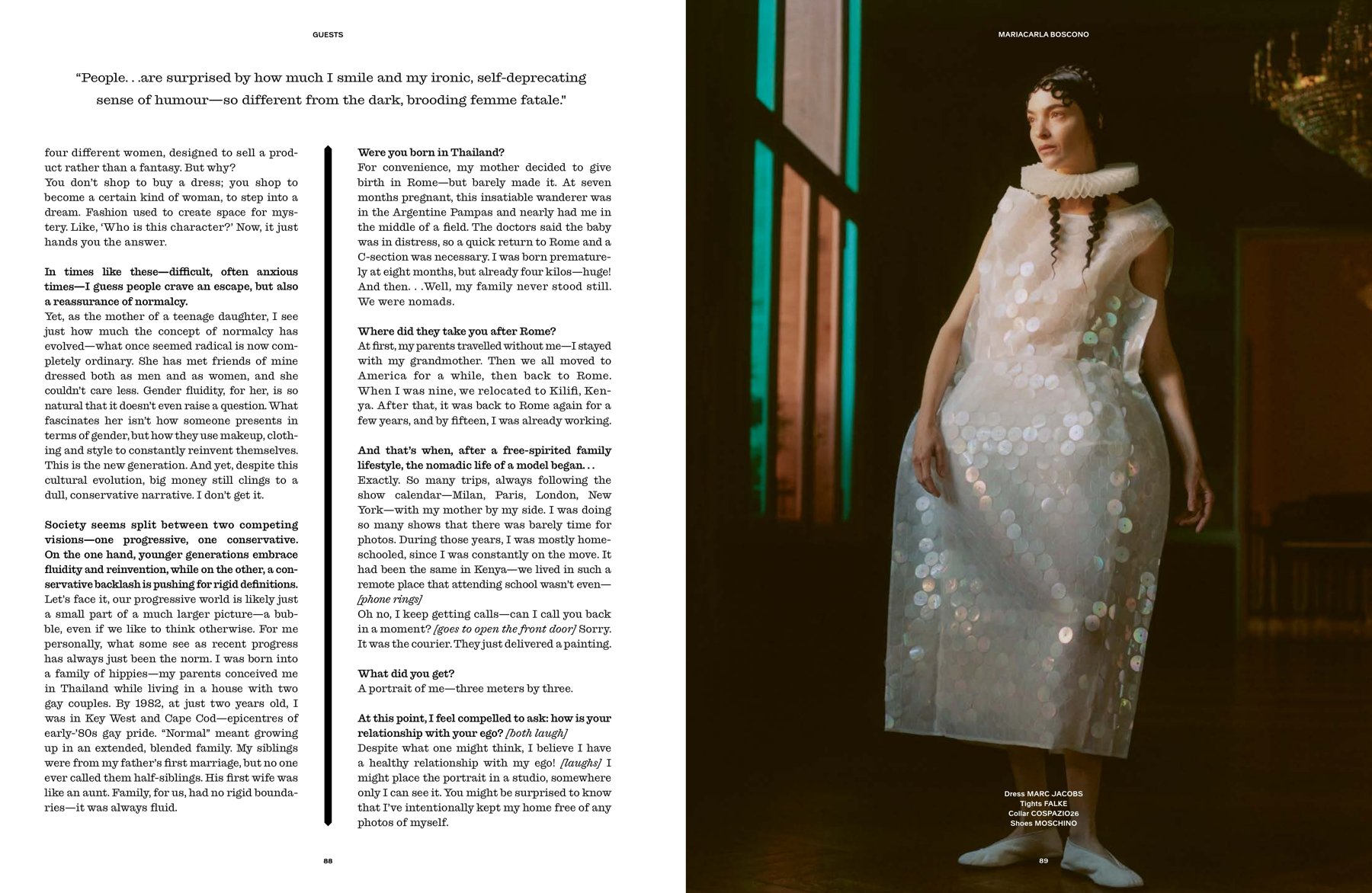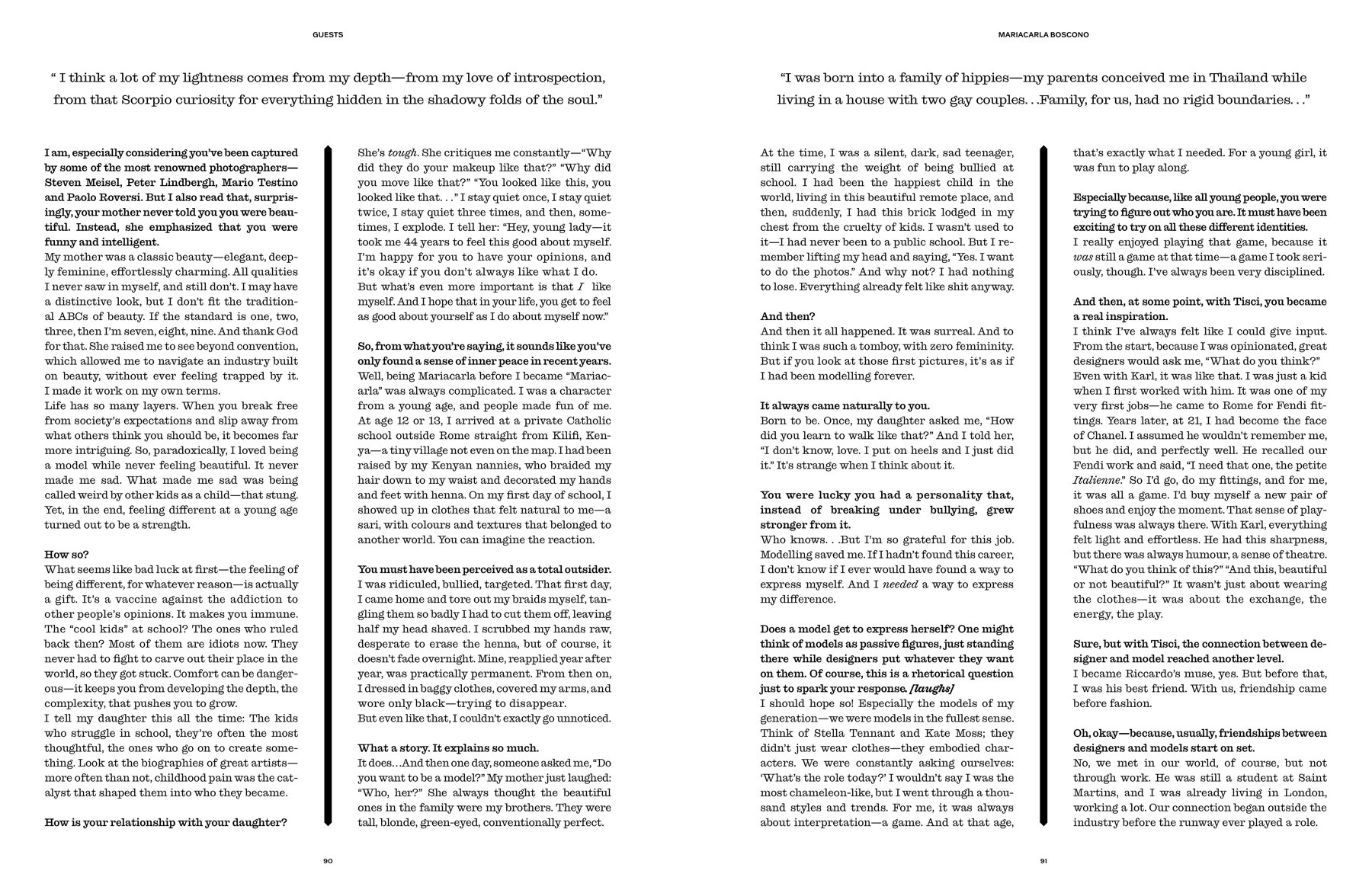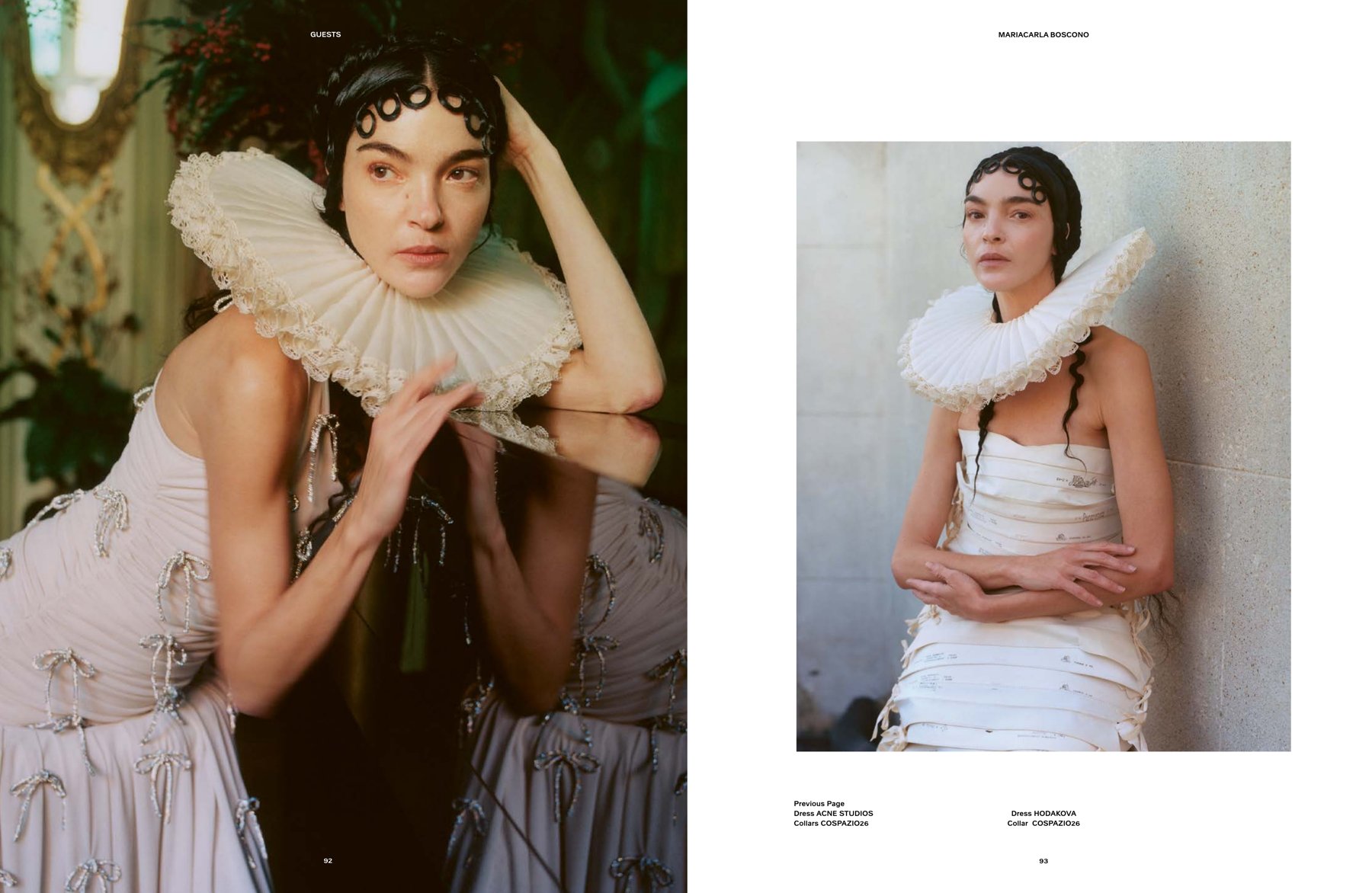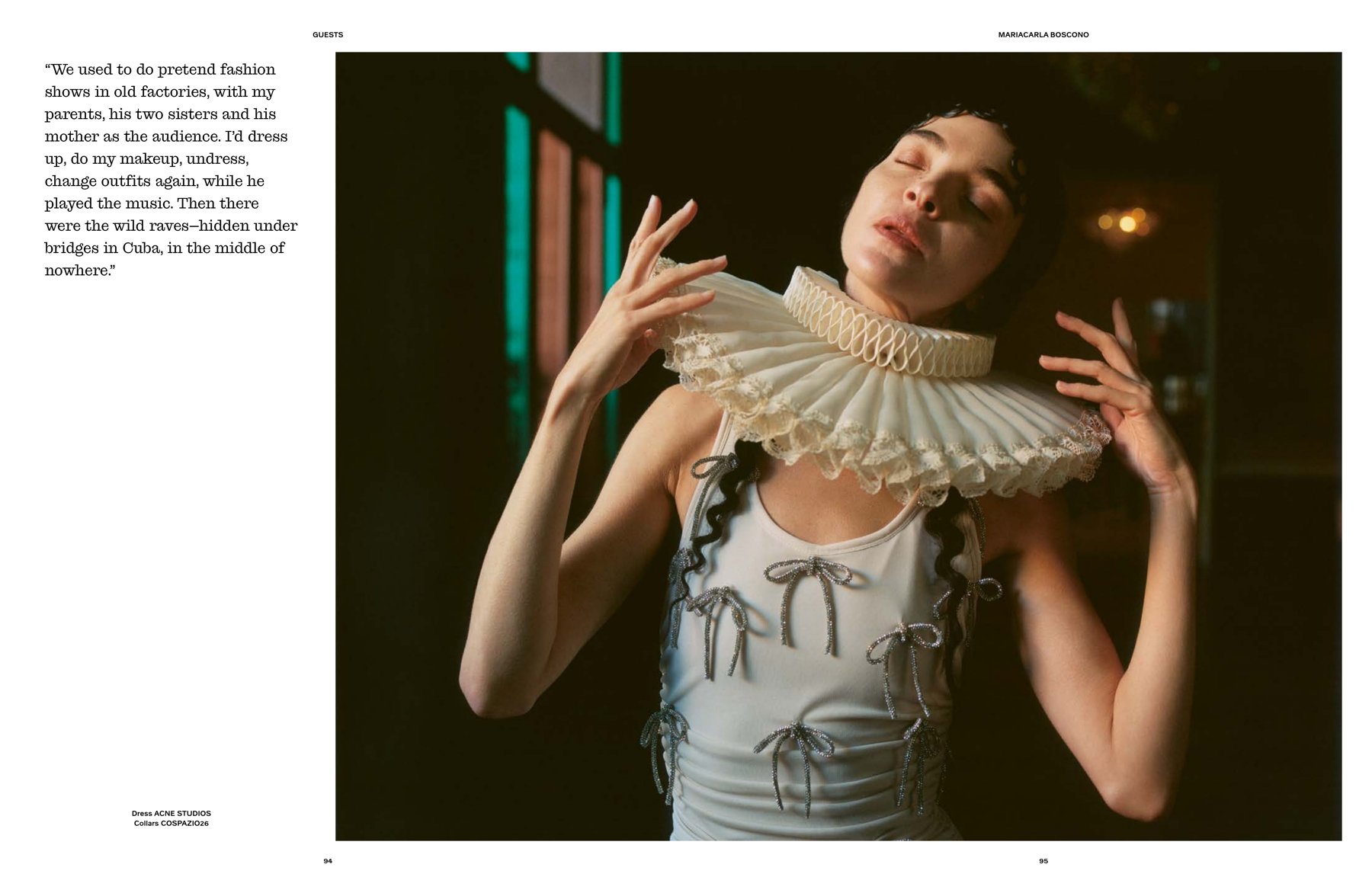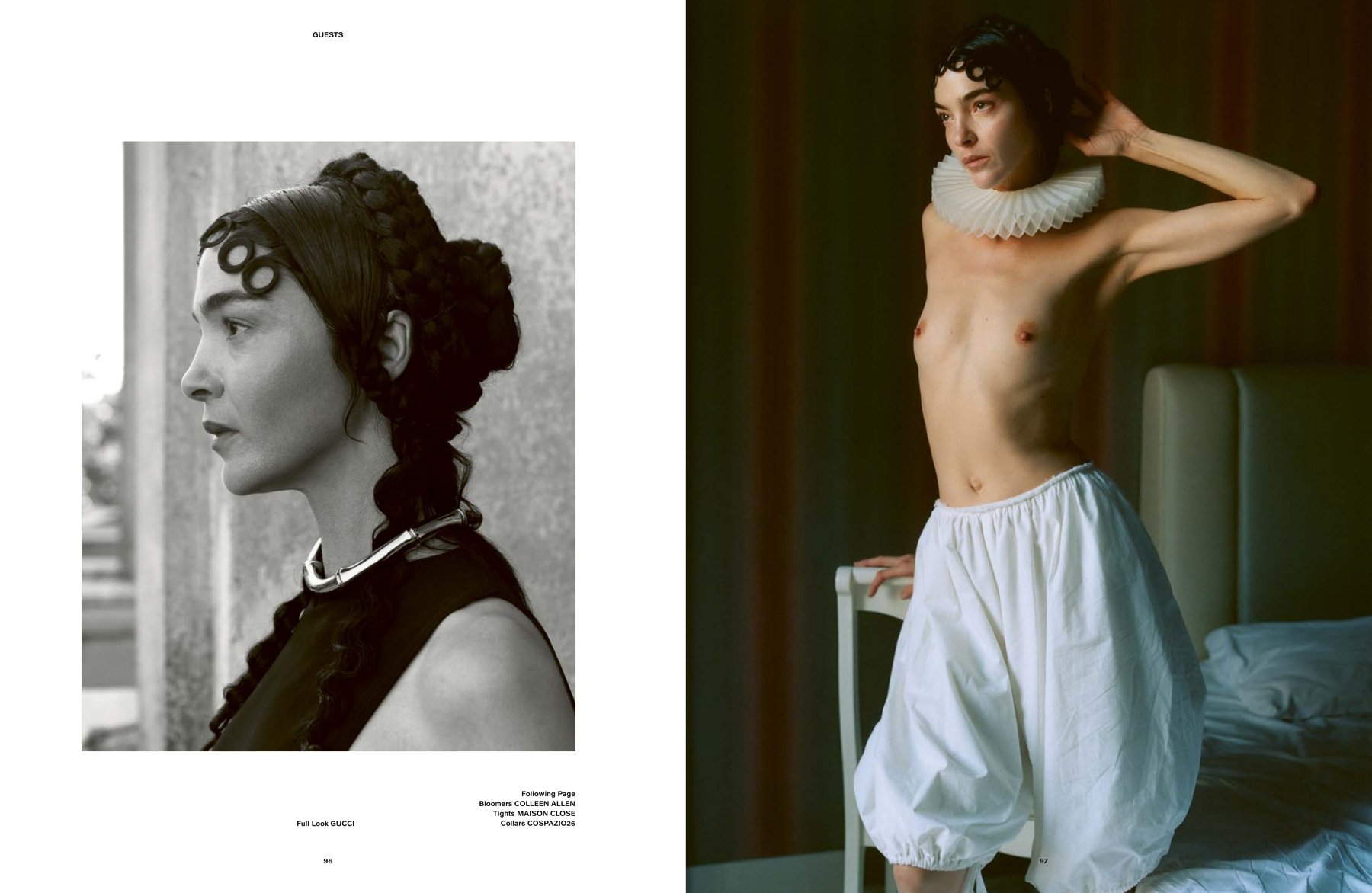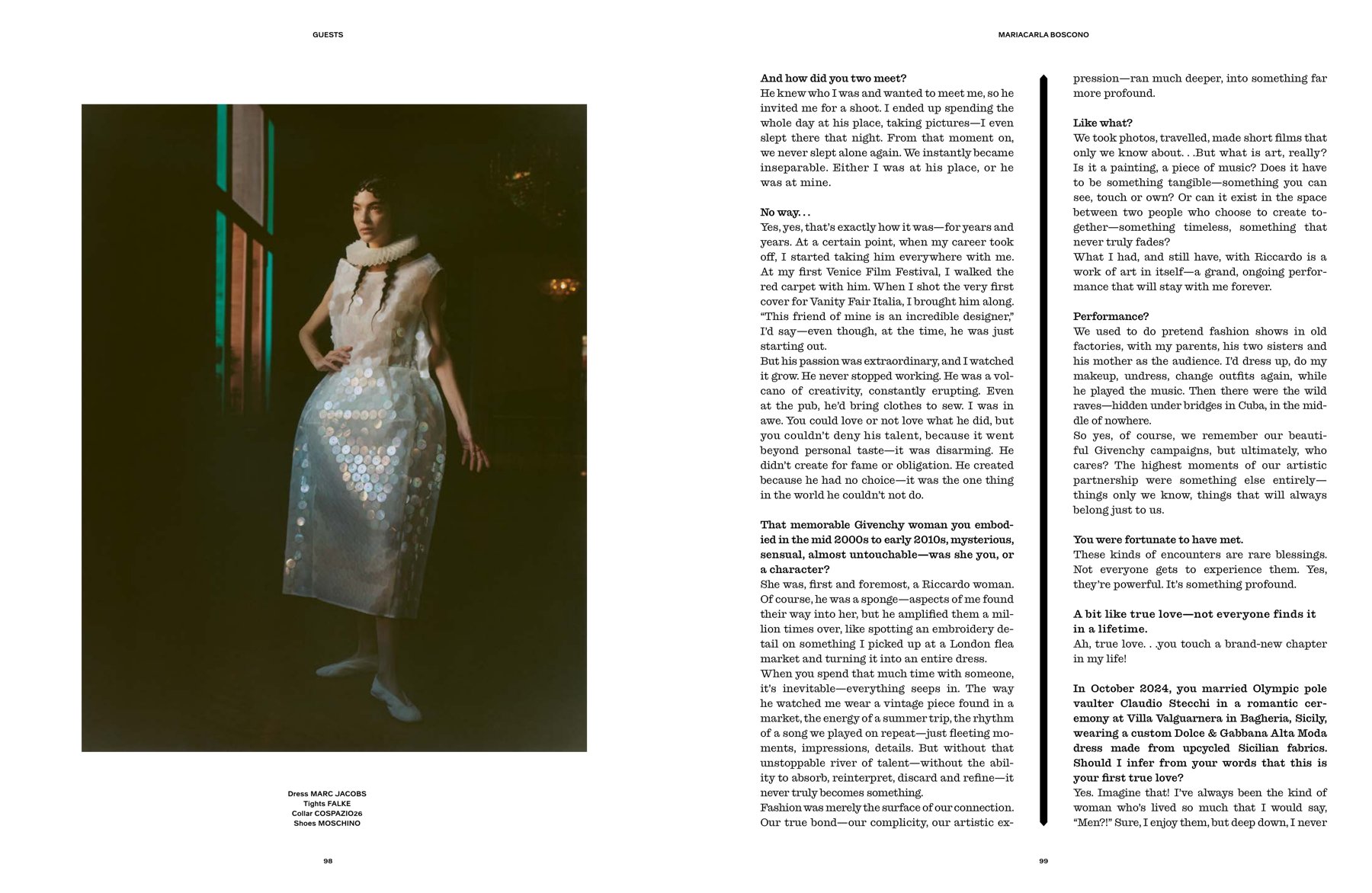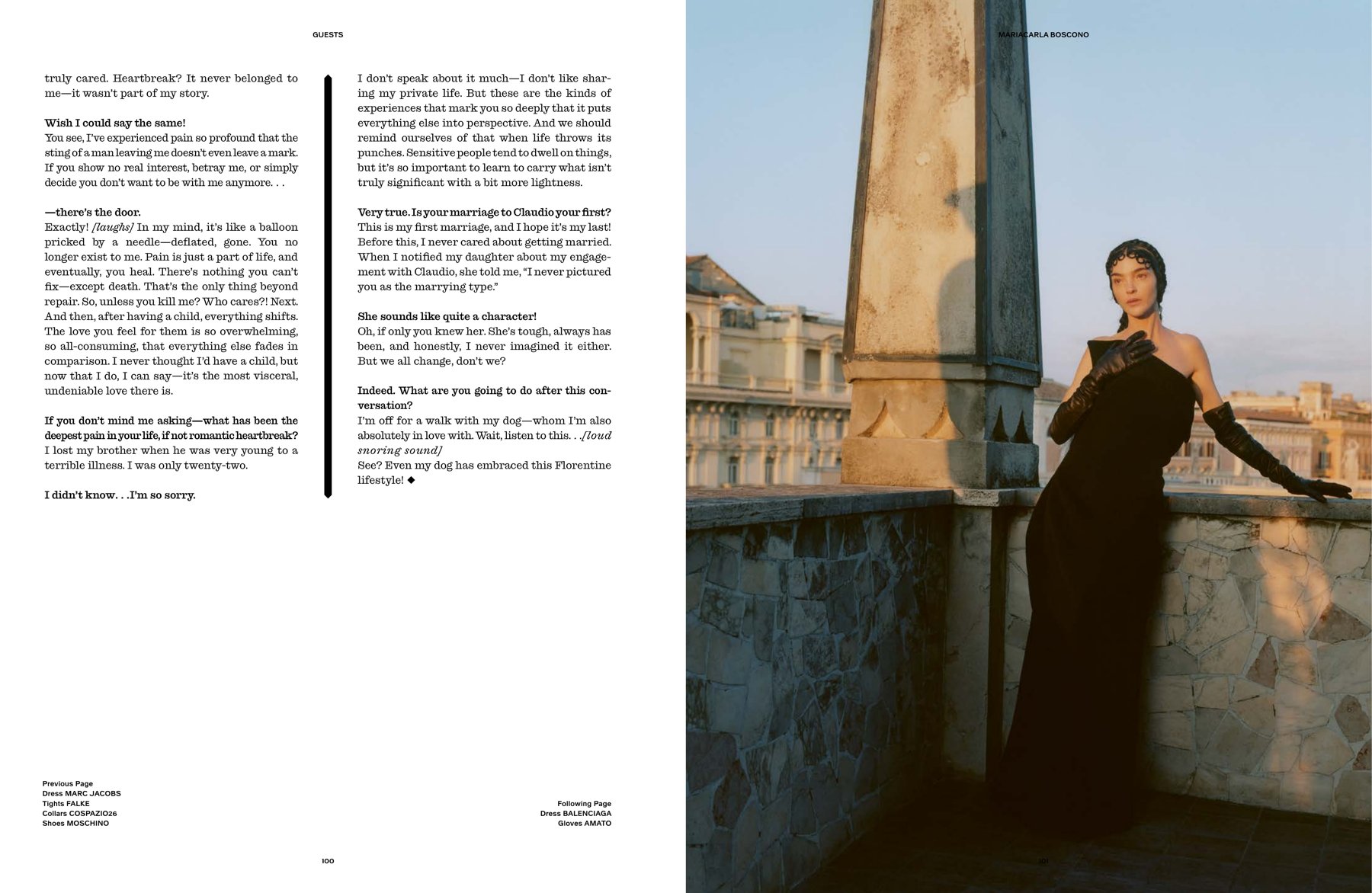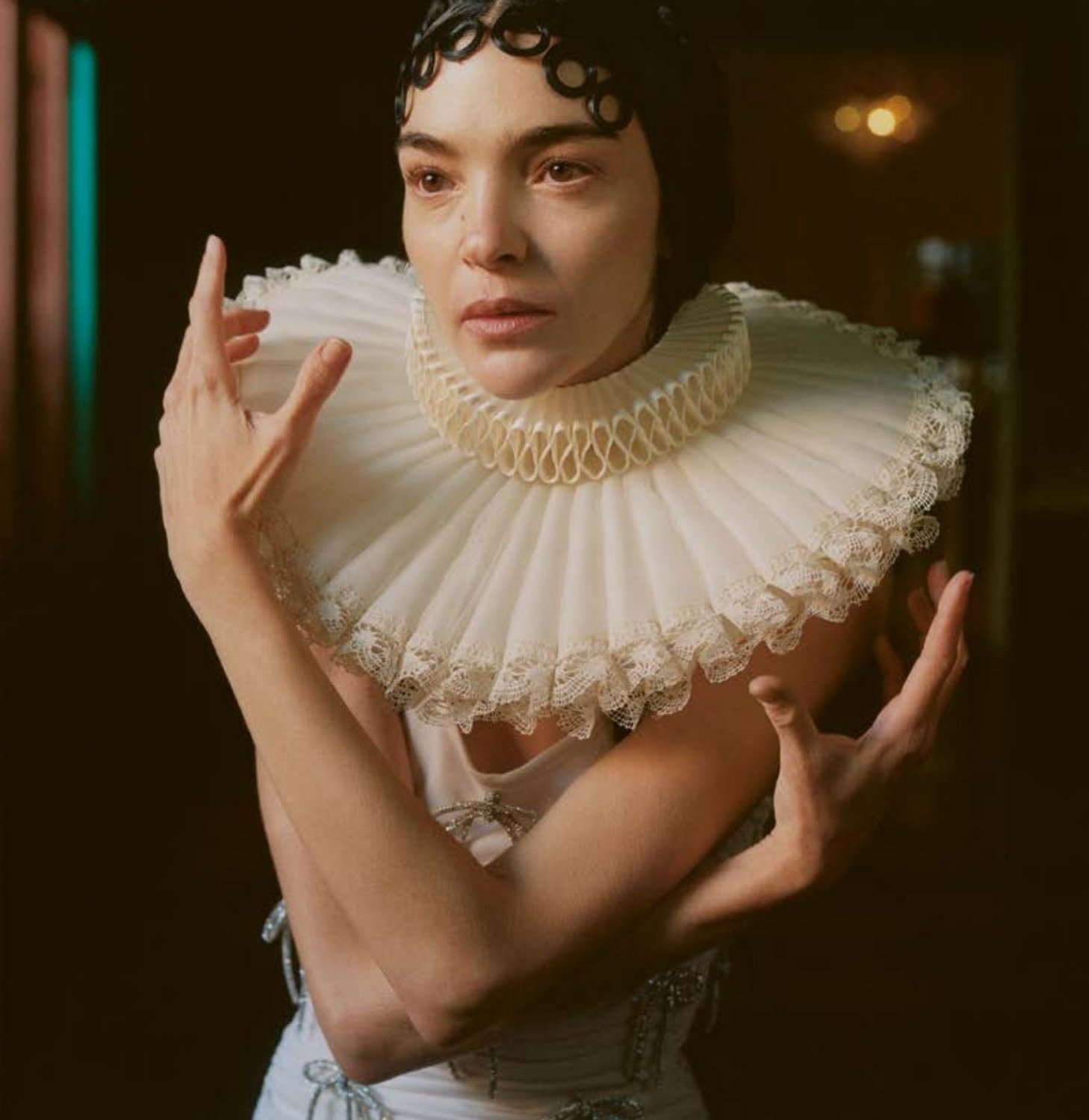
Born in Rome in 1980 to a free-spirited family, Mariacarla spent her childhood roaming across the globe—from Italy to the US to Kenya. Her nomadic upbringing shaped her approach to modelling. Discovered at 15, she debuted in the late ’90s, quickly rising to prominence with her fearless and magnetic presence. More than a passive muse, she has been an active collaborator, a disruptor and a storyteller, leaving her imprint on the work of visionary designers and photographers of her time. Most notably, her long-standing partnership with Givenchy under Riccardo Tisci defined an era in fashion. She wasn’t just a model for the house; she was the Givenchy woman, embodying the dark romance and sensual mystique of Tisci’s vision. Their creative synergy made it tough to distinguish between creator and catalyst, resulting in some of the most unforgettable runway moments and campaigns of the 2000s and beyond. Aside from Givenchy, Mariacarla has been a longtime source of inspiration for Rei Kawakubo at Comme des Garçons, helping to bring a sculptural intensity to her avant-garde designs. And she has walked for Alexander McQueen, John Galliano, Prada, Dior, Chanel, Versace and Valentino, effortlessly shifting between gothic drama, classic elegance and raw minimalism. In campaigns, she has fronted Dolce & Gabbana, Gucci, Burberry, Yves Saint Laurent and Lanvin, while also gracing the covers of Vogue, Numéro and i-D. After more than two decades at the top of her game, Mariacarla remains one of fashion’s most enduring figures, adapting to the industry’s shifts without ever losing her edge. Yet away from the spectacle of the catwalk, she carries herself with a wry and almost ironic perspective that is detached from the industry’s obsession with physical representation. Fiercely independent, deeply introspective and never one to conform—she continues to defy expectations both on and off the runway.
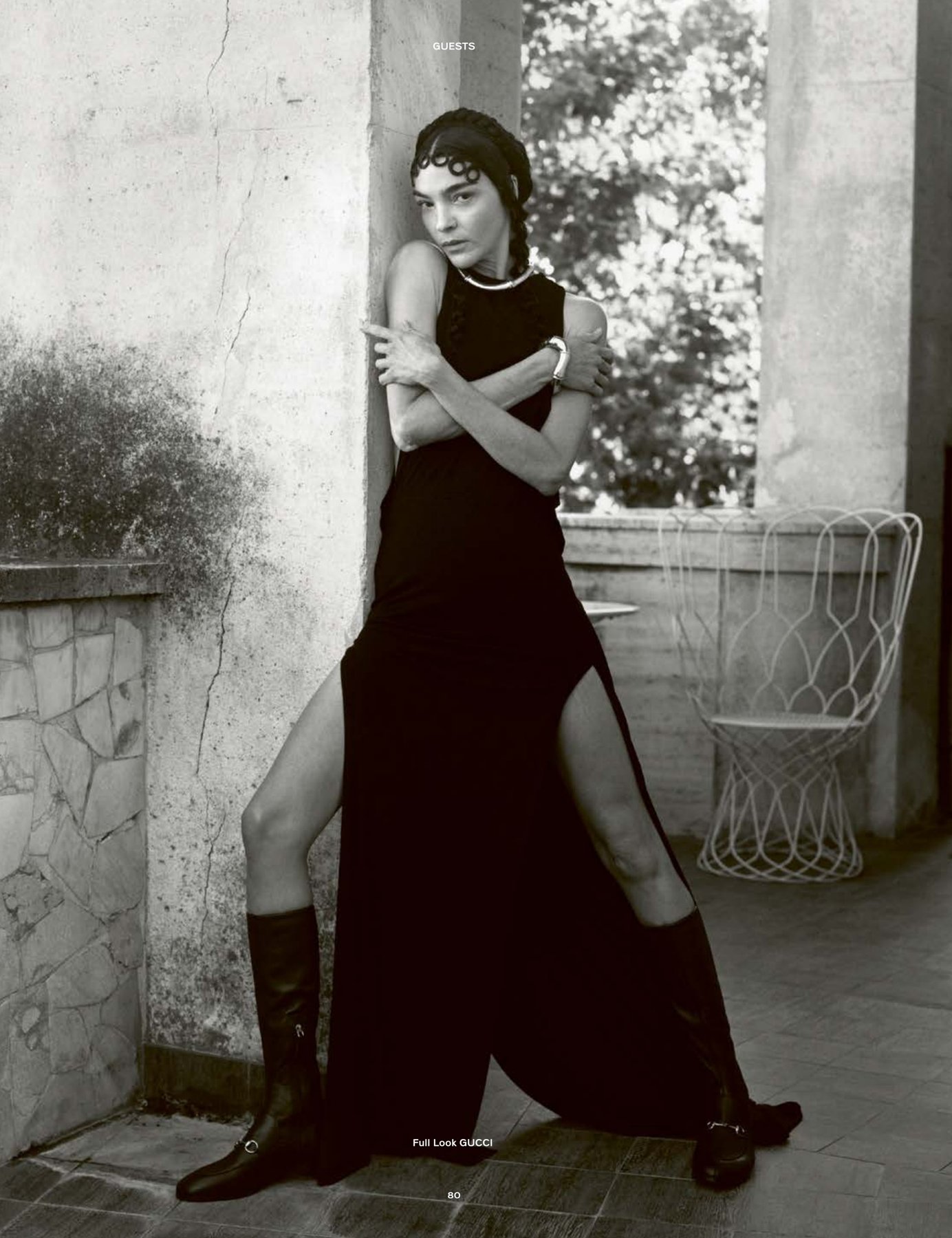
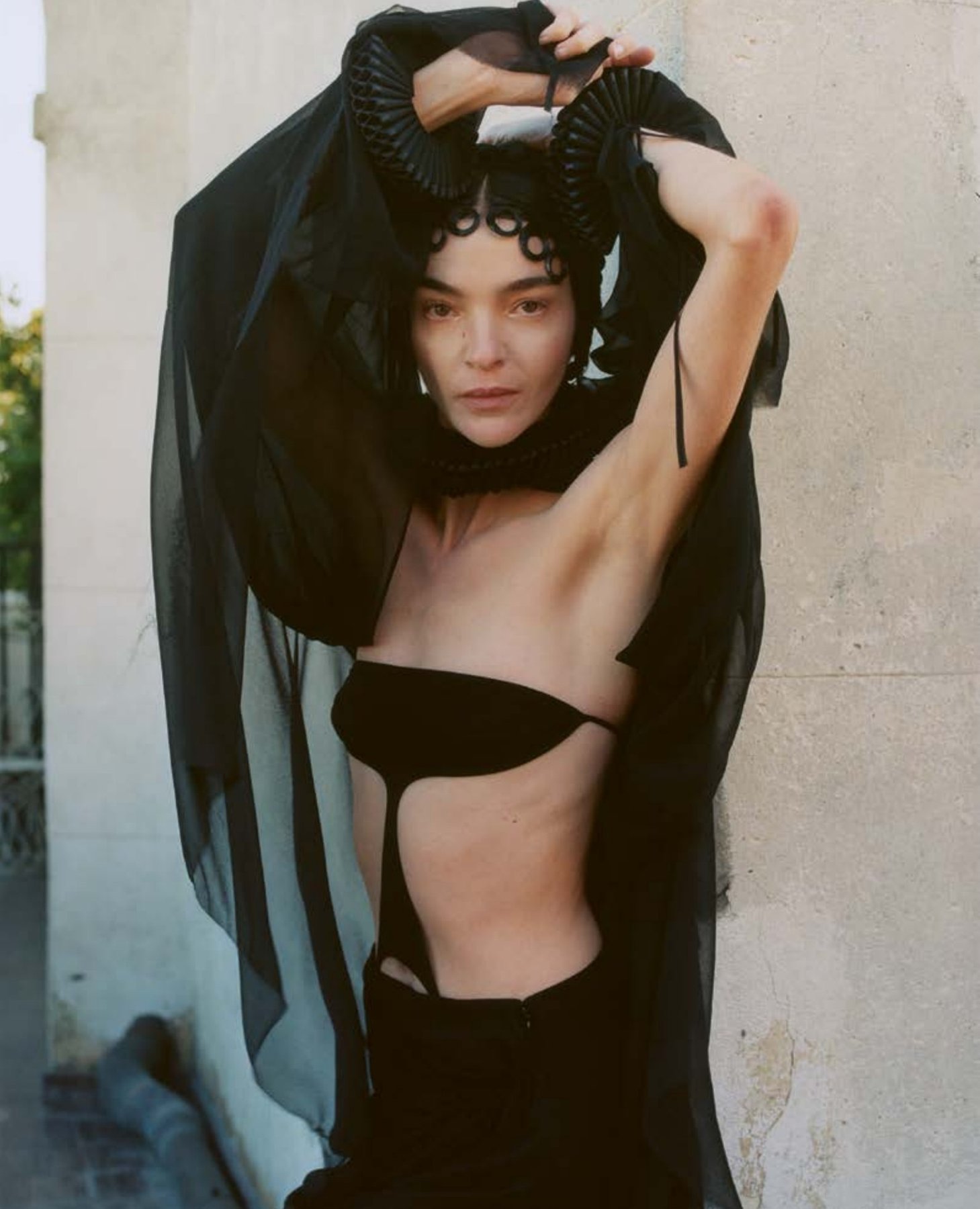
Where are you now?
I’m in Florence.
No way, that’s my hometown!
Ah, I thought so—I could hear the Florentine accent!
And what are you doing there?
I’m living in Florence since September—my husband is Florentine. We’re right in the city centre. To be honest, I would have preferred to be higher up, playing the part of the witch of the hills, [laughs] but I have to say, life in the centre is absolutely divine.
I don’t need much. I’ve found my three favourite little shops; I have my chats, my prosecco. . .Honestly, I’d be happy just wandering around the neighbourhood with my dog all day. I have no desire to work anymore, and my agents are in despair! [laughs]
I bet! Let’s start with something fun—star signs. I couldn’t help but wonder—are you a Scorpio? You have that intense, almost hypnotic energy. . .
You mean the energy of a bitch? [laughs] I’m actually a Virgo but with a Scorpio ascendant. And you’re onto something because I feel like I’ve lived my whole life as a Scorpio woman— just with the discipline and precision of a Virgo.
That makes sense. There’s a raw, almost untamed sensuality in how you carry yourself.
We’re a bit animalistic. Scorpio is a sign of people who are slightly unsettled and disturbed by themselves. They say Scorpios sting—but more often than not, they sting themselves.
Do you think you have a self-destructive side?
No, I wouldn’t say self-destructive. More that we’re extremely hard on ourselves, and we struggle to let things go. We’re just a little dark.
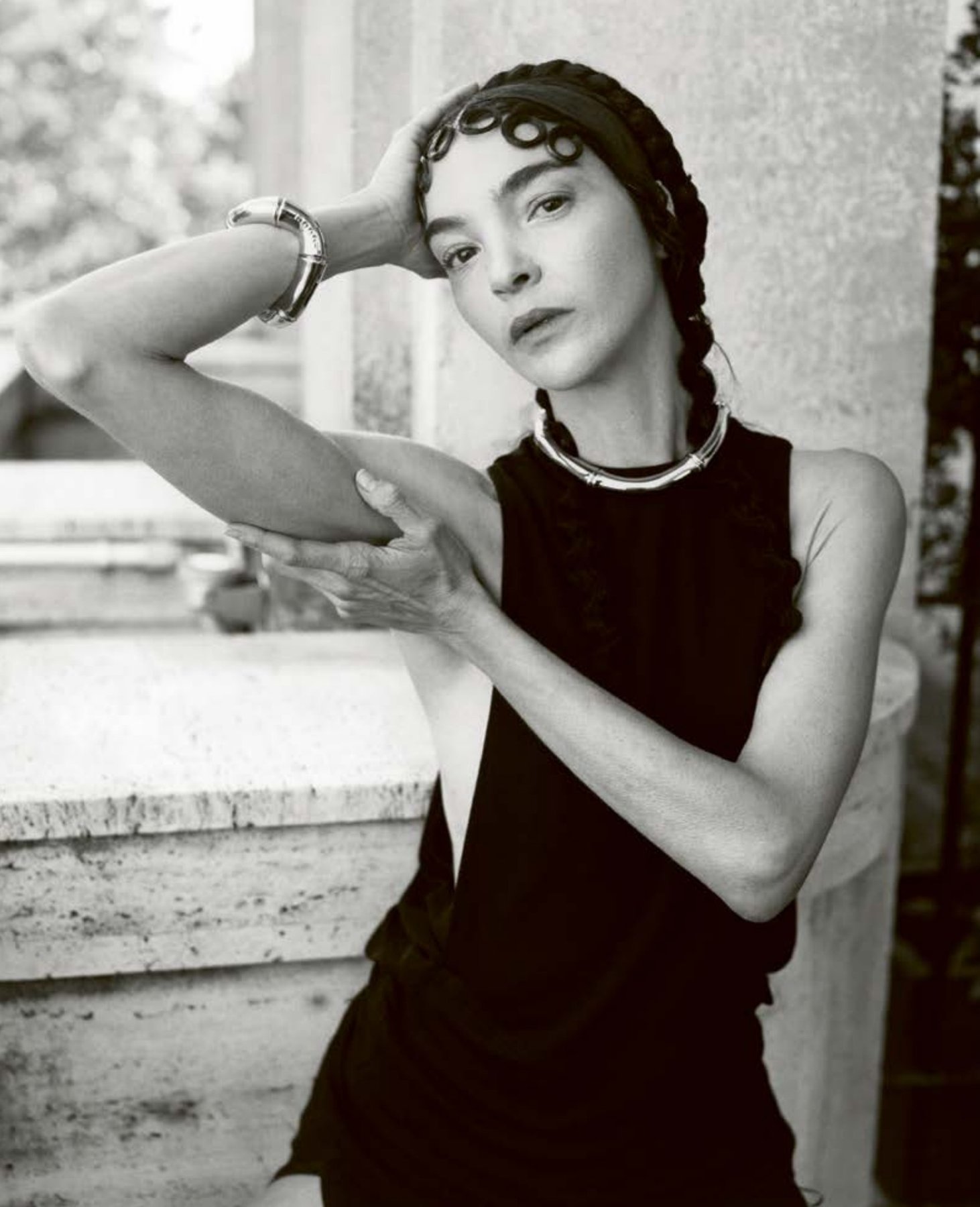
Indeed, Scorpios are undoubtedly known for their fascination with the dark side of things.
That, and an almost relentless self-discipline.
You seem to translate that Scorpio energy into fashion as well. I think of the predominance of black and red in your wardrobe—colours that suggest danger.
And yet, those who truly know me understand that I’m nothing like the image I project. I may exude a gothic aura and enjoy playing with that image, but deep down, I’m lighthearted and playful—I love to laugh. Often people meeting me for the first time are surprised by how much I smile and my ironic, self-deprecating sense of humour—so different from the dark, brooding femme fatale I often embody in fashion.
And that deep, pesnive Scorpio side?
It’s there, of course. I think much of my lightness comes from my depth—from my love of introspection, from that Scorpio curiosity for everything hidden in the shadowy folds of the soul.
Even though you work in an industry that is, at its core, ephemeral, light. . .
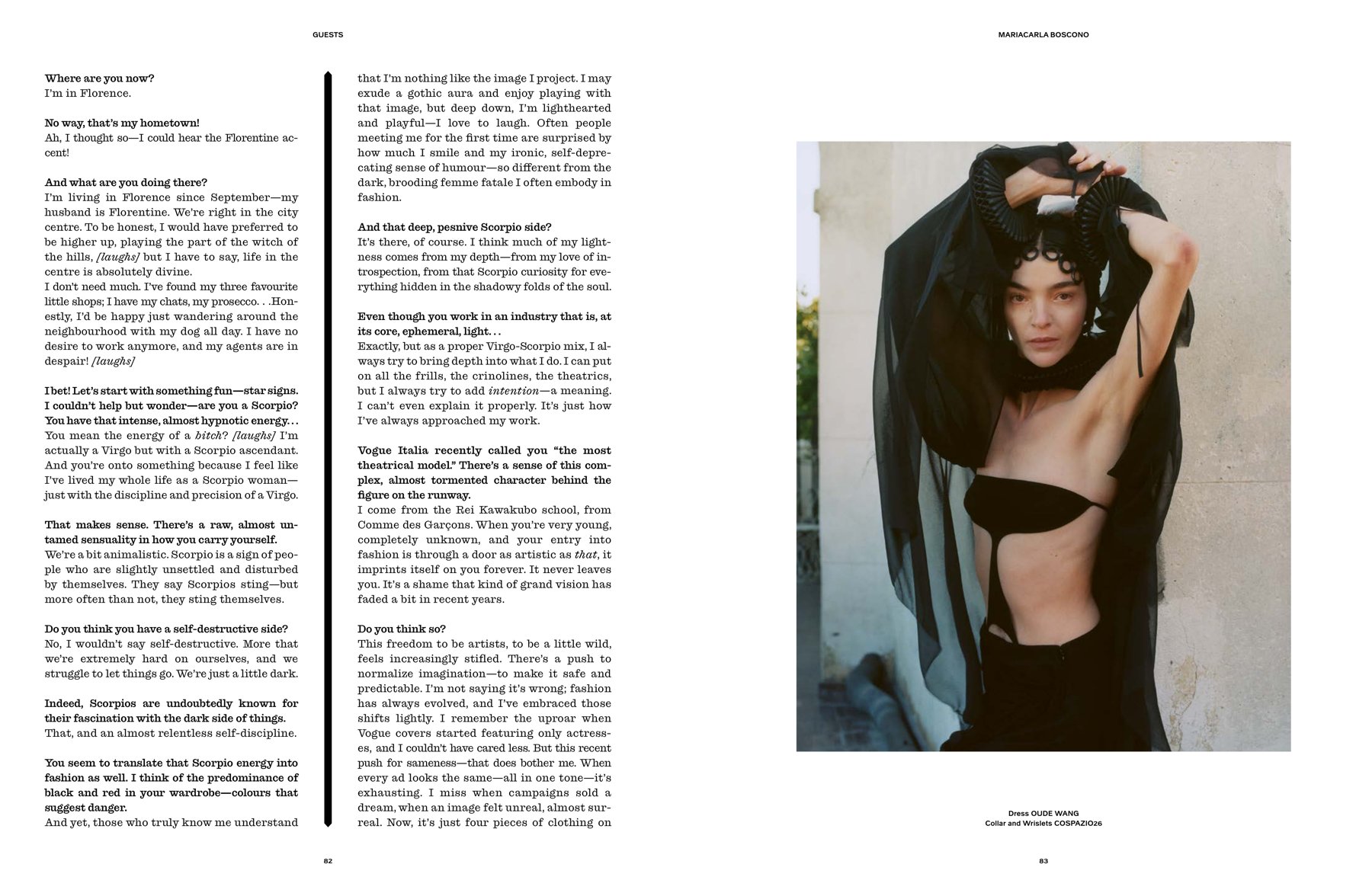
Exactly, but as a proper Virgo-Scorpio mix, I always try to bring depth into what I do. I can put on all the frills, the crinolines, the theatrics, but I always try to add intention—a meaning. I can’t even explain it properly. It’s just how I’ve always approached my work.
Vogue Italia recently called you “the most theatrical model.” There’s a sense of this complex, almost tormented character behind the figure on the runway.
I come from the Rei Kawakubo school, from Comme des Garçons. When you’re very young, completely unknown, and your entry into fashion is through a door as artistic as that, it imprints itself on you forever. It never leaves you. It’s a shame that kind of grand vision has faded a bit in recent years.
Do you think so?
This freedom to be artists, to be a little wild, feels increasingly stifled. There’s a push to normalize imagination—to make it safe and predictable. I’m not saying it’s wrong; fashion has always evolved, and I’ve embraced those shifts lightly. I remember the uproar when Vogue covers started featuring only actresses, and I couldn’t have cared less. But this recent push for sameness—that does bother me. When every ad looks the same—all in one tone—it’s exhausting. I miss when campaigns sold a dream, when an image felt unreal, almost surreal. Now, it’s just four pieces of clothing on four different women, designed to sell a product rather than a fantasy. But why?
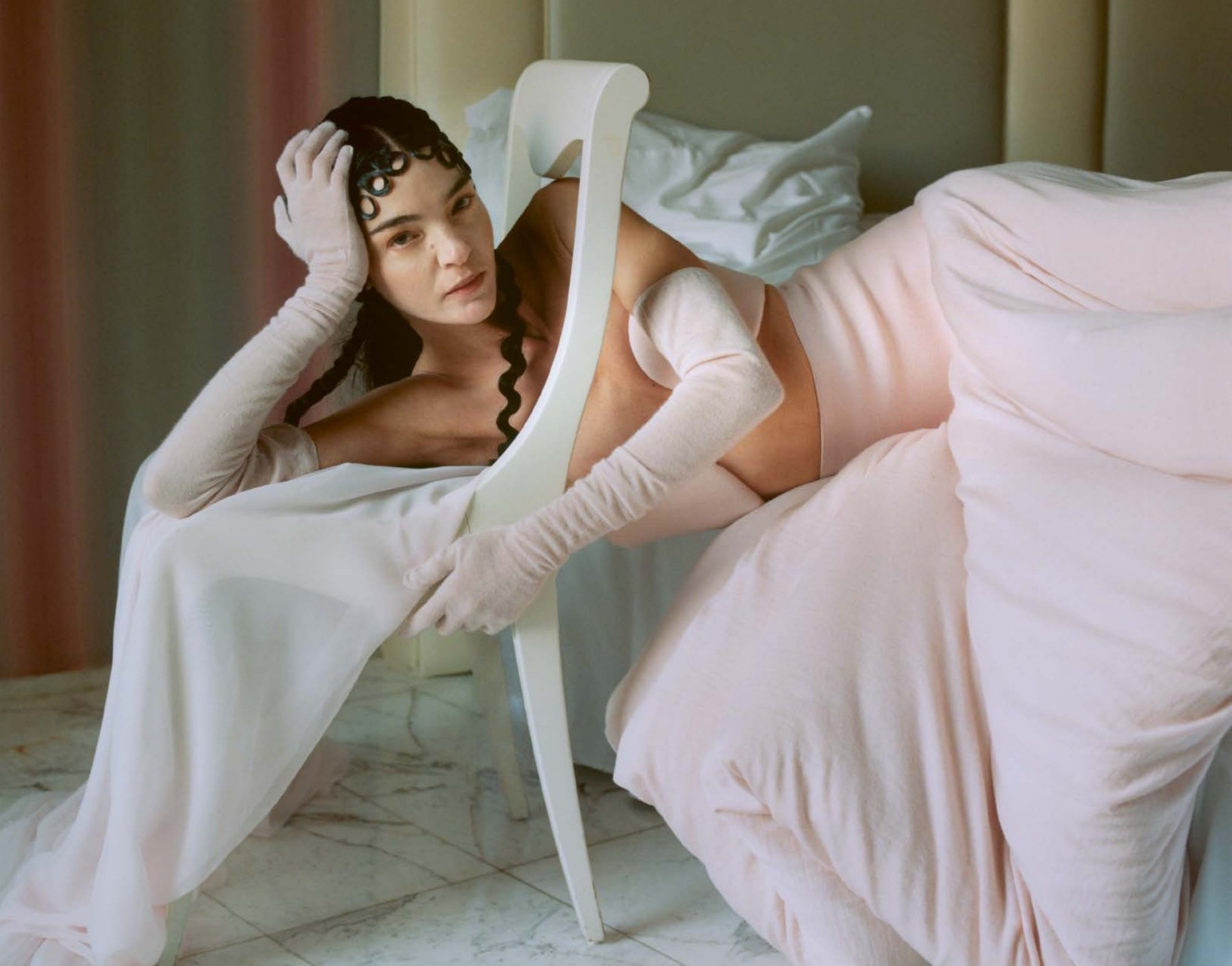
You don’t shop to buy a dress; you shop to become a certain kind of woman, to step into a dream. Fashion used to create space for mystery. Like, ‘Who is this character?’ Now, it just hands you the answer.
In times like these—difficult, often anxious times—I guess people crave an escape, but also a reassurance of normalcy.
Yet, as the mother of a teenage daughter, I see just how much the concept of normalcy has evolved—what once seemed radical is now completely ordinary. She has met friends of mine dressed both as men and as women, and she couldn’t care less. Gender fluidity, for her, is so natural that it doesn’t even raise a question. What fascinates her isn’t how someone presents in terms of gender, but how they use makeup, clothing and style to constantly reinvent themselves.
This is the new generation. And yet, despite this cultural evolution, big money still clings to a dull, conservative narrative. I don’t get it.
Society seems split between two competing visions—one progressive, one conservative. On the one hand, younger generations embrace fluidity and reinvention, while on the other, a conservative backlash is pushing for rigid definitions.
Let’s face it, our progressive world is likely just a small part of a much larger picture—a bubble, even if we like to think otherwise. For me personally, what some see as recent progress has always just been the norm. I was born into a family of hippies—my parents conceived me in Thailand while living in a house with two gay couples. By 1982, at just two years old, I was in Key West and Cape Cod—epicentres of early-’80s gay pride. “Normal” meant growing up in an extended, blended family. My siblings were from my father’s first marriage, but no one ever called them half-siblings. His first wife was like an aunt. Family, for us, had no rigid boundaries—it was always fluid.
Were you born in Thailand?
For convenience, my mother decided to give birth in Rome—but barely made it. At seven months pregnant, this insatiable wanderer was in the Argentine Pampas and nearly had me in the middle of a field. The doctors said the baby was in distress, so a quick return to Rome and a C-section was necessary. I was born prematurely at eight months, but already four kilos—huge! And then. . .Well, my family never stood still. We were nomads.
Where did they take you after Rome?
At first, my parents travelled without me—I stayed with my grandmother. Then we all moved to America for a while, then back to Rome. When I was nine, we relocated to Kilifi, Kenya. After that, it was back to Rome again for a few years, and by fifteen, I was already working.
And that’s when, after a free-spirited family lifestyle, the nomadic life of a model began. . .
Exactly. So many trips, always following the show calendar—Milan, Paris, London, New York—with my mother by my side. I was doing so many shows that there was barely time for photos. During those years, I was mostly homeschooled, since I was constantly on the move. It had been the same in Kenya—we lived in such a remote place that attending school wasn’t even— [phone rings]
Oh no, I keep getting calls—can I call you back in a moment? [goes to open the front door] Sorry. It was the courier. They just delivered a painting.
What did you get?
A portrait of me—three meters by three.
At this point, I feel compelled to ask: how is your relationship with your ego? [both laugh]
Despite what one might think, I believe I have a healthy relationship with my ego! [laughs] I might place the portrait in a studio, somewhere only I can see it. You might be surprised to know that I’ve intentionally kept my home free of any photos of myself.
I am, especially considering you’ve been captured by some of the most renowned photographers— Steven Meisel, Peter Lindbergh, Mario Testino and Paolo Roversi. But I also read that, surprisingly, your mother never told you you were beautiful. Instead, she emphasized that you were funny and intelligent.
My mother was a classic beauty—elegant, deeply feminine, effortlessly charming. All qualities I never saw in myself, and still don’t. I may have a distinctive look, but I don’t fit the traditional ABCs of beauty. If the standard is one, two, three, then I’m seven, eight, nine. And thank God for that. She raised me to see beyond convention, which allowed me to navigate an industry built on beauty, without ever feeling trapped by it.
I made it work on my own terms.
Life has so many layers. When you break free from society’s expectations and slip away from what others think you should be, it becomes far more intriguing. So, paradoxically, I loved being a model while never feeling beautiful. It never made me sad. What made me sad was being called weird by other kids as a child—that stung.
Yet, in the end, feeling different at a young age turned out to be a strength.
How so?
What seems like bad luck at first—the feeling of being different, for whatever reason—is actually a gift. It’s a vaccine against the addiction to other people’s opinions. It makes you immune.
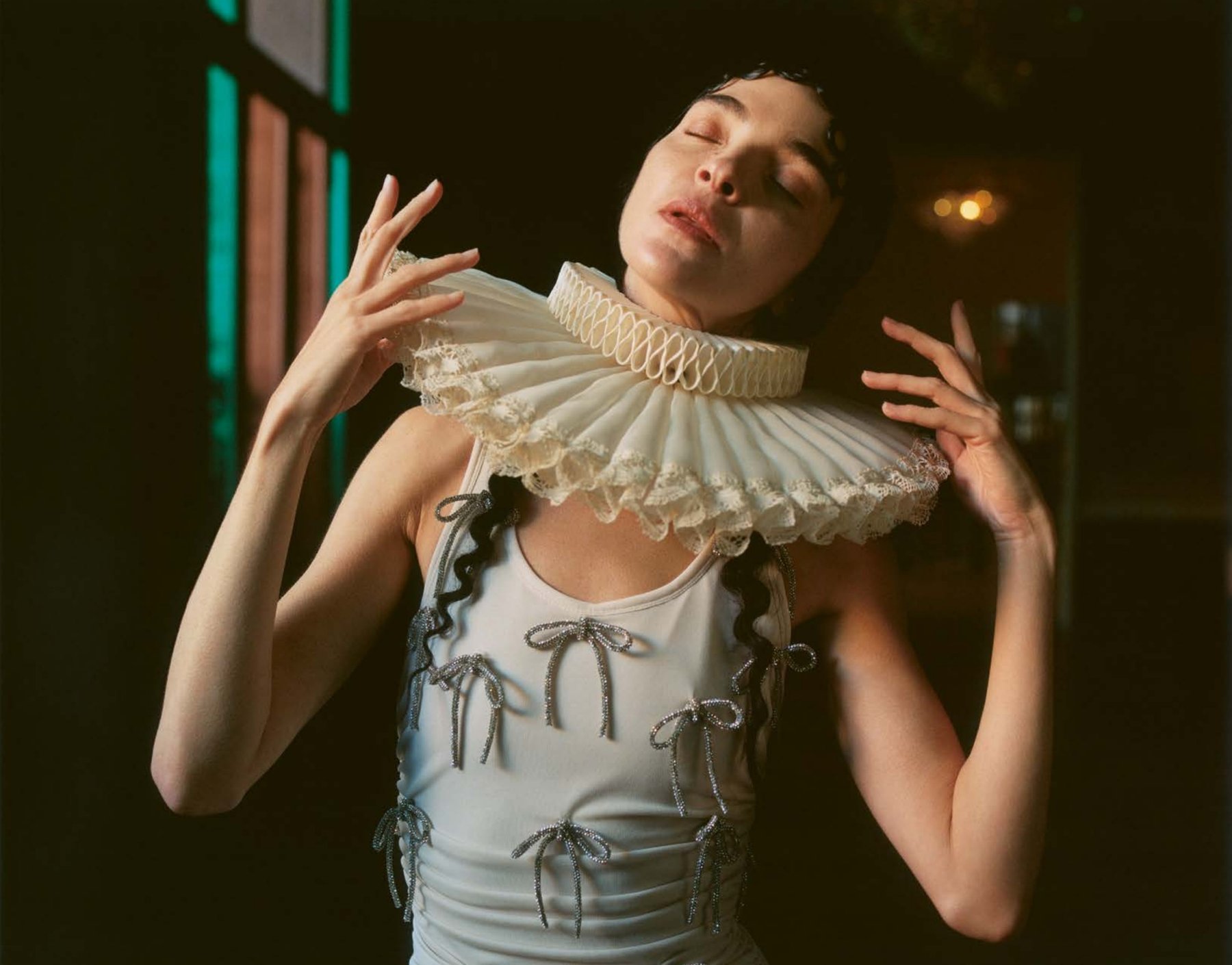
The “cool kids” at school? The ones who ruled back then? Most of them are idiots now. They never had to fight to carve out their place in the world, so they got stuck. Comfort can be dangerous—it keeps you from developing the depth, the complexity, that pushes you to grow.
I tell my daughter this all the time: The kids who struggle in school, they’re often the most thoughtful, the ones who go on to create something. Look at the biographies of great artists— more often than not, childhood pain was the catalyst that shaped them into who they became.
How is your relationship with your daughter?
She’s tough. She critiques me constantly—“Why did they do your makeup like that?” “Why did you move like that?” “You looked like this, you looked like that. . .” I stay quiet once, I stay quiet twice, I stay quiet three times, and then, sometimes, I explode. I tell her: “Hey, young lady—it took me 44 years to feel this good about myself. I’m happy for you to have your opinions, and it’s okay if you don’t always like what I do. But what’s even more important is that I like myself. And I hope that in your life, you get to feel as good about yourself as I do about myself now.”
So, from what you’re saying, it sounds like you’ve only found a sense of inner peace in recent years.
Well, being Mariacarla before I became “Mariacarla” was always complicated. I was a character from a young age, and people made fun of me. At age 12 or 13, I arrived at a private Catholic school outside Rome straight from Kilifi, Kenya—a tiny village not even on the map. I had been raised by my Kenyan nannies, who braided my hair down to my waist and decorated my hands and feet with henna. On my first day of school, I showed up in clothes that felt natural to me—a sari, with colours and textures that belonged to another world. You can imagine the reaction.
You must have been perceived as a total outsider.
I was ridiculed, bullied, targeted. That first day, I came home and tore out my braids myself, tangling them so badly I had to cut them off, leaving half my head shaved. I scrubbed my hands raw, desperate to erase the henna, but of course, it doesn’t fade overnight. Mine, reapplied year after year, was practically permanent. From then on, I dressed in baggy clothes, covered my arms, and wore only black—trying to disappear.
But even like that, I couldn’t exactly go unnoticed.
What a story. It explains so much.
It does. . .And then one day, someone asked me, “Do you want to be a model?” My mother just laughed: “Who, her?” She always thought the beautiful ones in the family were my brothers. They were tall, blonde, green-eyed, conventionally perfect.
At the time, I was a silent, dark, sad teenager, still carrying the weight of being bullied at school. I had been the happiest child in the world, living in this beautiful remote place, and then, suddenly, I had this brick lodged in my chest from the cruelty of kids. I wasn’t used to it—I had never been to a public school. But I remember lifting my head and saying, “Yes. I want to do the photos.” And why not? I had nothing to lose. Everything already felt like shit anyway.
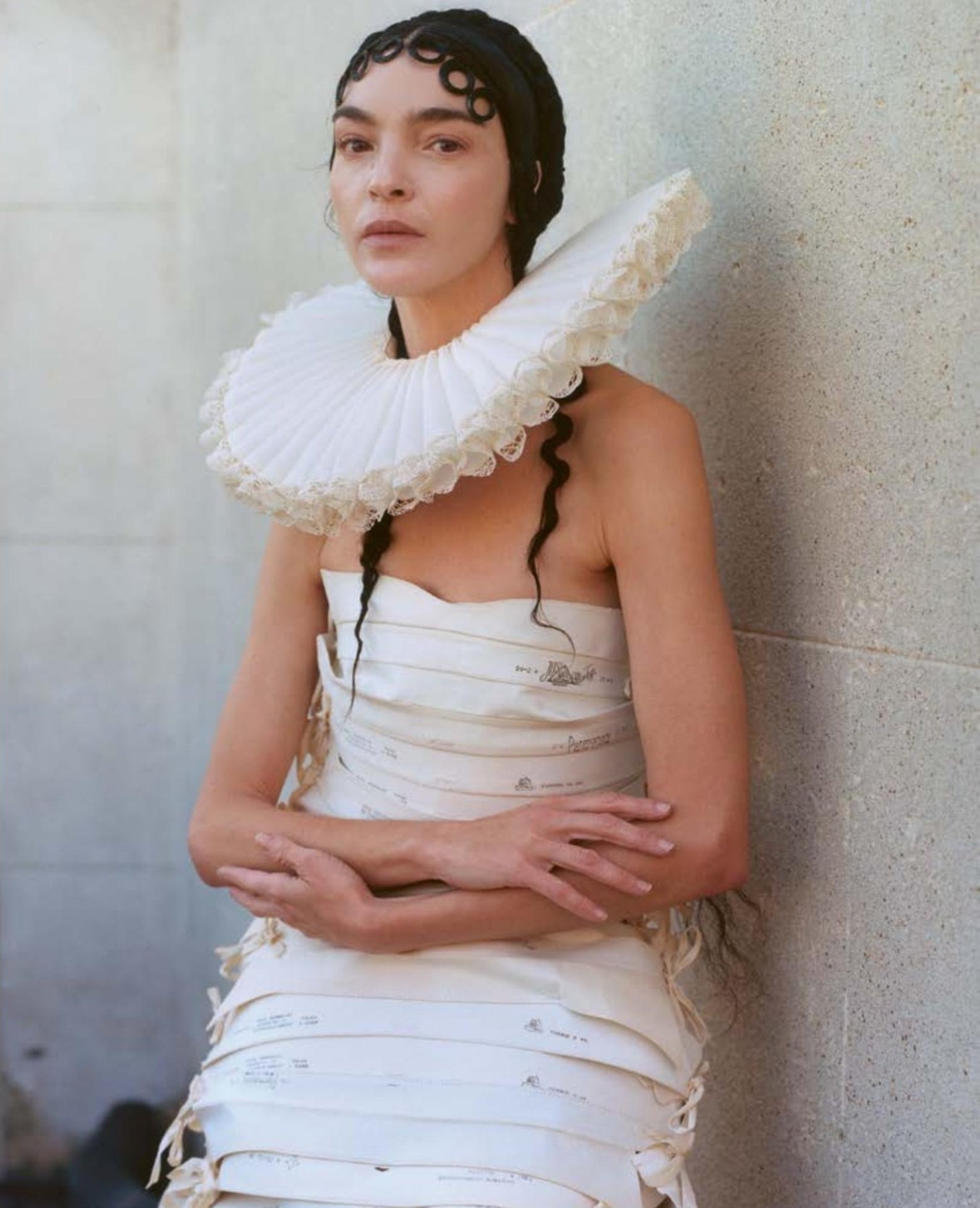
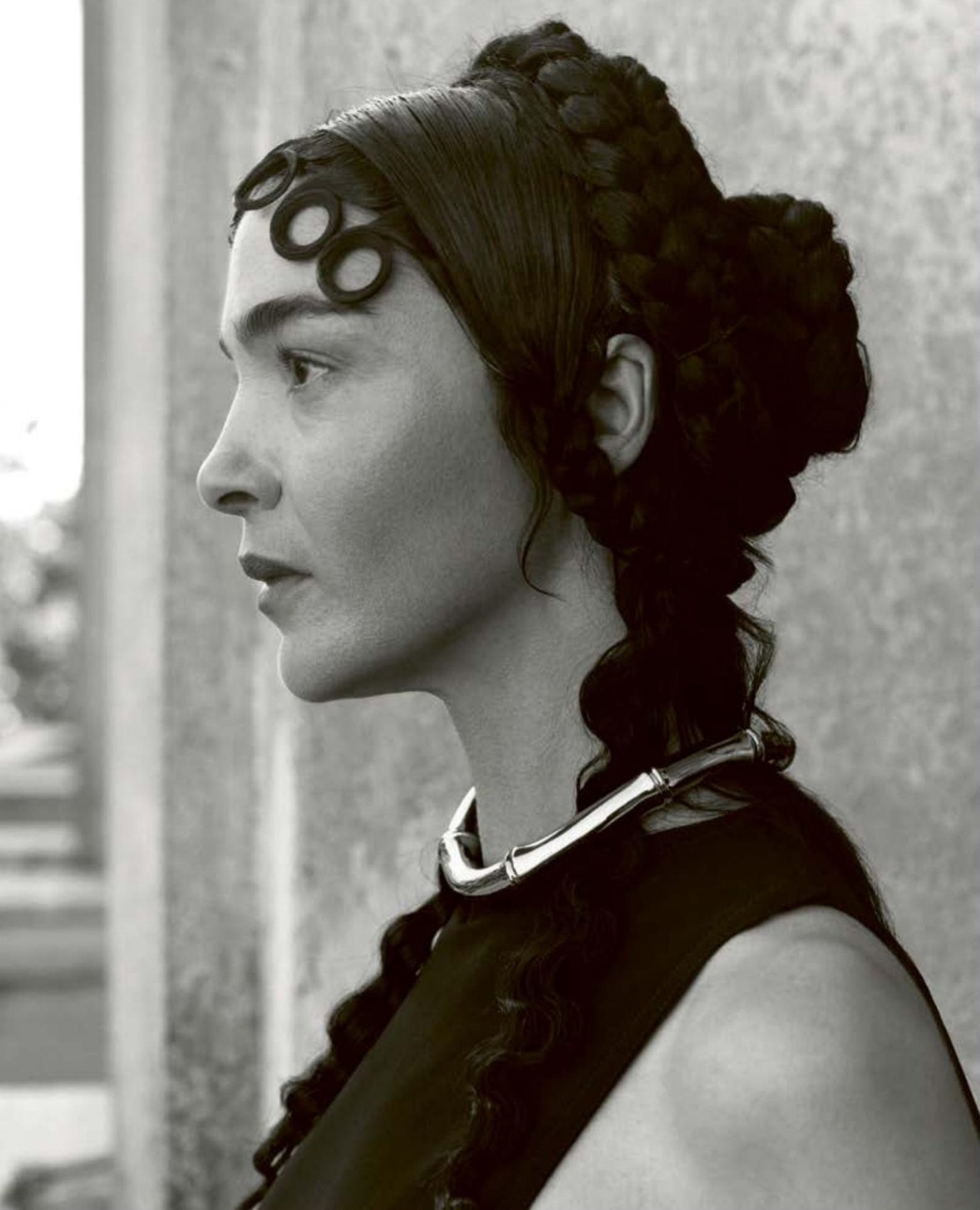
And then?
And then it all happened. It was surreal. And to think I was such a tomboy, with zero femininity.
But if you look at those first pictures, it’s as if I had been modelling forever.
It always came naturally to you.
Born to be. Once, my daughter asked me, “How did you learn to walk like that?” And I told her, “I don’t know, love. I put on heels and I just did it.” It’s strange when I think about it.
You were lucky you had a personality that, instead of breaking under bullying, grew stronger from it.
Who knows. . .But I’m so grateful for this job.
Modelling saved me. If I hadn’t found this career, I don’t know if I ever would have found a way to express myself. And I needed a way to express my difference.
Does a model get to express herself? One might think of models as passive figures, just standing there while designers put whatever they want on them. Of course, this is a rhetorical question just to spark your response. [laughs]
I should hope so! Especially the models of my generation—we were models in the fullest sense.
Think of Stella Tennant and Kate Moss; they didn’t just wear clothes—they embodied characters. We were constantly asking ourselves: ‘What’s the role today?’ I wouldn’t say I was the most chameleon-like, but I went through a thousand styles and trends. For me, it was always about interpretation—a game. And at that age, that’s exactly what I needed. For a young girl, it was fun to play along.
Especially because, like all young people, you were trying to figure out who you are. It must have been exciting to try on all these different identities.
I really enjoyed playing that game, because it was still a game at that time—a game I took seriously, though. I’ve always been very disciplined.
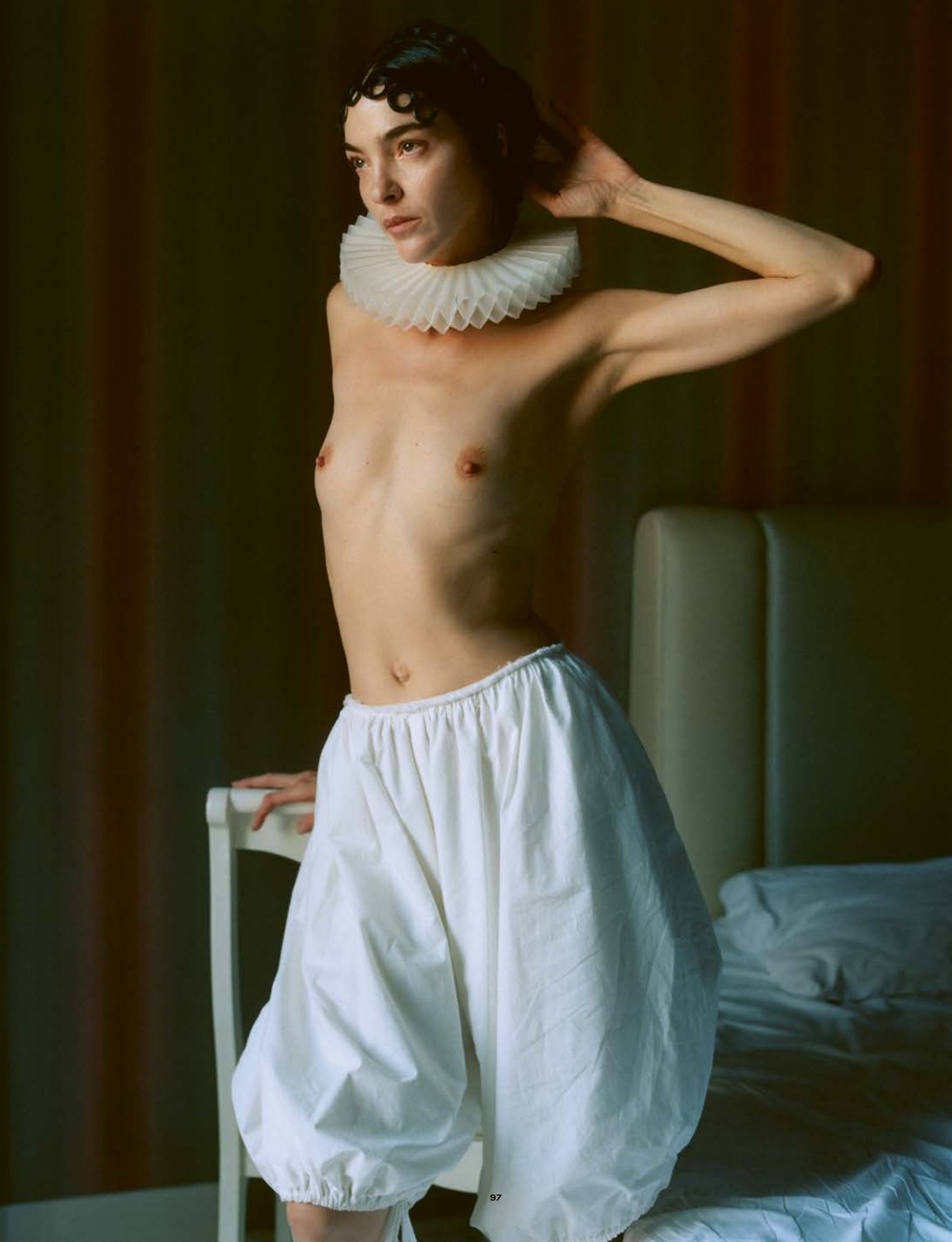
And then, at some point, with Tisci, you became a real inspiration.
I think I’ve always felt like I could give input. From the start, because I was opinionated, great designers would ask me, “What do you think?” Even with Karl, it was like that. I was just a kid when I first worked with him. It was one of my very first jobs—he came to Rome for Fendi fittings. Years later, at 21, I had become the face of Chanel. I assumed he wouldn’t remember me, but he did, and perfectly well. He recalled our Fendi work and said, “I need that one, the petite Italienne.” So I’d go, do my fittings, and for me, it was all a game. I’d buy myself a new pair of shoes and enjoy the moment. That sense of playfulness was always there. With Karl, everything felt light and effortless. He had this sharpness, but there was always humour, a sense of theatre. “What do you think of this?” “And this, beautiful or not beautiful?” It wasn’t just about wearing the clothes—it was about the exchange, the energy, the play.
Sure, but with Tisci, the connection between designer and model reached another level.
I became Riccardo’s muse, yes. But before that, I was his best friend. With us, friendship came before fashion.
Oh, okay—because, usually, friendships between designers and models start on set.
No, we met in our world, of course, but not through work. He was still a student at Saint Martins, and I was already living in London, working a lot. Our connection began outside the industry before the runway ever played a role.
And how did you two meet?
He knew who I was and wanted to meet me, so he invited me for a shoot. I ended up spending the whole day at his place, taking pictures—I even slept there that night. From that moment on, we never slept alone again. We instantly became inseparable. Either I was at his place, or he was at mine.
No way. . .
Yes, yes, that’s exactly how it was—for years and years. At a certain point, when my career took off, I started taking him everywhere with me. At my first Venice Film Festival, I walked the red carpet with him. When I shot the very first cover for Vanity Fair Italia, I brought him along. “This friend of mine is an incredible designer,” I’d say—even though, at the time, he was just starting out.
But his passion was extraordinary, and I watched it grow. He never stopped working. He was a volcano of creativity, constantly erupting. Even at the pub, he’d bring clothes to sew. I was in awe. You could love or not love what he did, but you couldn’t deny his talent, because it went beyond personal taste—it was disarming. He didn’t create for fame or obligation. He created because he had no choice—it was the one thing in the world he couldn’t not do.
That memorable Givenchy woman you embodied in the mid 2000s to early 2010s, mysterious, sensual, almost untouchable—was she you, or a character?
She was, first and foremost, a Riccardo woman. Of course, he was a sponge—aspects of me found their way into her, but he amplified them a million times over, like spotting an embroidery detail on something I picked up at a London flea market and turning it into an entire dress. When you spend that much time with someone, it’s inevitable—everything seeps in. The way he watched me wear a vintage piece found in a market, the energy of a summer trip, the rhythm of a song we played on repeat—just fleeting moments, impressions, details. But without that unstoppable river of talent—without the ability to absorb, reinterpret, discard and refine—it never truly becomes something.
Fashion was merely the surface of our connection. Our true bond—our complicity, our artistic expression—ran much deeper, into something far more profound.
Like what?
We took photos, travelled, made short films that only we know about. . .But what is art, really? Is it a painting, a piece of music? Does it have to be something tangible—something you can see, touch or own? Or can it exist in the space between two people who choose to create together—something timeless, something that never truly fades?
What I had, and still have, with Riccardo is a work of art in itself—a grand, ongoing performance that will stay with me forever.
Performance?
We used to do pretend fashion shows in old factories, with my parents, his two sisters and his mother as the audience. I’d dress up, do my makeup, undress, change outfits again, while he played the music. Then there were the wild raves—hidden under bridges in Cuba, in the middle of nowhere.
So yes, of course, we remember our beautiful Givenchy campaigns, but ultimately, who cares? The highest moments of our artistic partnership were something else entirely— things only we know, things that will always belong just to us.
You were fortunate to have met.
These kinds of encounters are rare blessings. Not everyone gets to experience them. Yes, they’re powerful. It’s something profound.
A bit like true love—not everyone finds it in a lifetime.
Ah, true love. . .you touch a brand-new chapter in my life!
In October 2024, you married Olympic pole vaulter Claudio Stecchi in a romantic ceremony at Villa Valguarnera in Bagheria, Sicily, wearing a custom Dolce & Gabbana Alta Moda dress made from upcycled Sicilian fabrics. Should I infer from your words that this is your first true love?
Yes. Imagine that! I’ve always been the kind of woman who’s lived so much that I would say, “Men?!” Sure, I enjoy them, but deep down, I never truly cared. Heartbreak? It never belonged to me—it wasn’t part of my story.
Wish I could say the same!
You see, I’ve experienced pain so profound that the sting of a man leaving me doesn’t even leave a mark. If you show no real interest, betray me, or simply decide you don’t want to be with me anymore. . .
—there’s the door.
Exactly! [laughs] In my mind, it’s like a balloon pricked by a needle—deflated, gone. You no longer exist to me. Pain is just a part of life, and eventually, you heal. There’s nothing you can’t fix—except death. That’s the only thing beyond repair. So, unless you kill me? Who cares?! Next. And then, after having a child, everything shifts. The love you feel for them is so overwhelming, so all-consuming, that everything else fades in comparison. I never thought I’d have a child, but now that I do, I can say—it’s the most visceral, undeniable love there is.
If you don’t mind me asking—what has been the deepest pain in your life, if not romantic heartbreak?
I lost my brother when he was very young to a terrible illness. I was only twenty-two.
I didn’t know. . .I’m so sorry.
I don’t speak about it much—I don’t like sharing my private life. But these are the kinds of experiences that mark you so deeply that it puts everything else into perspective. And we should remind ourselves of that when life throws its punches. Sensitive people tend to dwell on things, but it’s so important to learn to carry what isn’t truly significant with a bit more lightness.
Very true. Is your marriage to Claudio your first?
This is my first marriage, and I hope it’s my last! Before this, I never cared about getting married. When I notified my daughter about my engagement with Claudio, she told me, “I never pictured you as the marrying type.”
She sounds like quite a character!
Oh, if only you knew her. She’s tough, always has been, and honestly, I never imagined it either. But we all change, don’t we?
Indeed. What are you going to do after this conversation?
I’m off for a walk with my dog—whom I’m also absolutely in love with. Wait, listen to this. . .[loud snoring sound]
See? Even my dog has embraced this Florentine lifestyle!
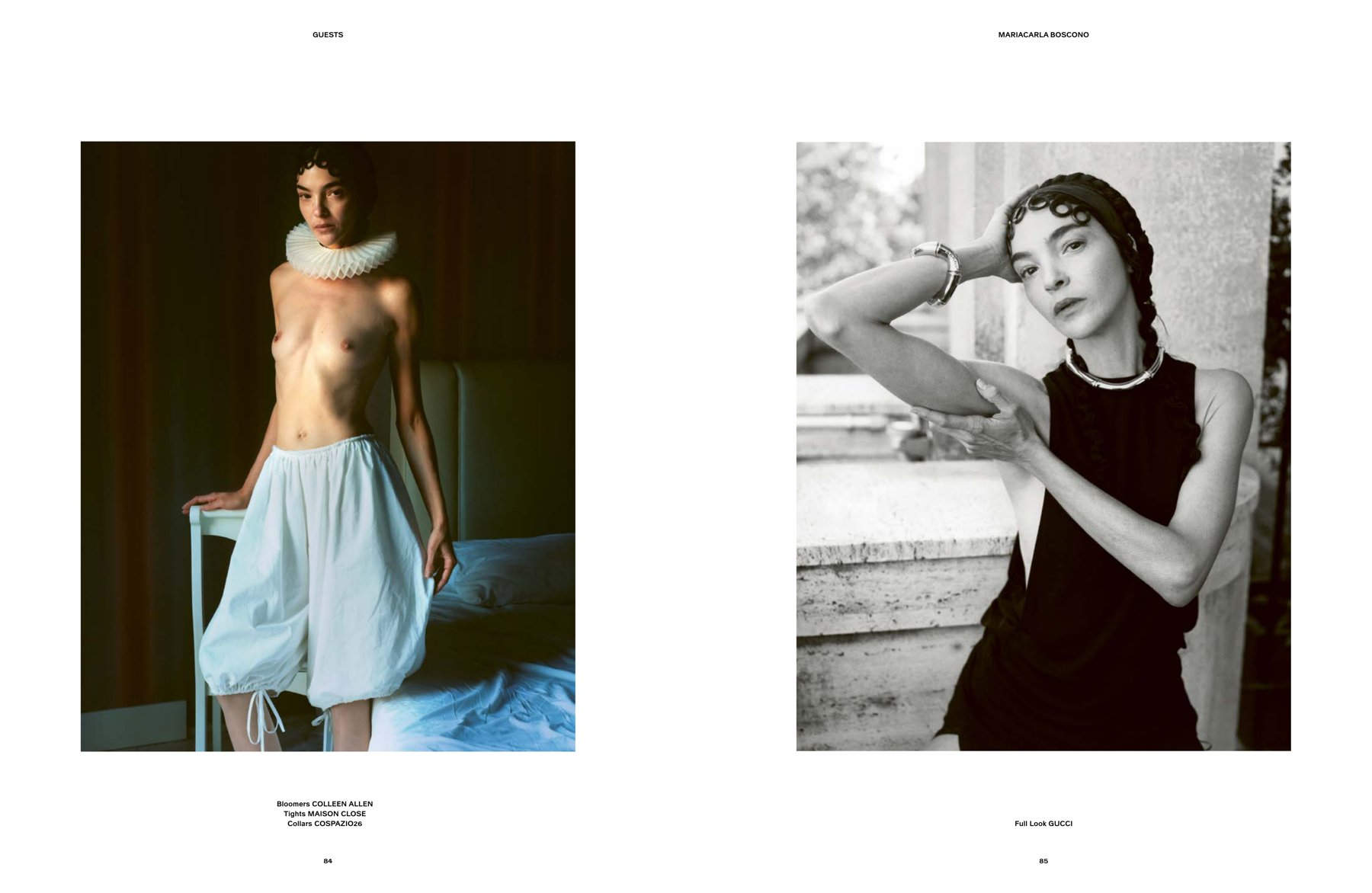
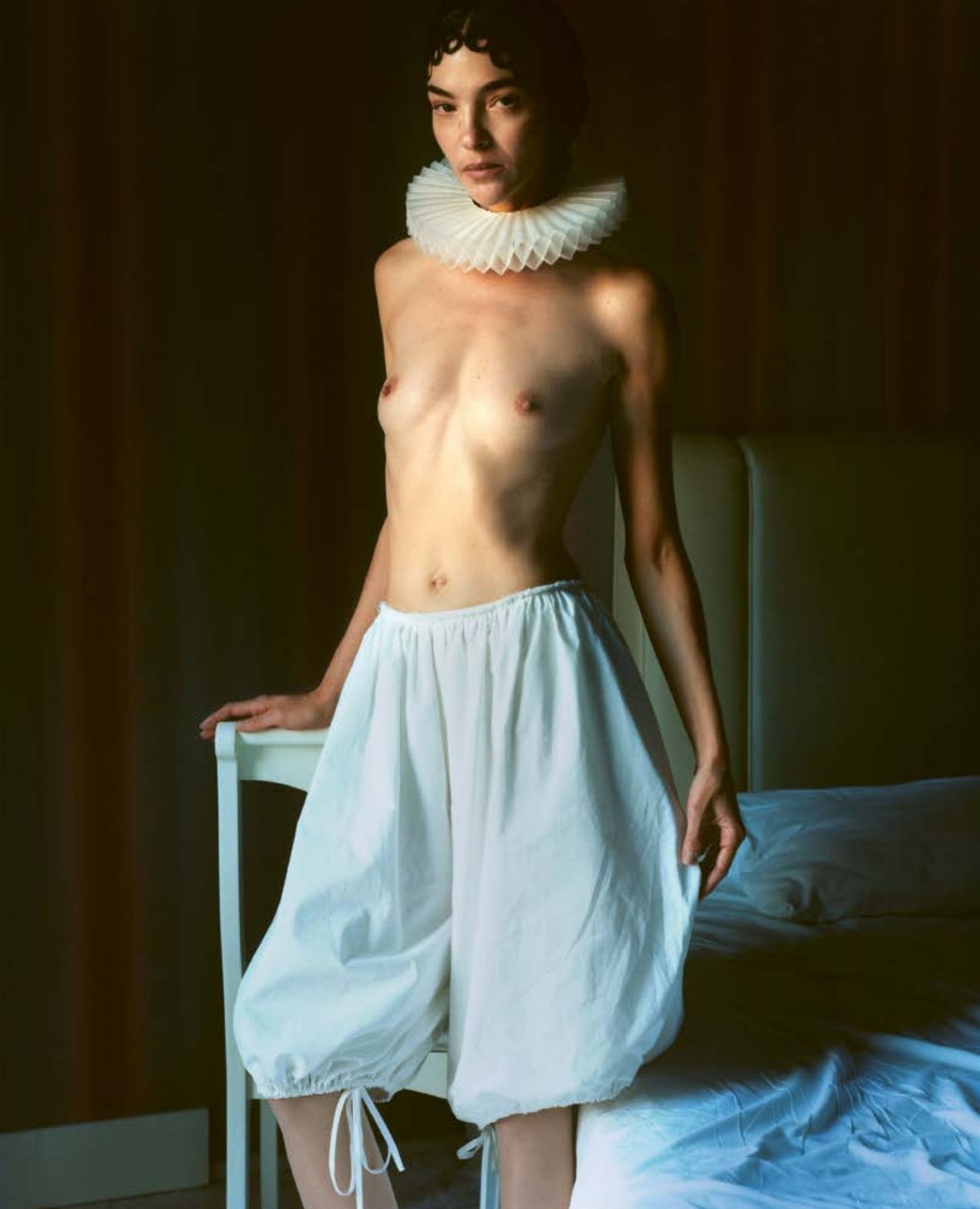
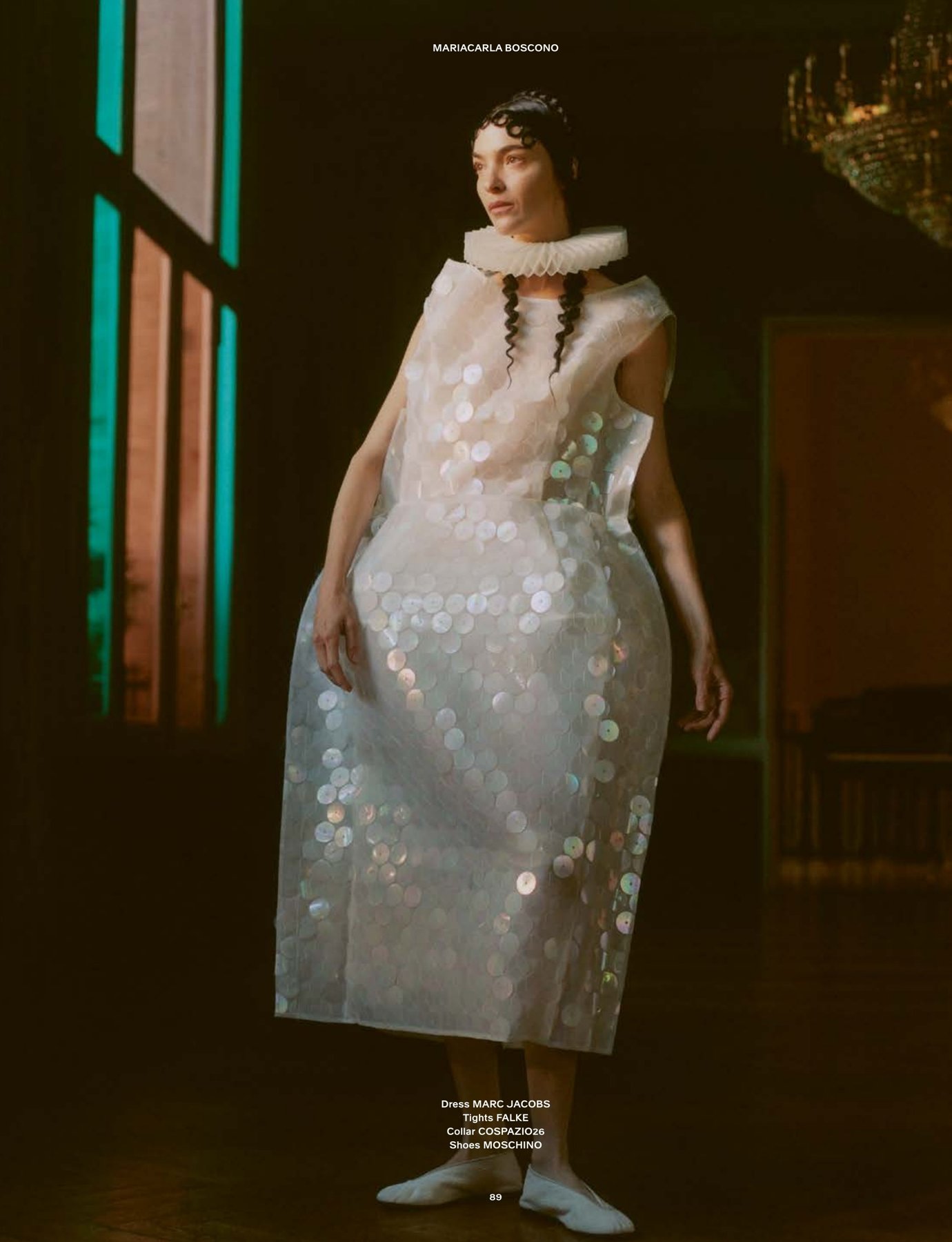
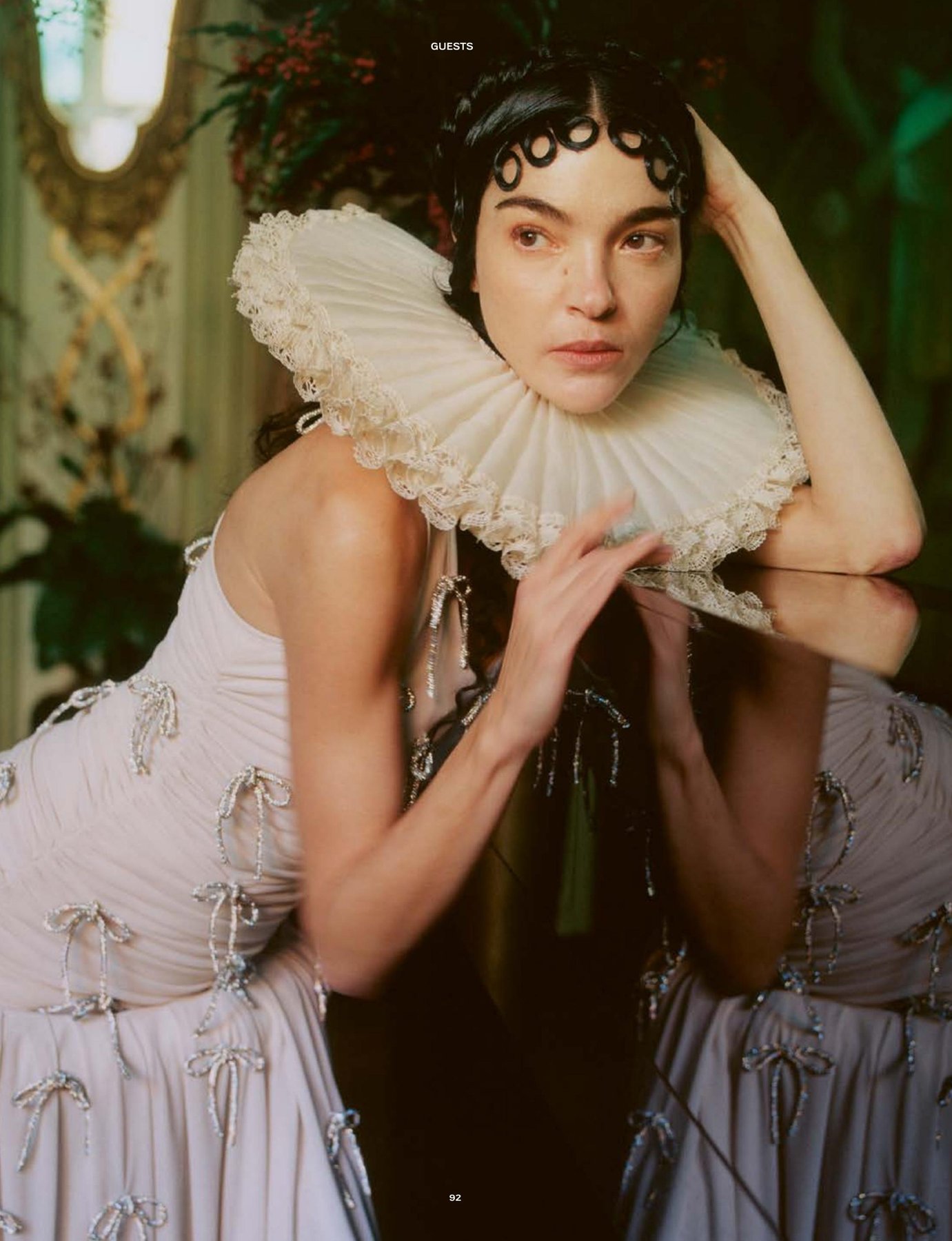
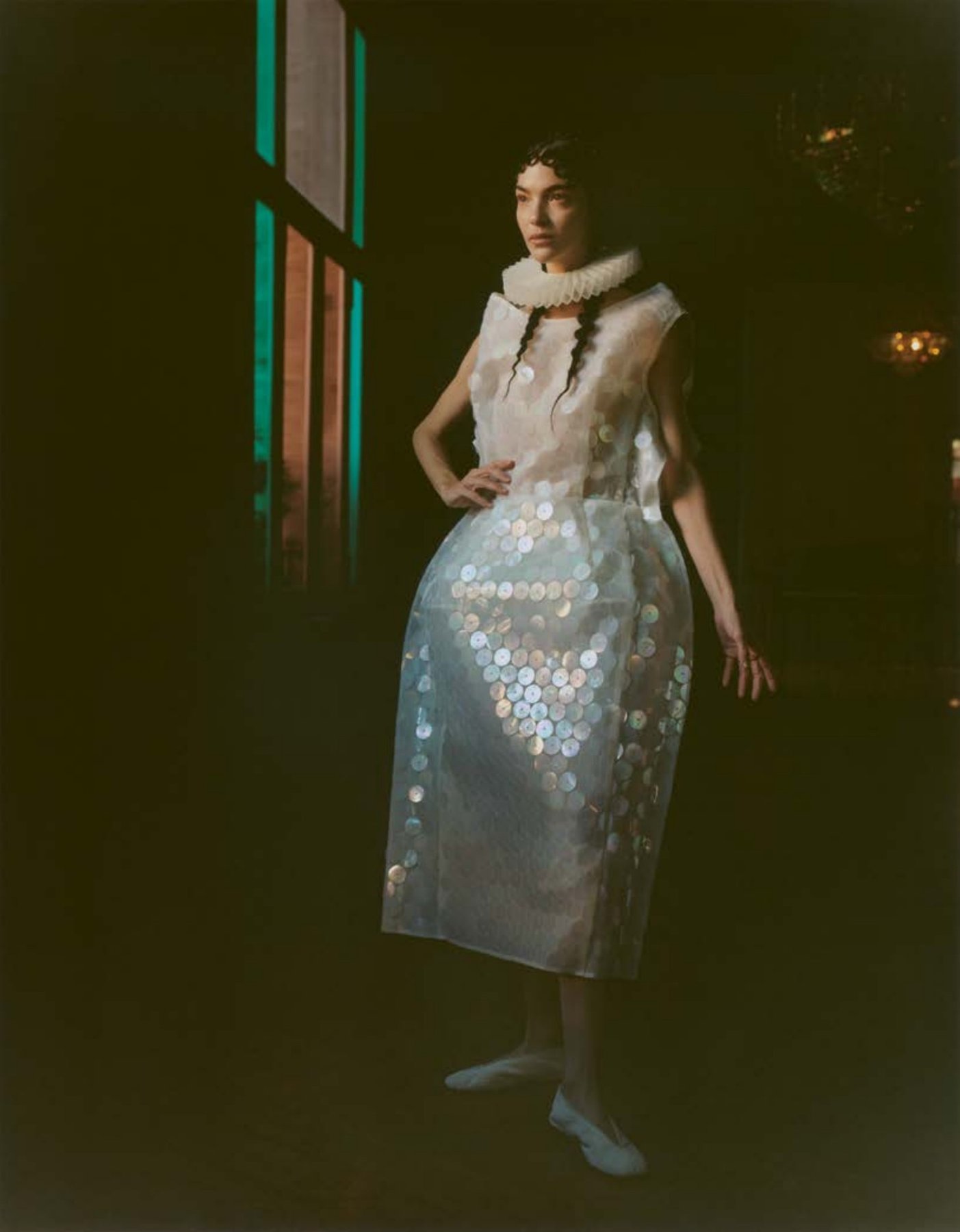
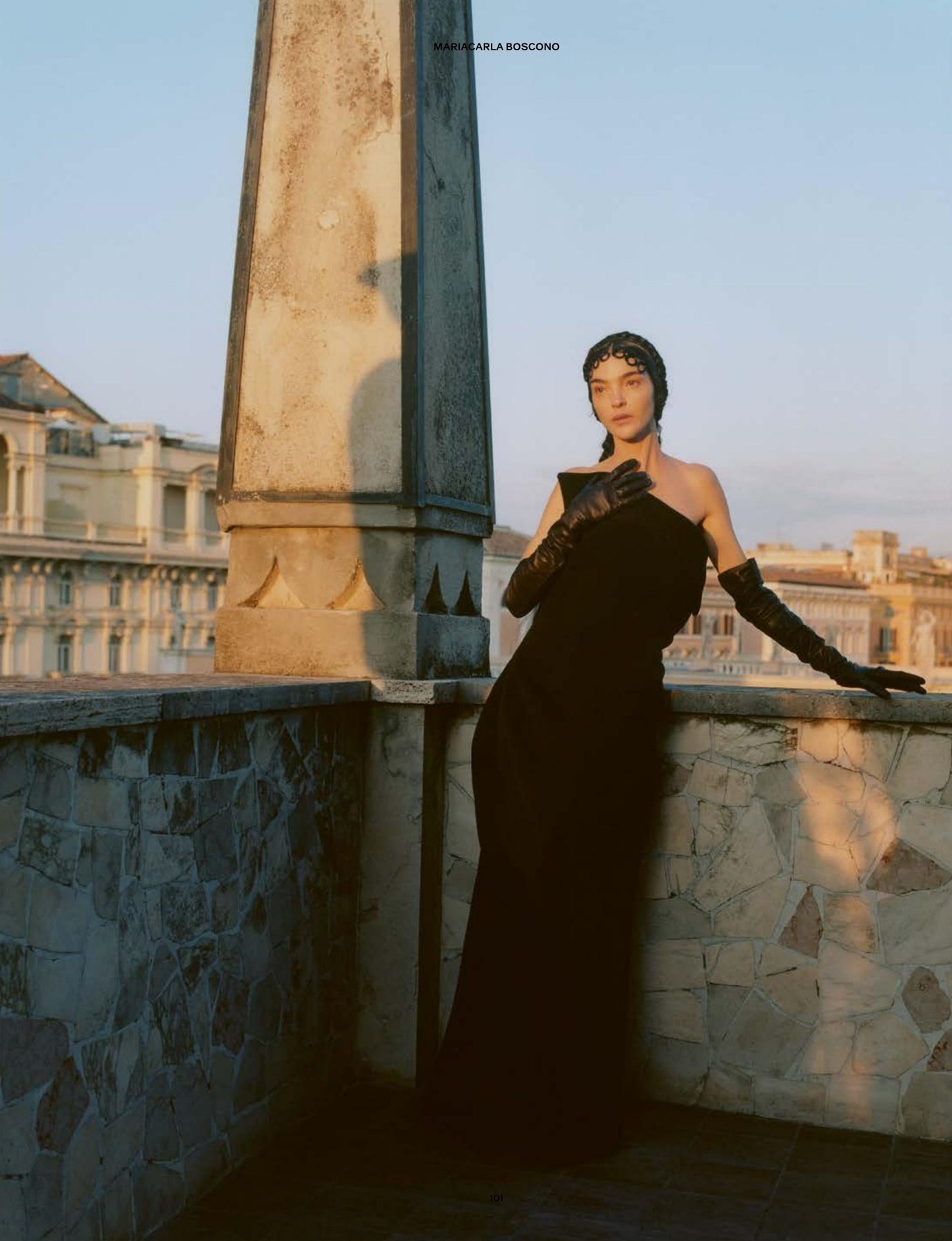
Location Roma. Photography Theo de Gueltzl. Styling Clare Byrne. Casting Bert Martirosyan. Talent Mariacarla Boscono / Women Paris. Hair Ramona Eschbach. Makeup Ammy Drammeh. Production Lumen. Fashion: Acne Studios, Gucci, Oude Wang, Alaïa, Khaite, Marc Jacobs, Hodakova, Balenciaga, Colleen Allen, Maison Close, Falke, Moschino, Amato; collars and wristlets Cospazio26.
Interview by Michele Fossi
Published in The Travel Almanac #26 «Free Will», 2025