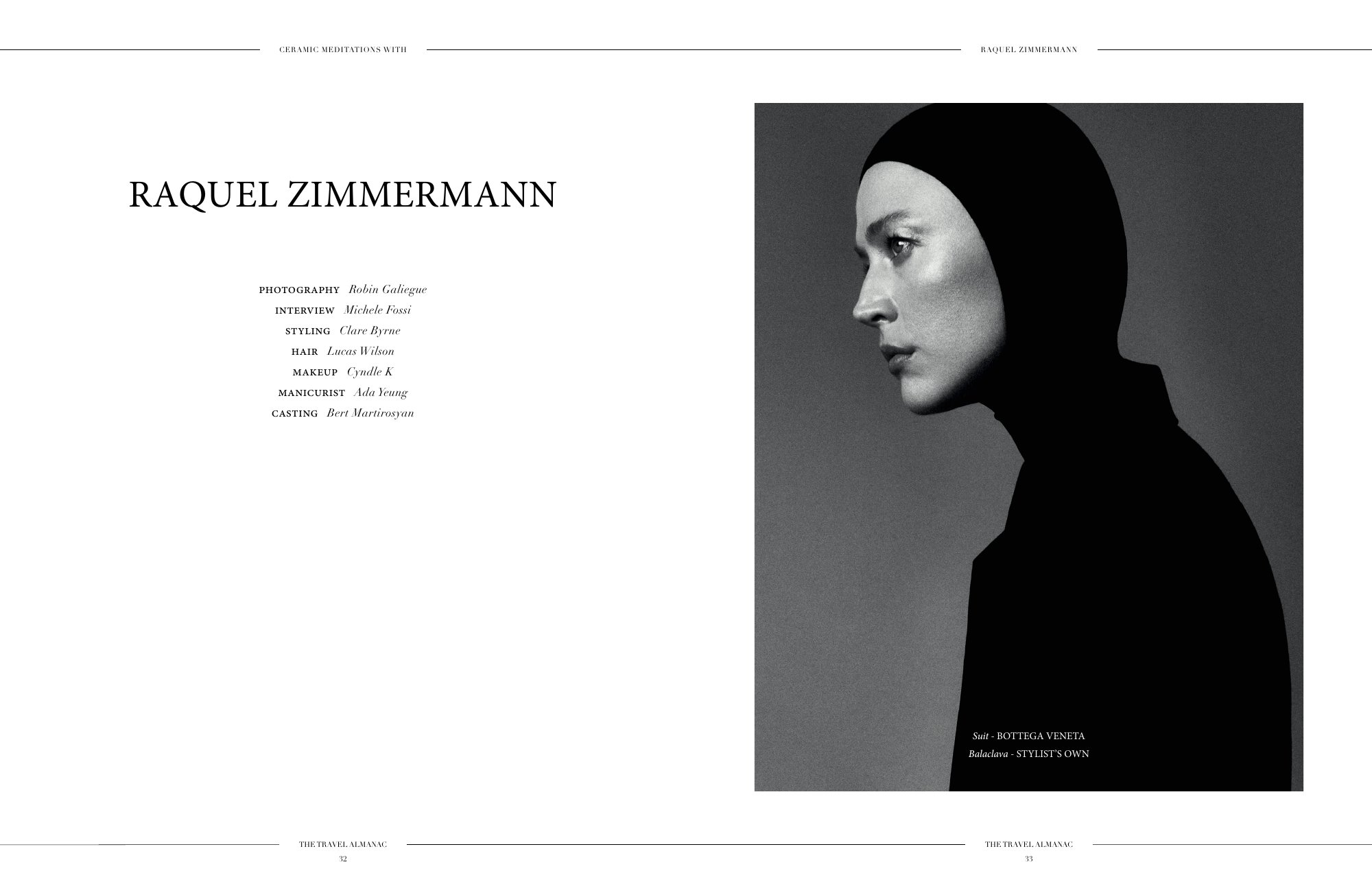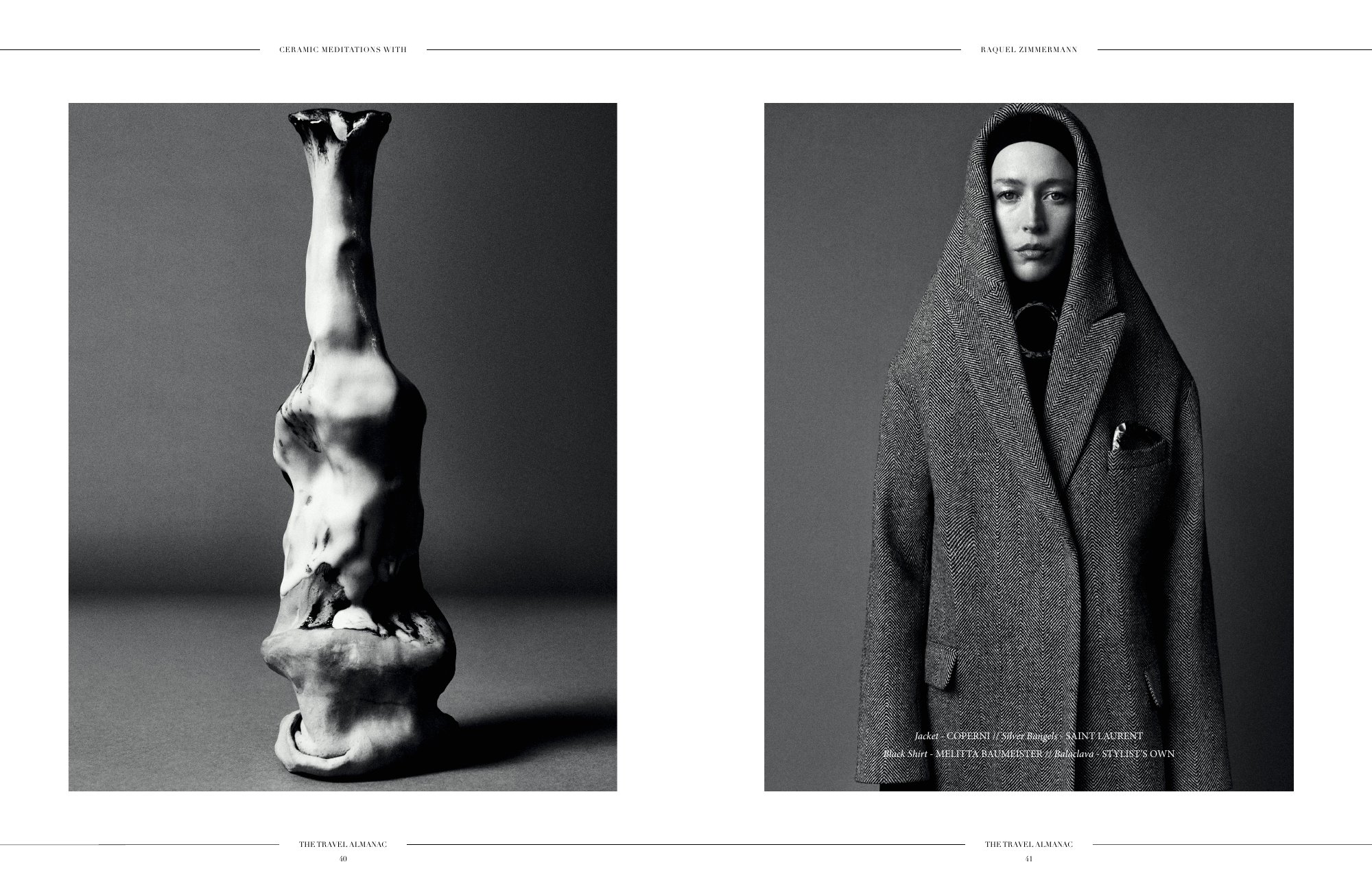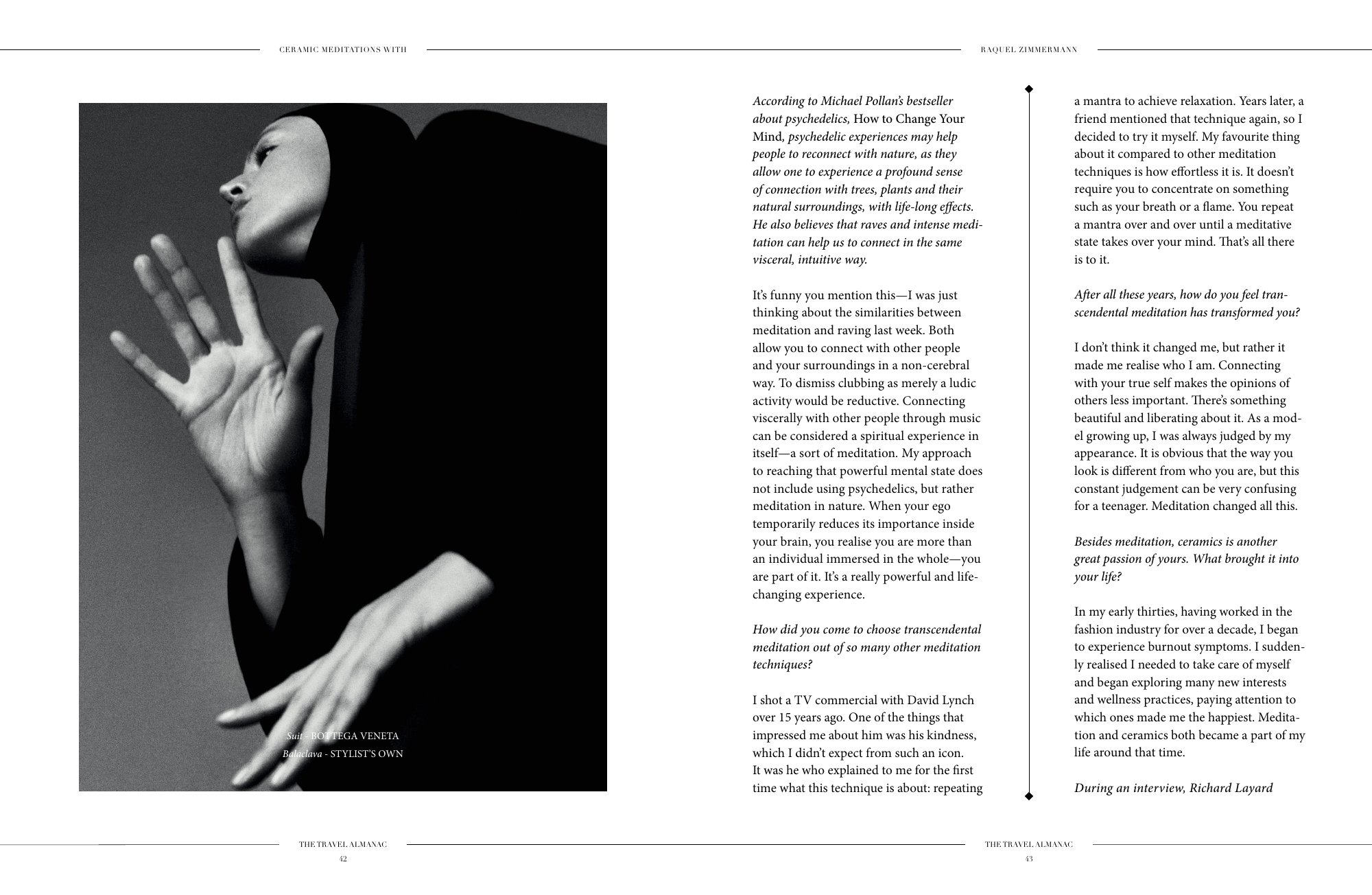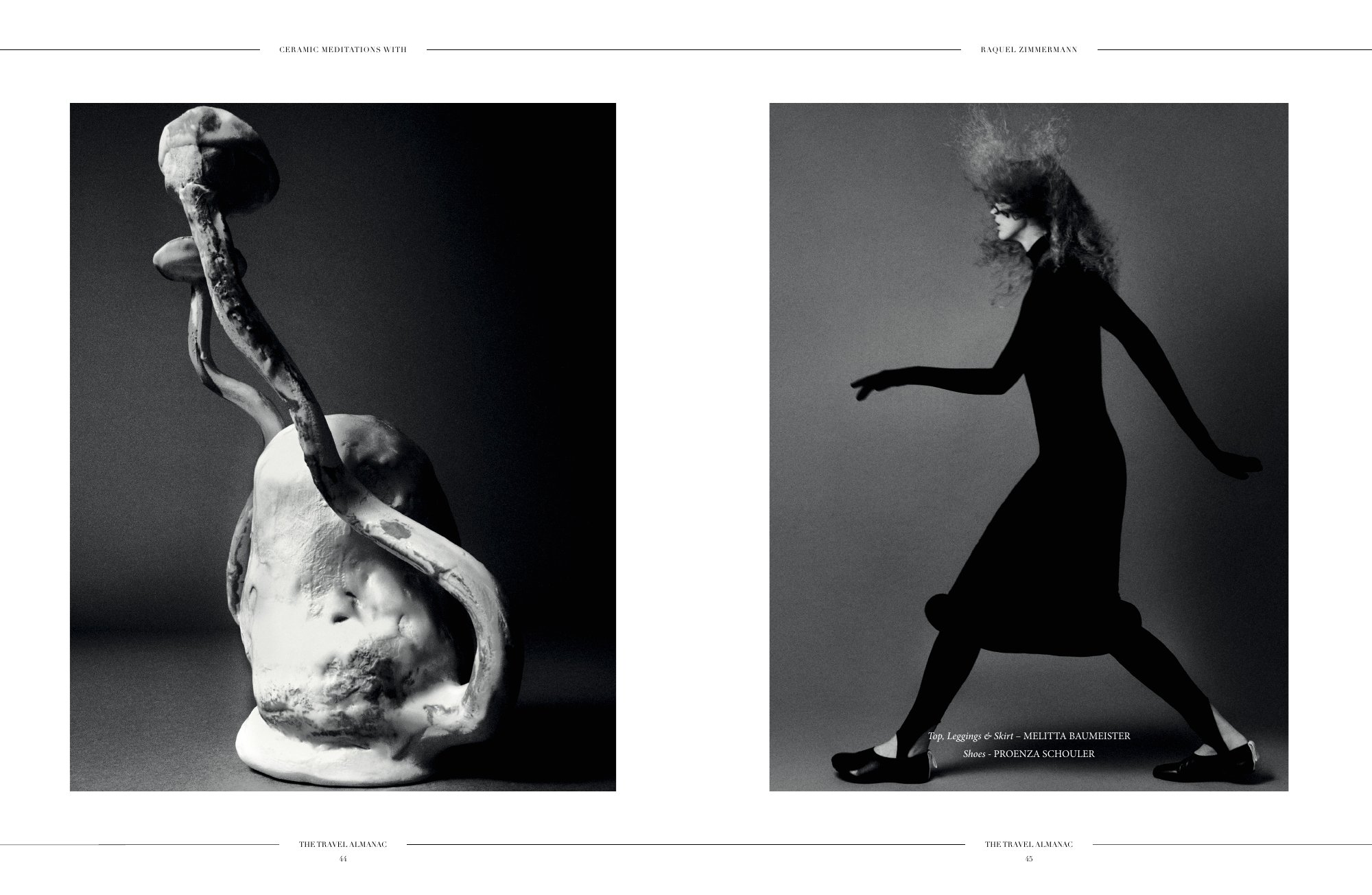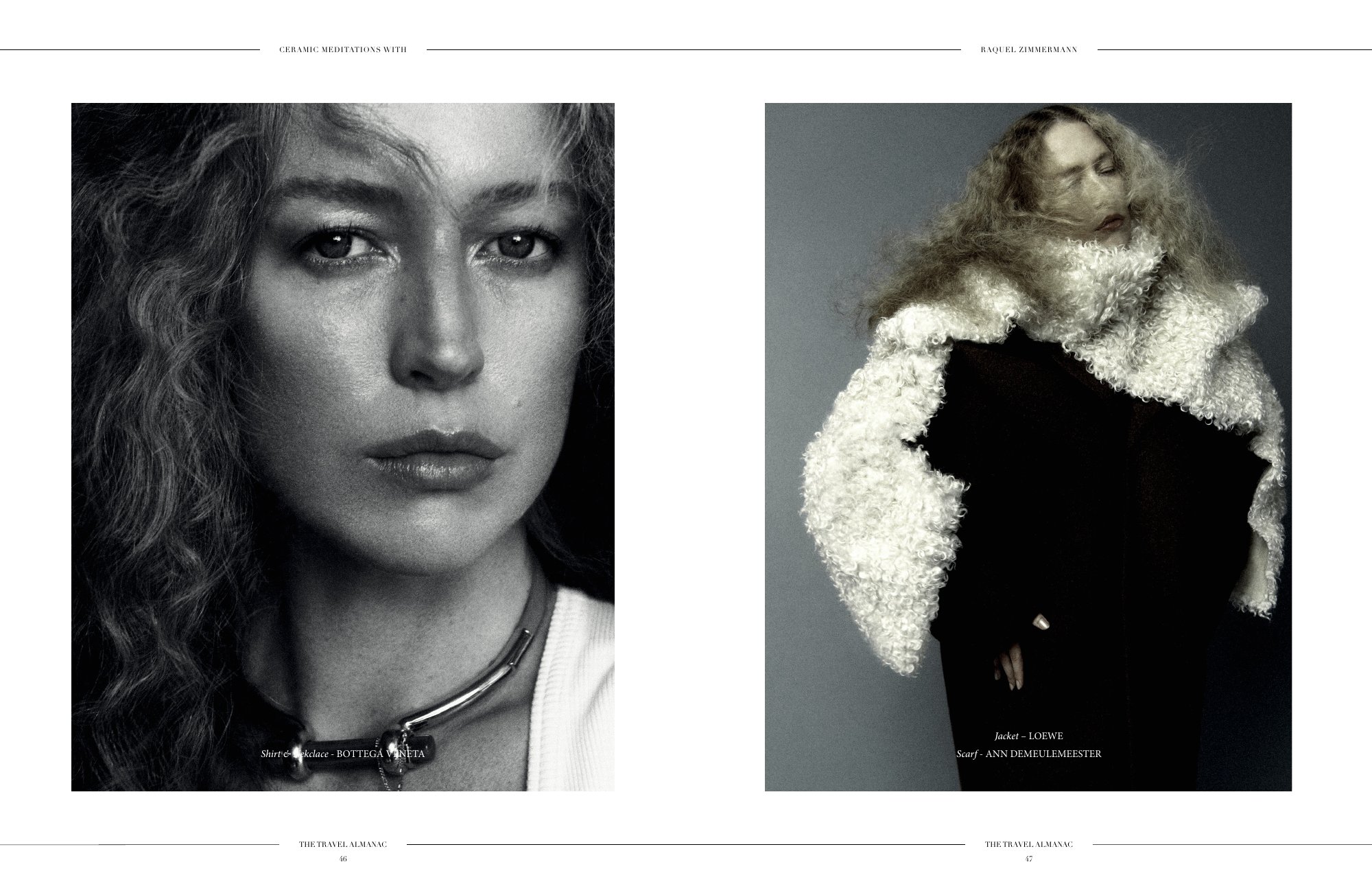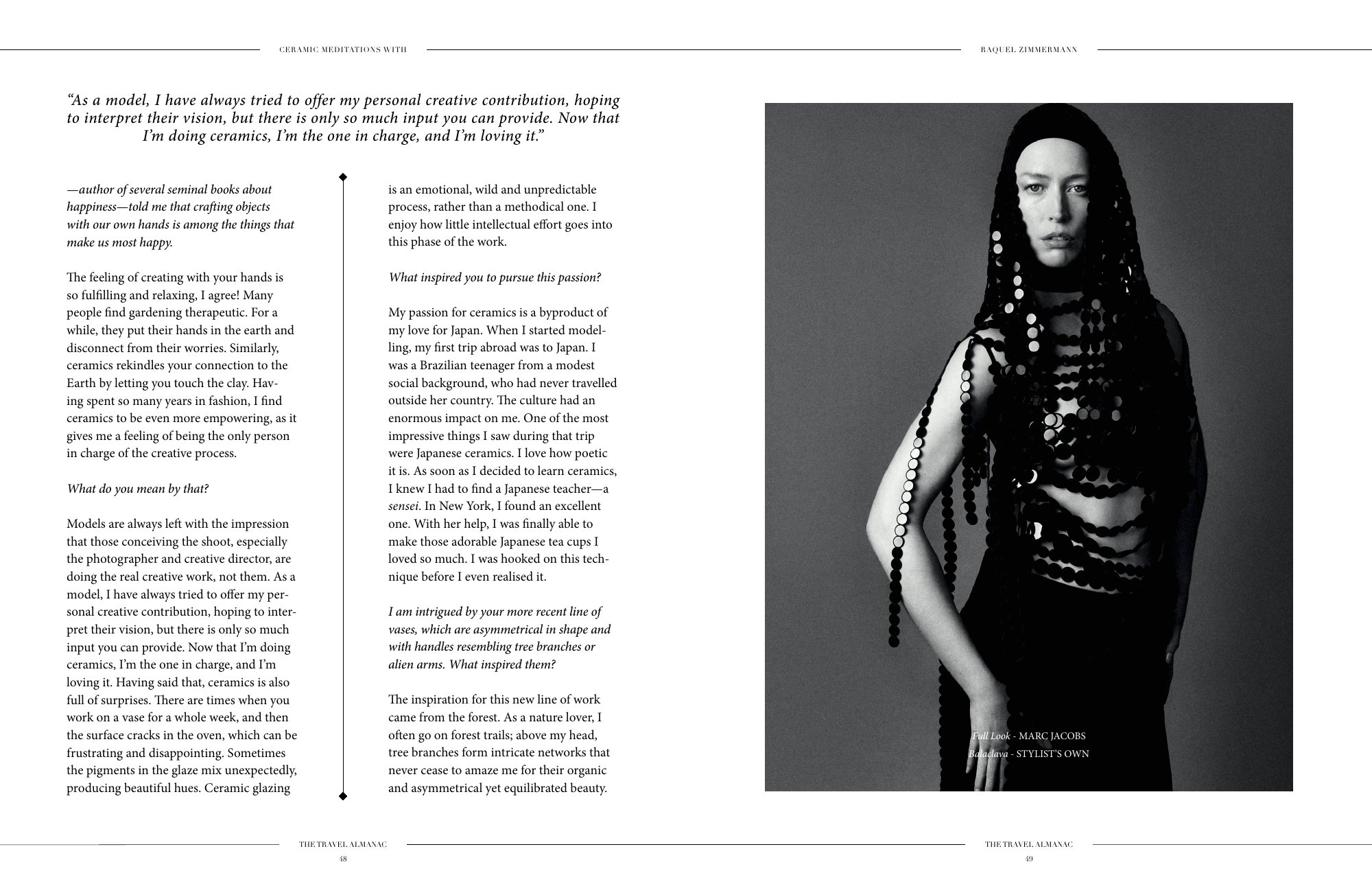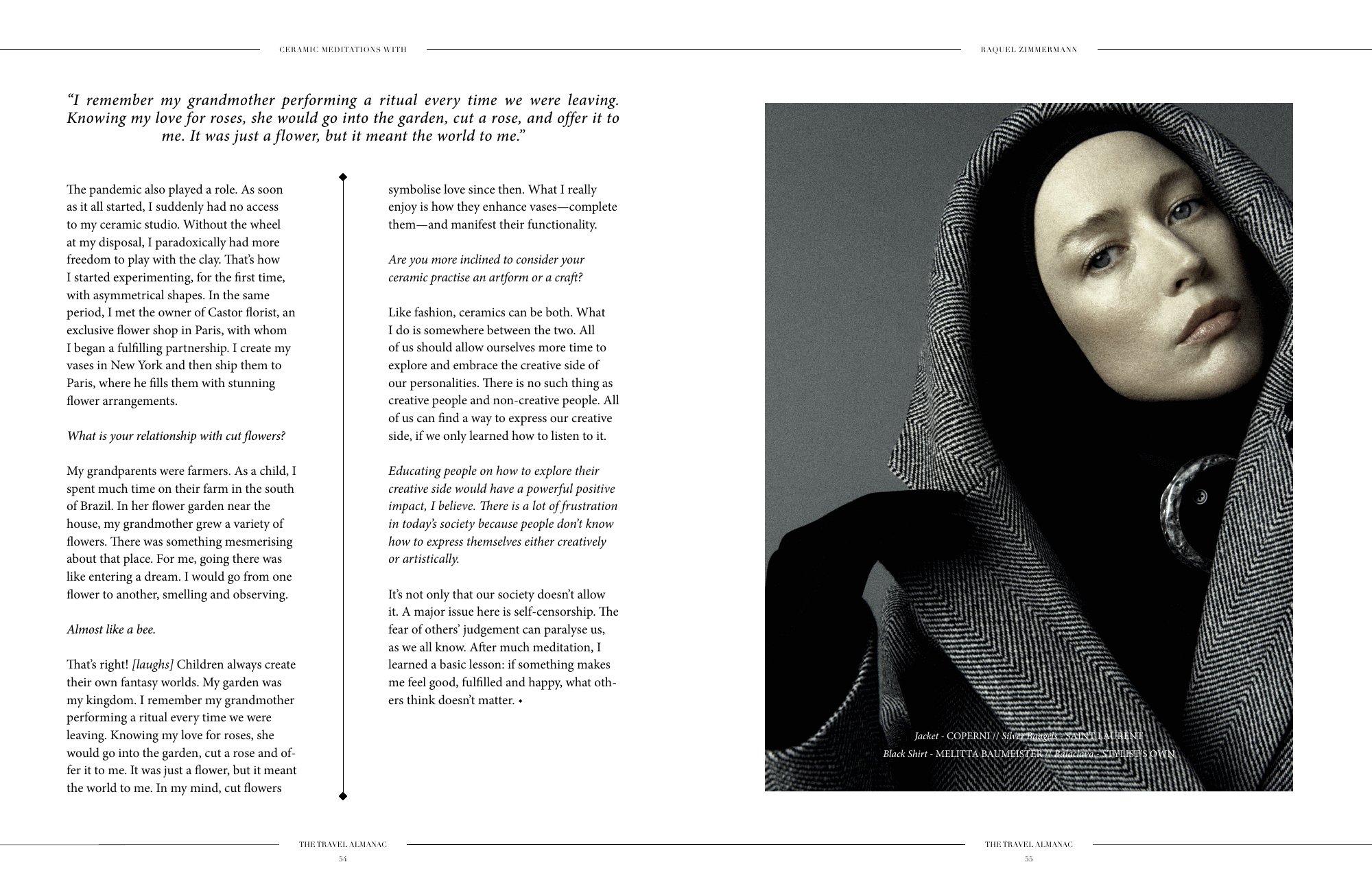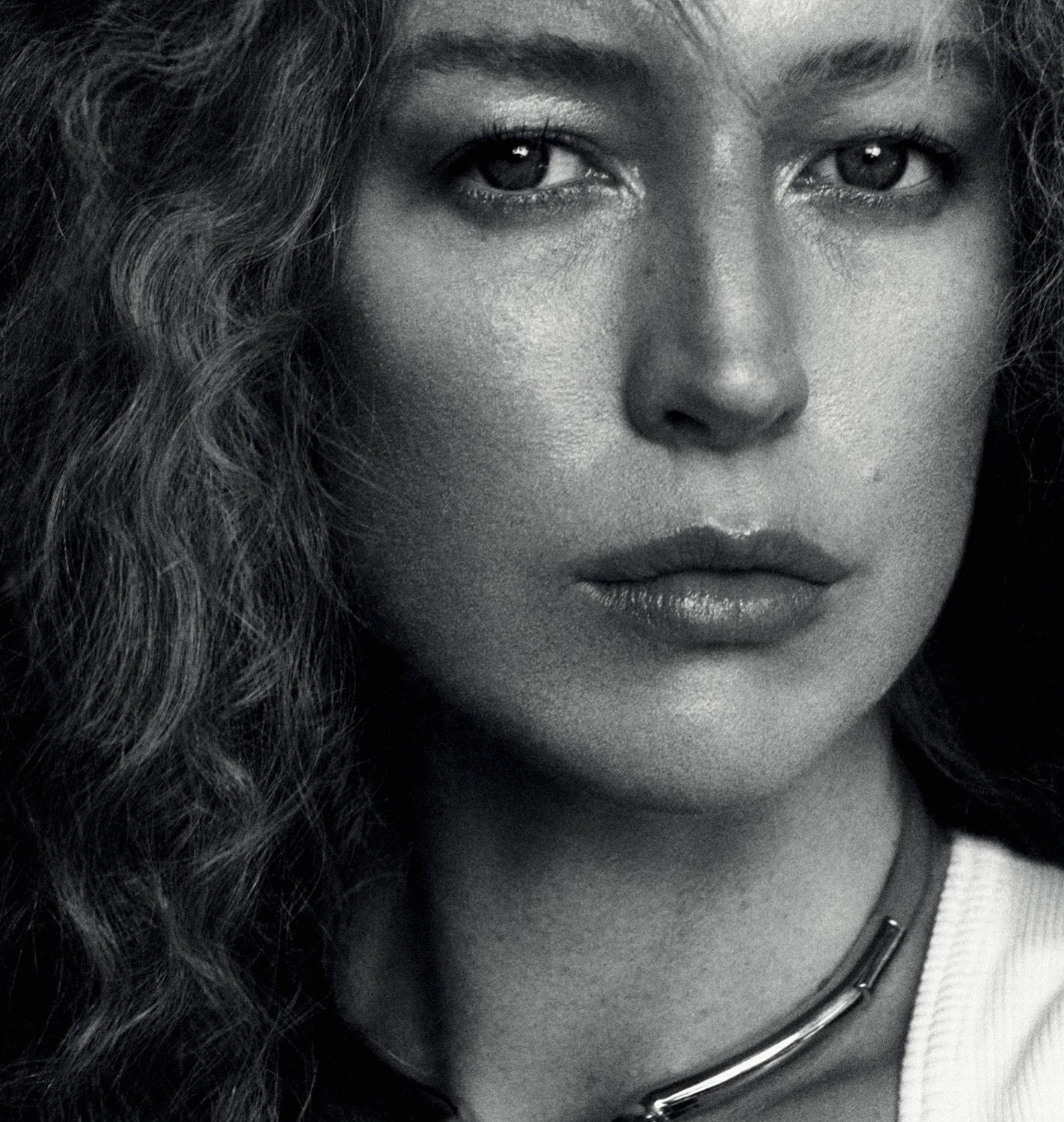
Described as “an artist in front of the camera” for her willingness to bring her own creative input to photoshoots and embody different characters, Raquel Zimmermann belongs to an elite group of models who always exceed photographers’ expectations. Born into a modest family in the southern part of Brazil, her journey to the Olymp of fashion has the air of a fairytale. An agency in Porto Alegre discovered her when she was just 15, propelling her onto the runaways of Tokyo and Paris. But it was a cover for the September 2000 issue of Vogue Italia that launched her career in earnest, granting her overnight worldwide visibility. In the following years, she shot campaigns for brands such as Prada, Alexander McQueen, Versace and Balenciaga, and frequently appeared in Italian, American and French Vogue. Between December 2007 and February 2010, she was ranked number one on the international model-ranking website models.com. In addition to her legendary professionalism and versatility as a fashion model, Raquel is also known for her rich spiritual life. Twice a day, she practises transcendental meditation, a relaxation technique she jokingly calls her “vice.” In this exclusive interview with TTA, Raquel talks for the first time about her other great passion, ceramics, along with her quest for happiness, love of nature and, among other things, how Steven Meisel changed her life forever.
What is Raquel Zimmermann’s definition of fashion?
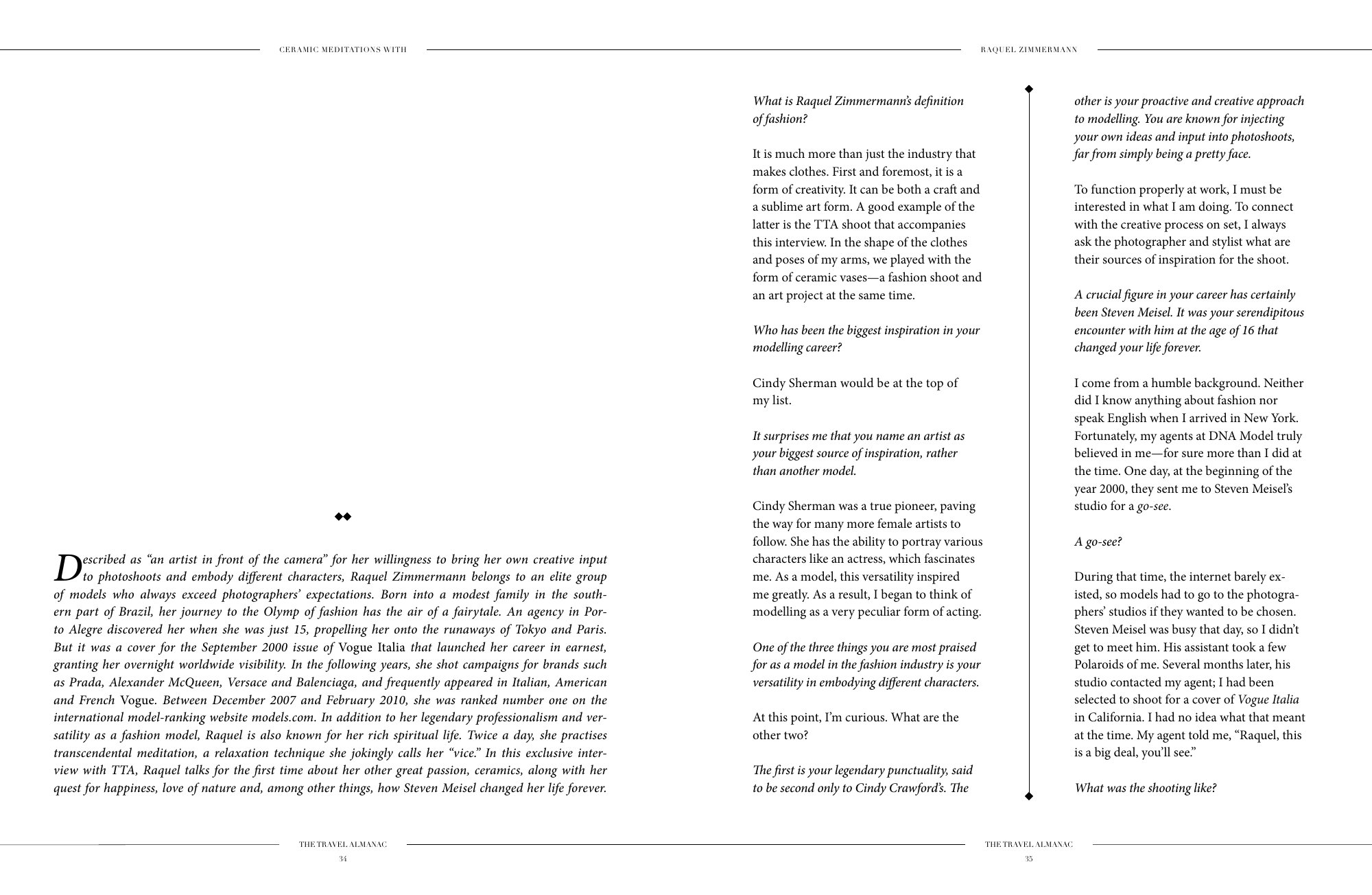
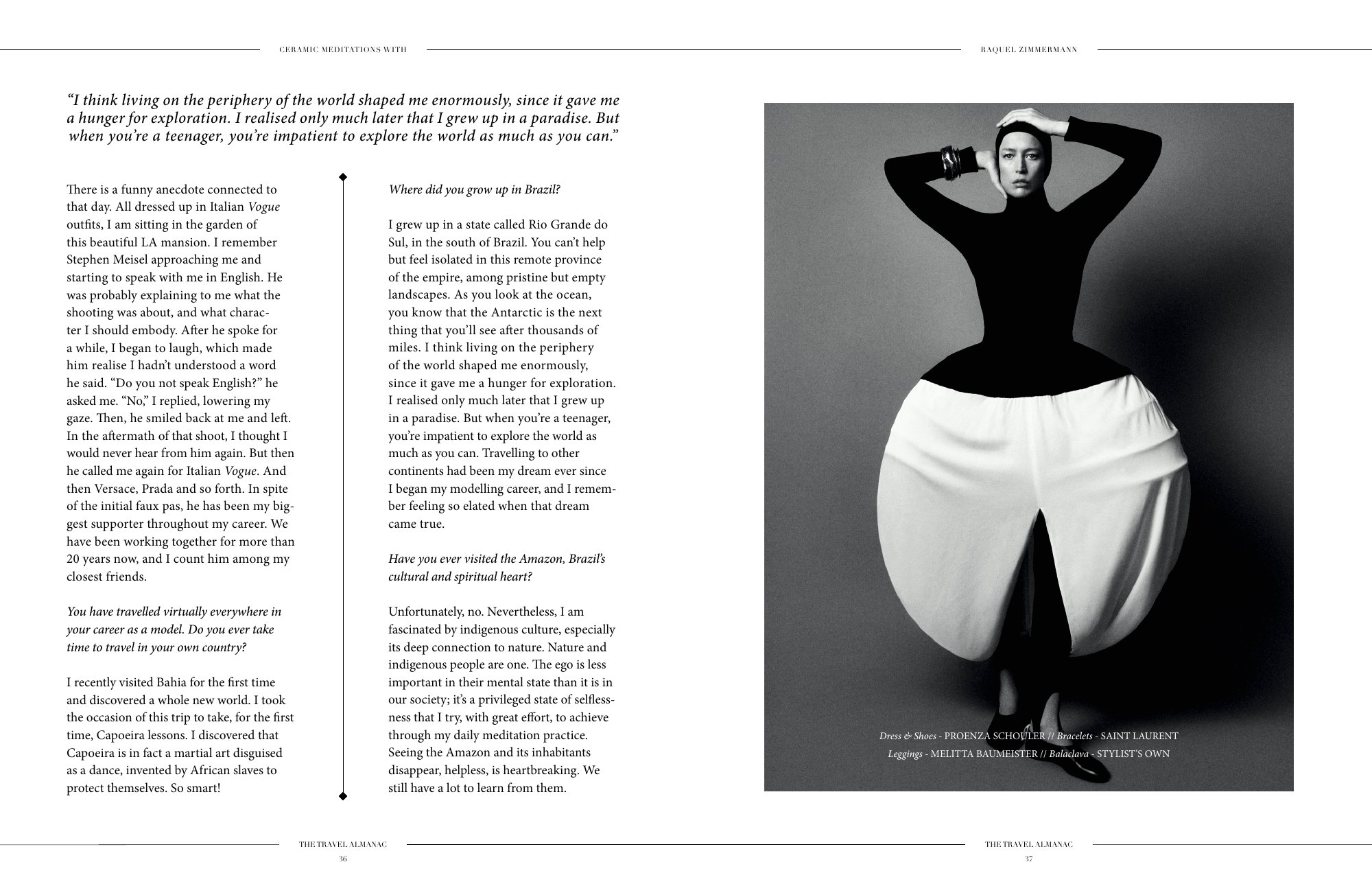
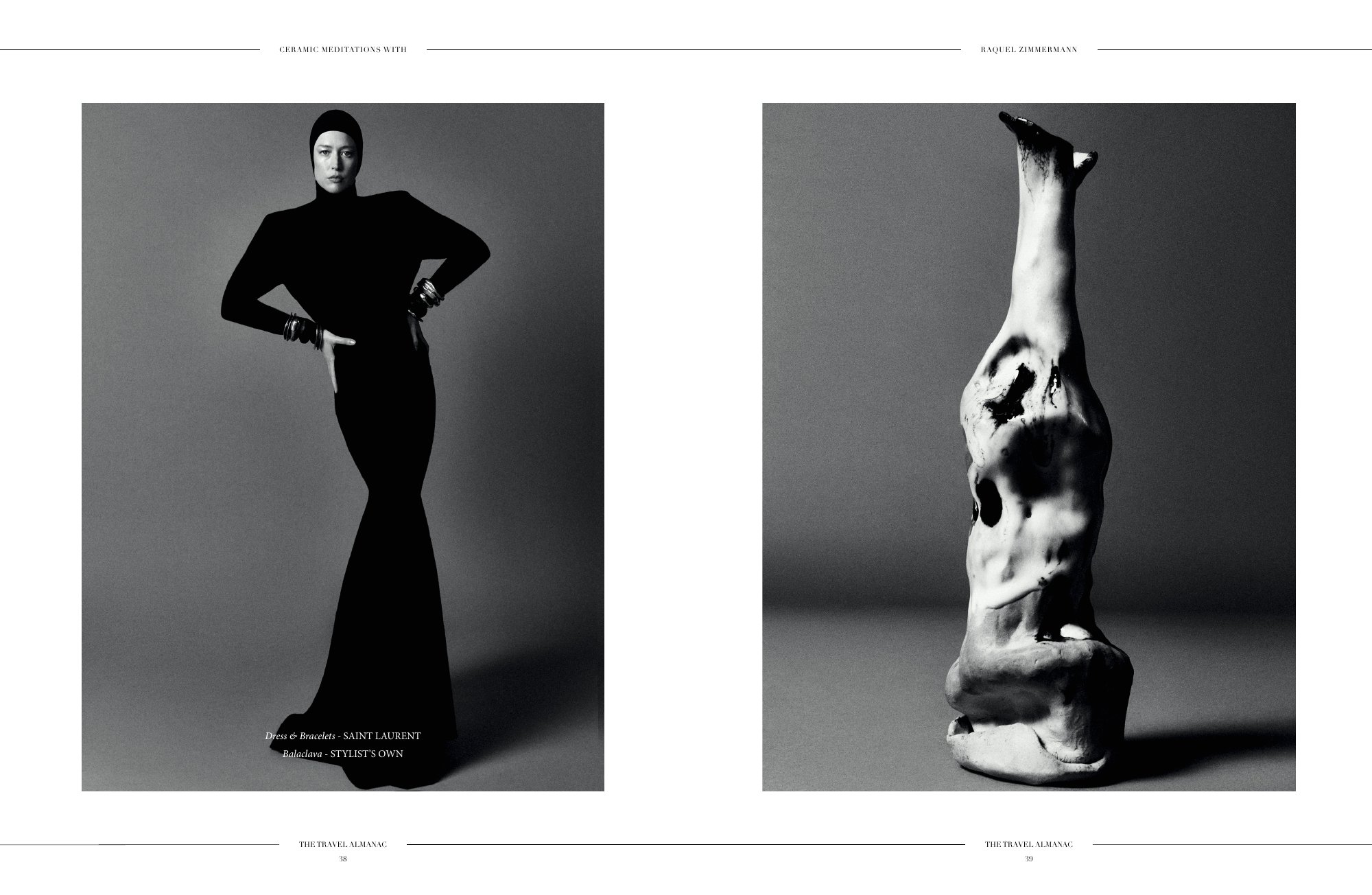
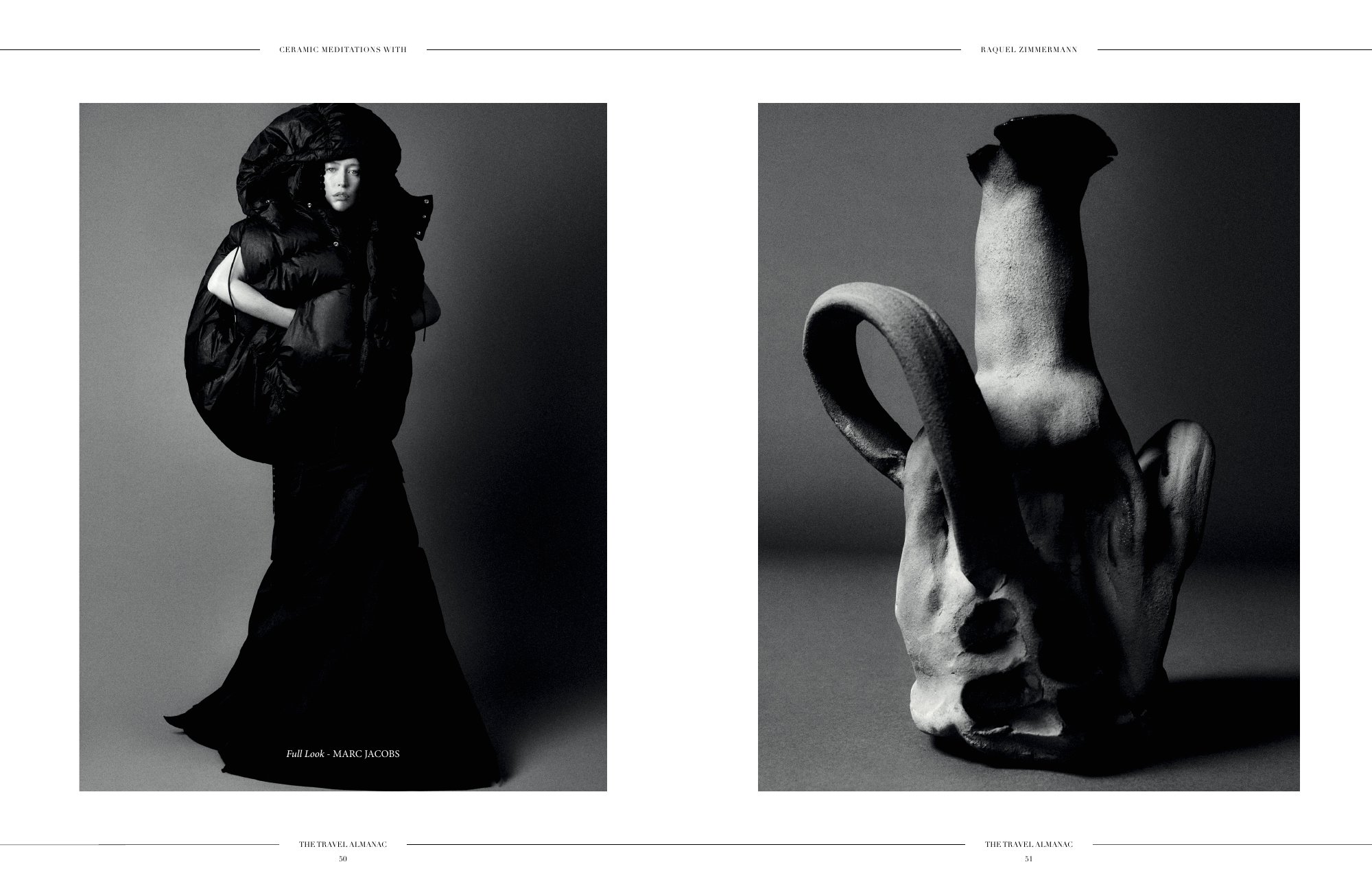
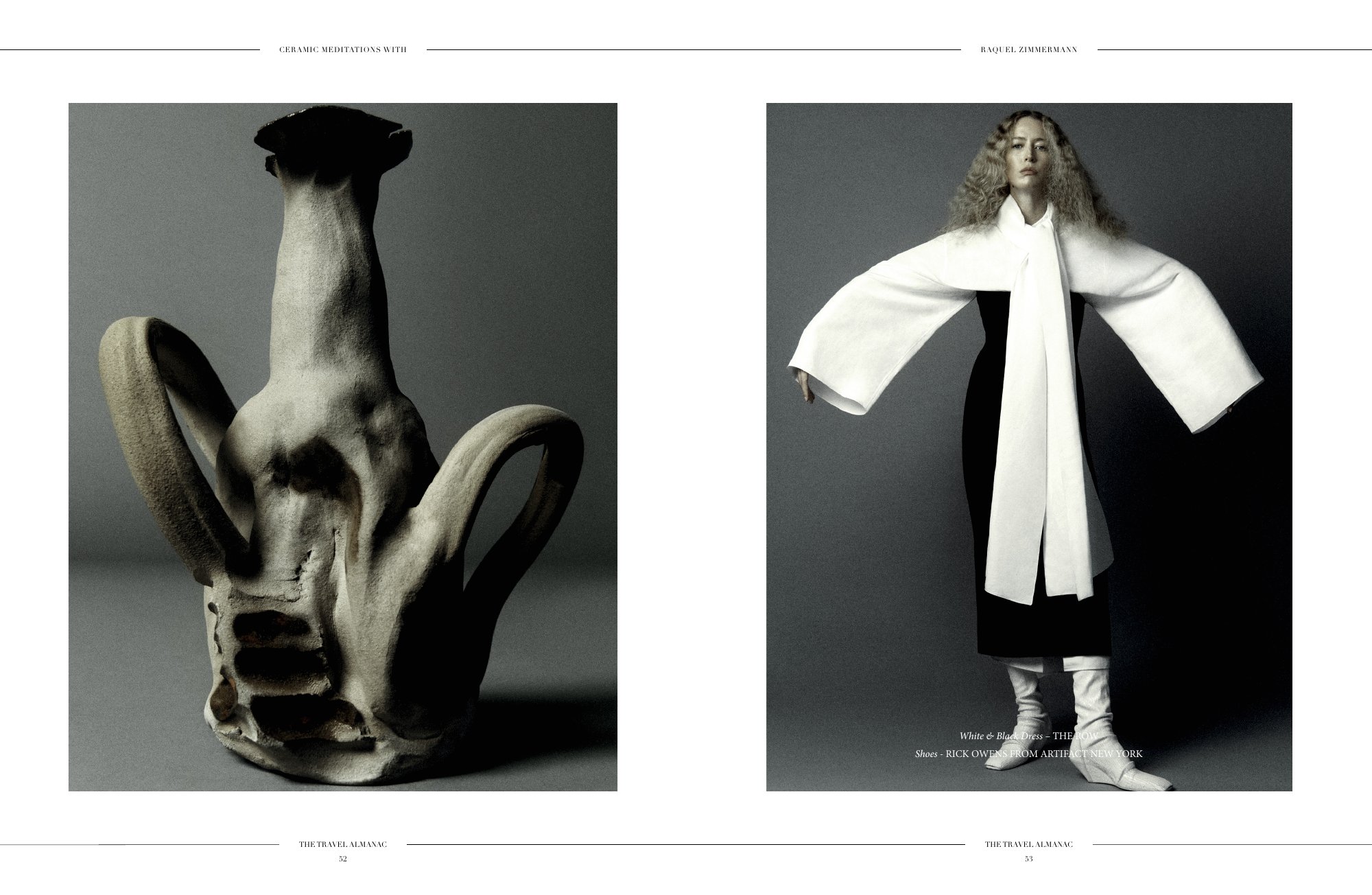
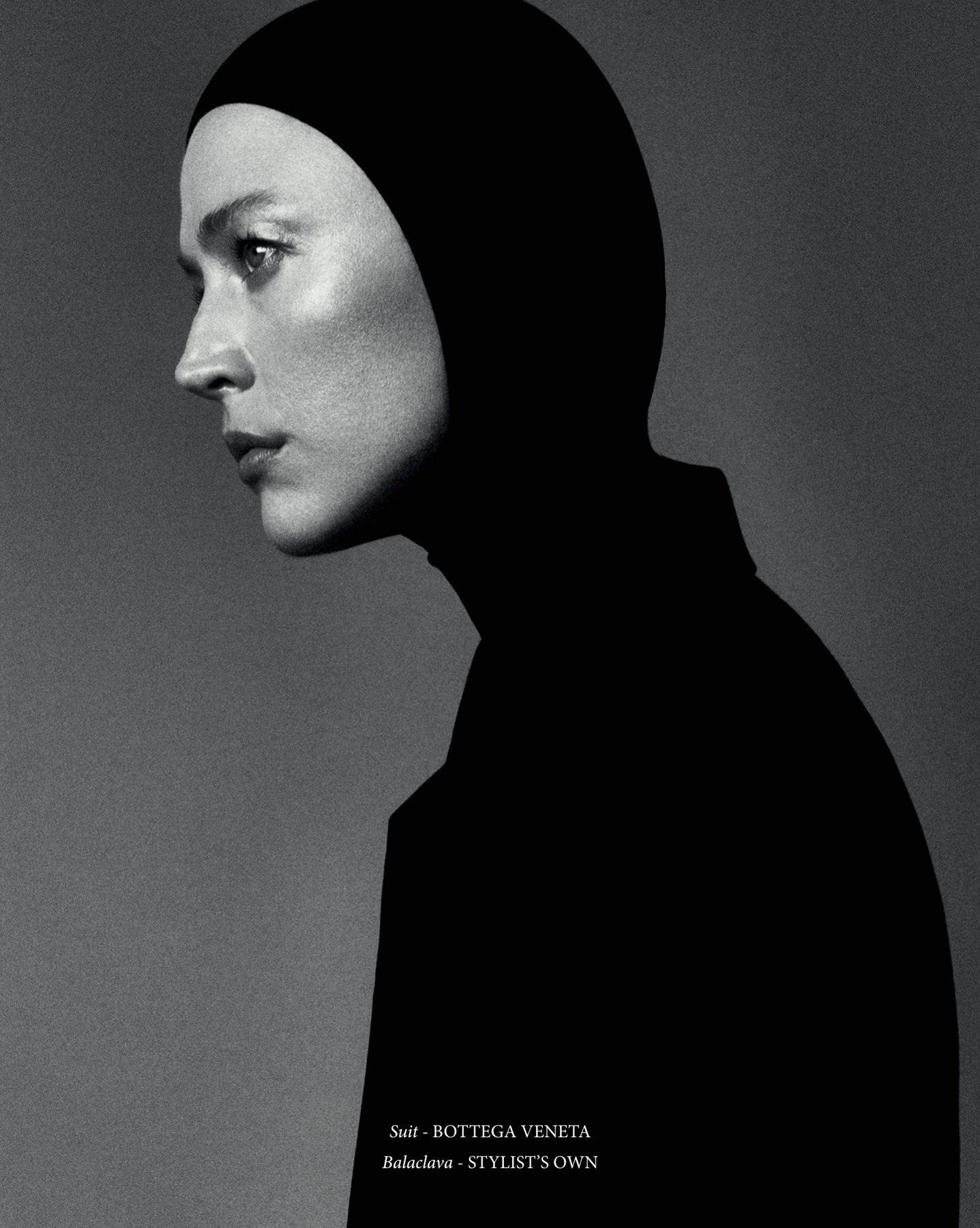
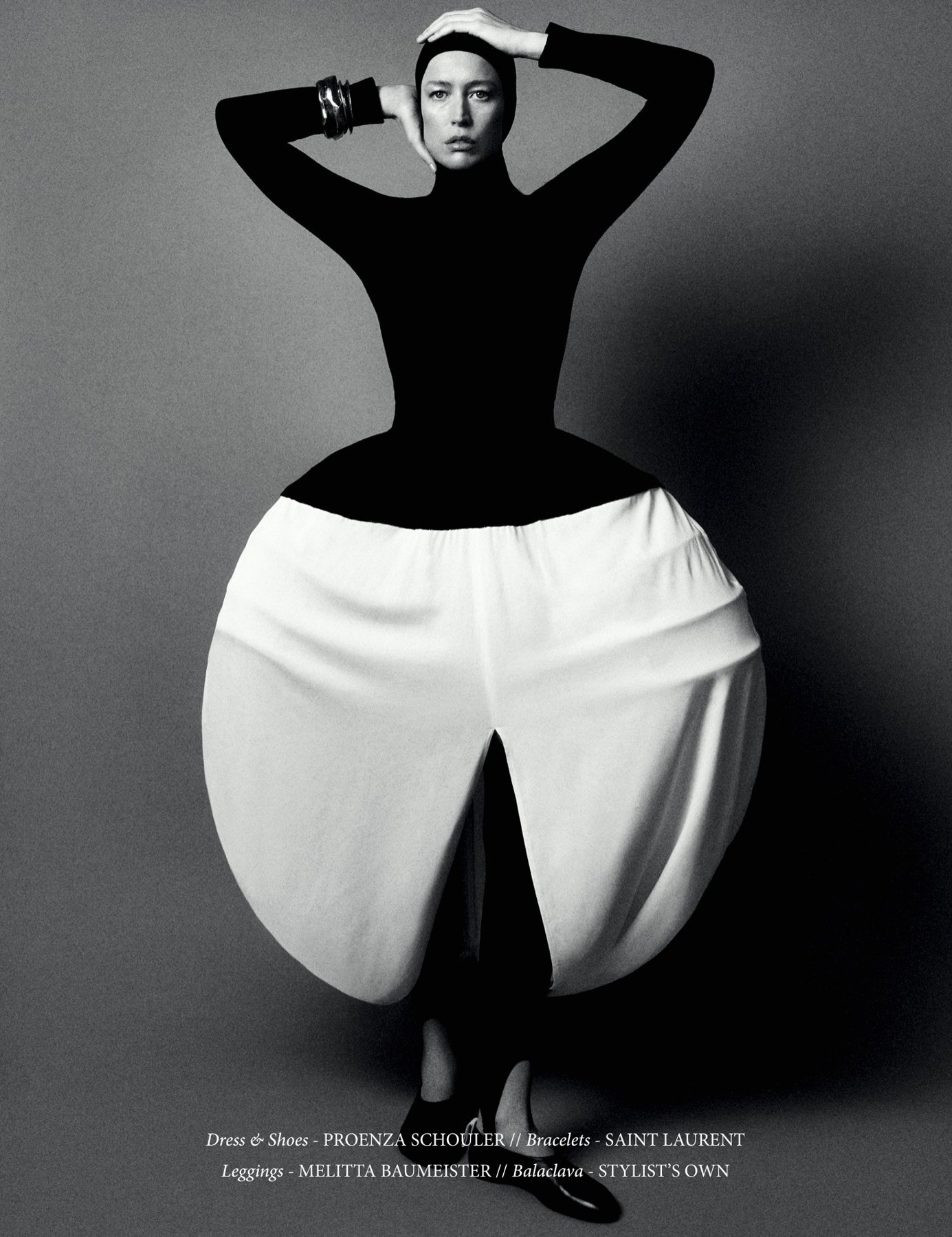
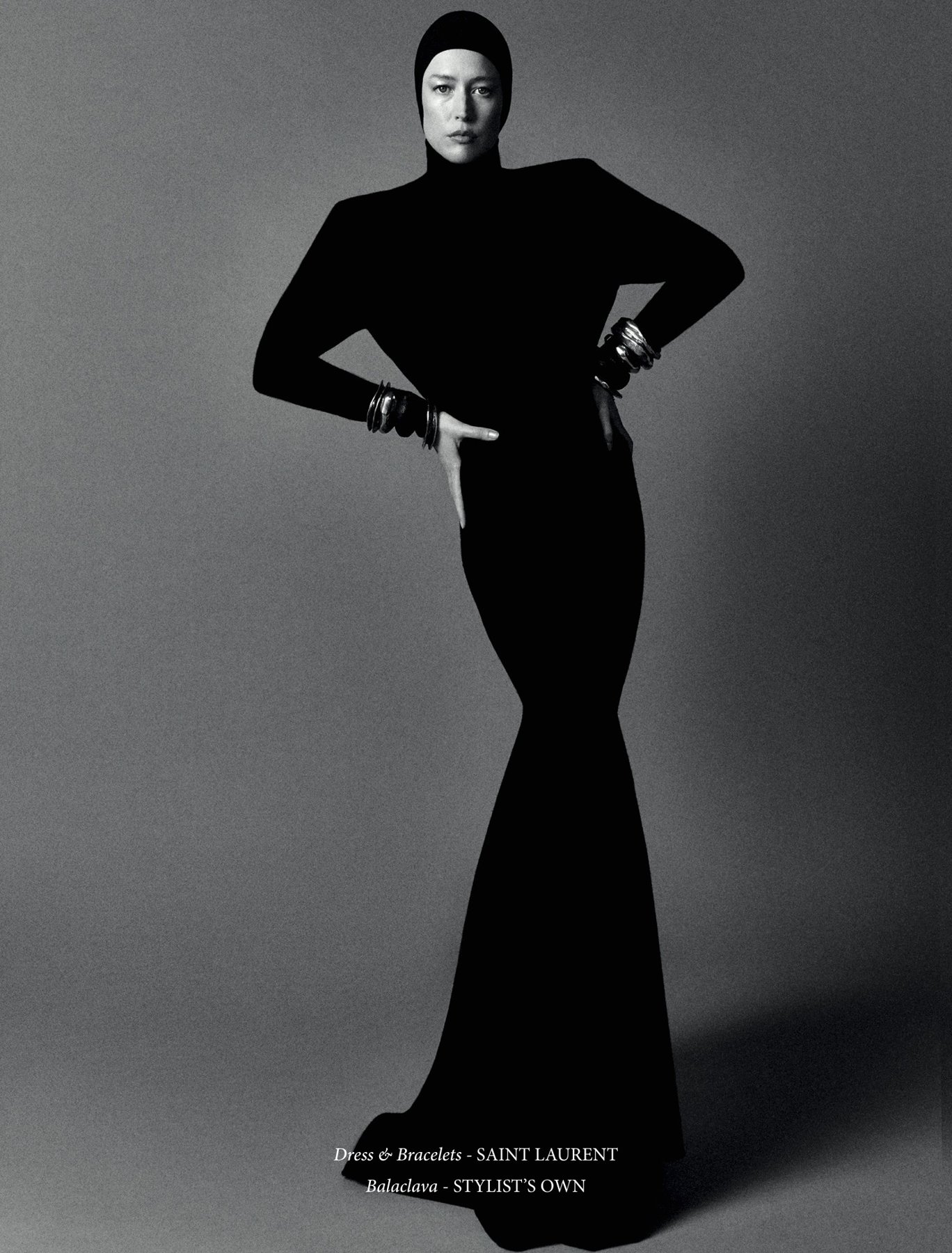
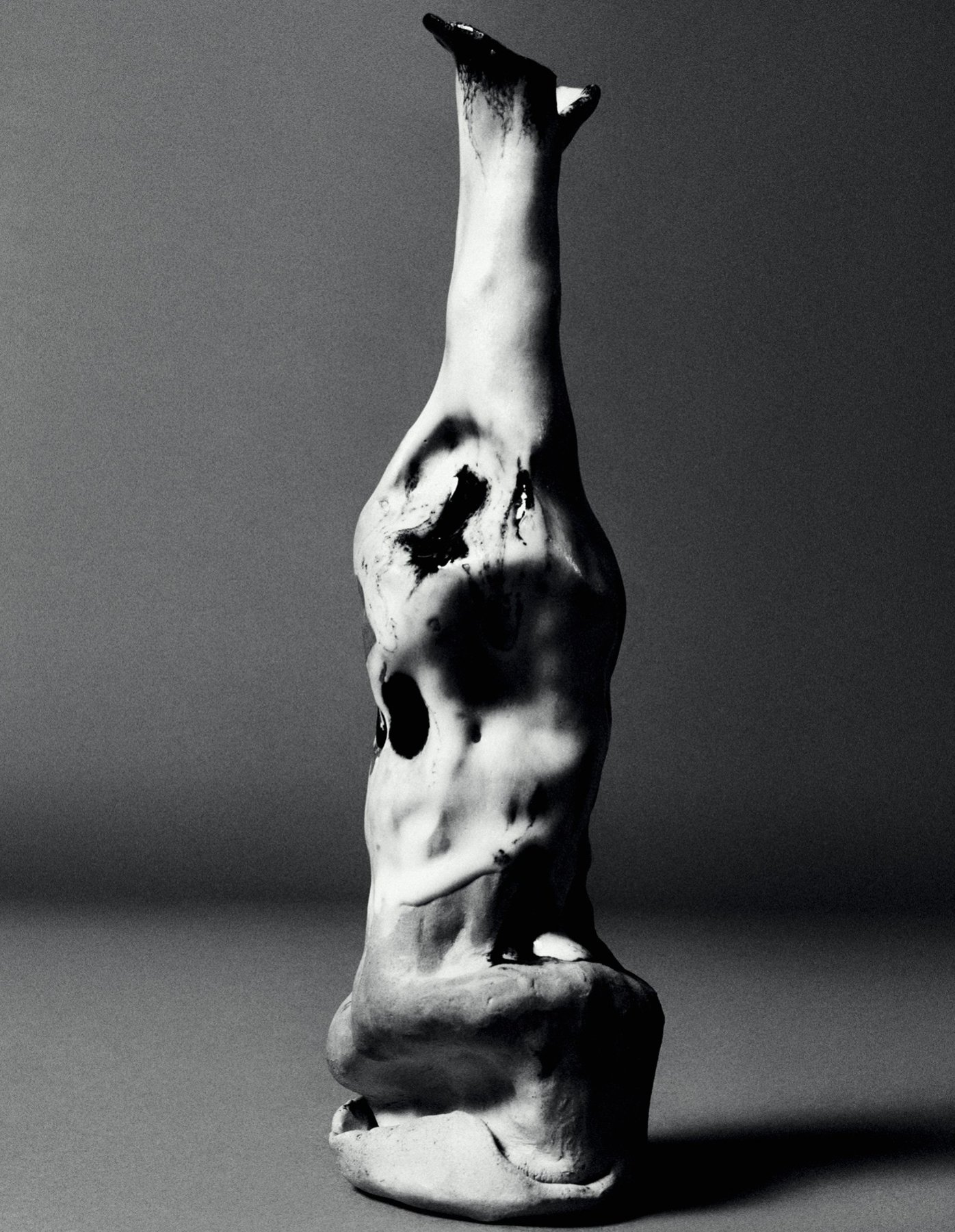
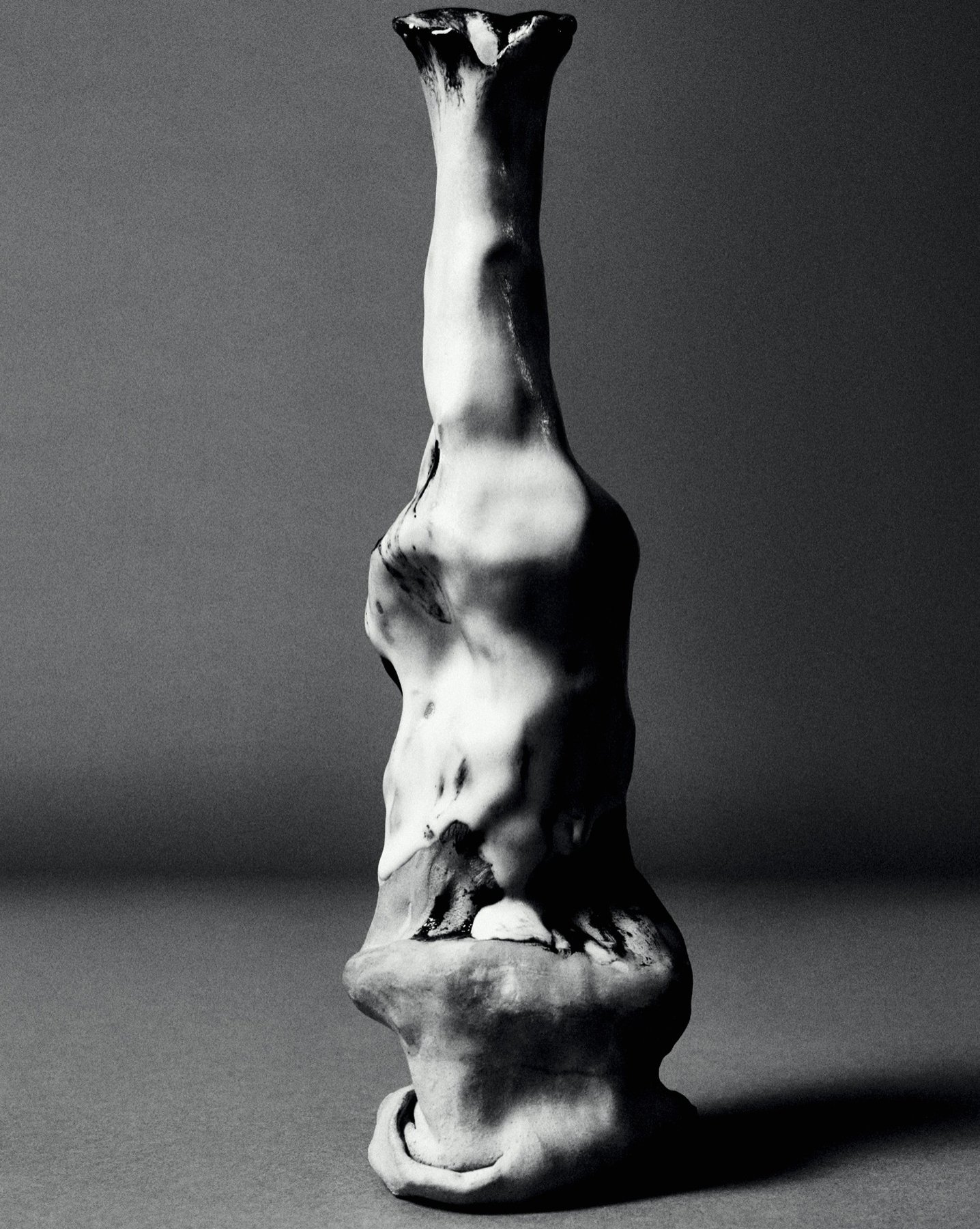
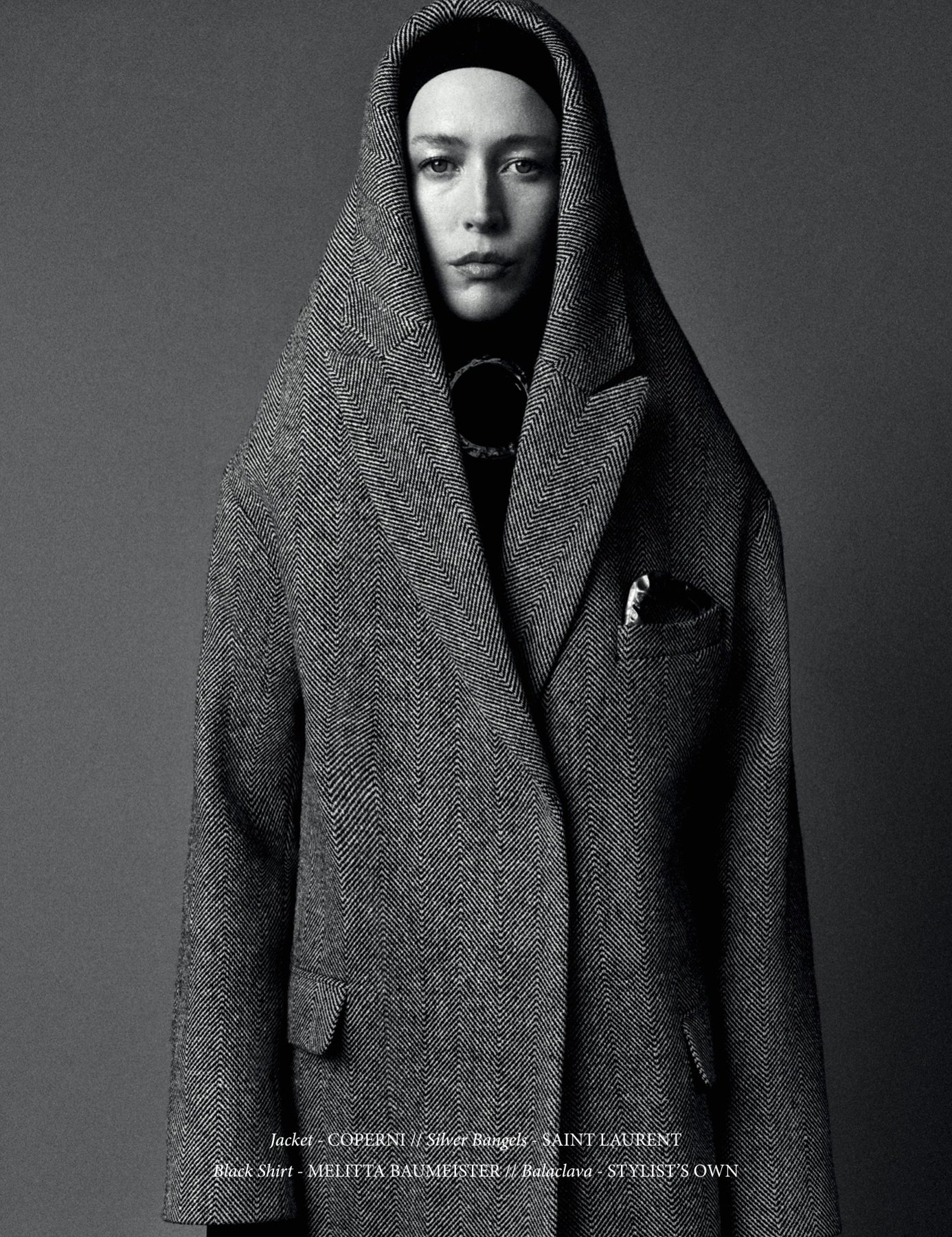
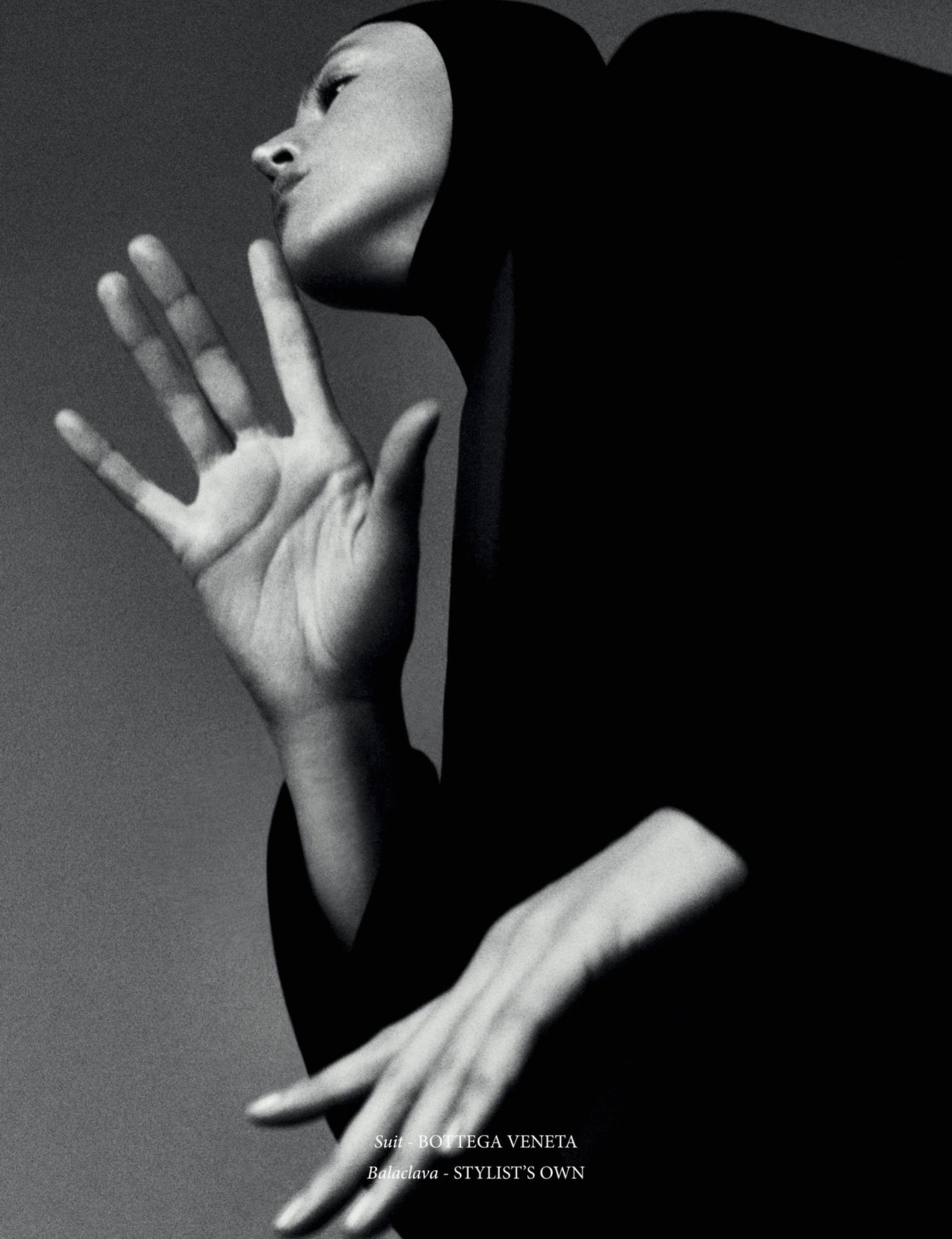
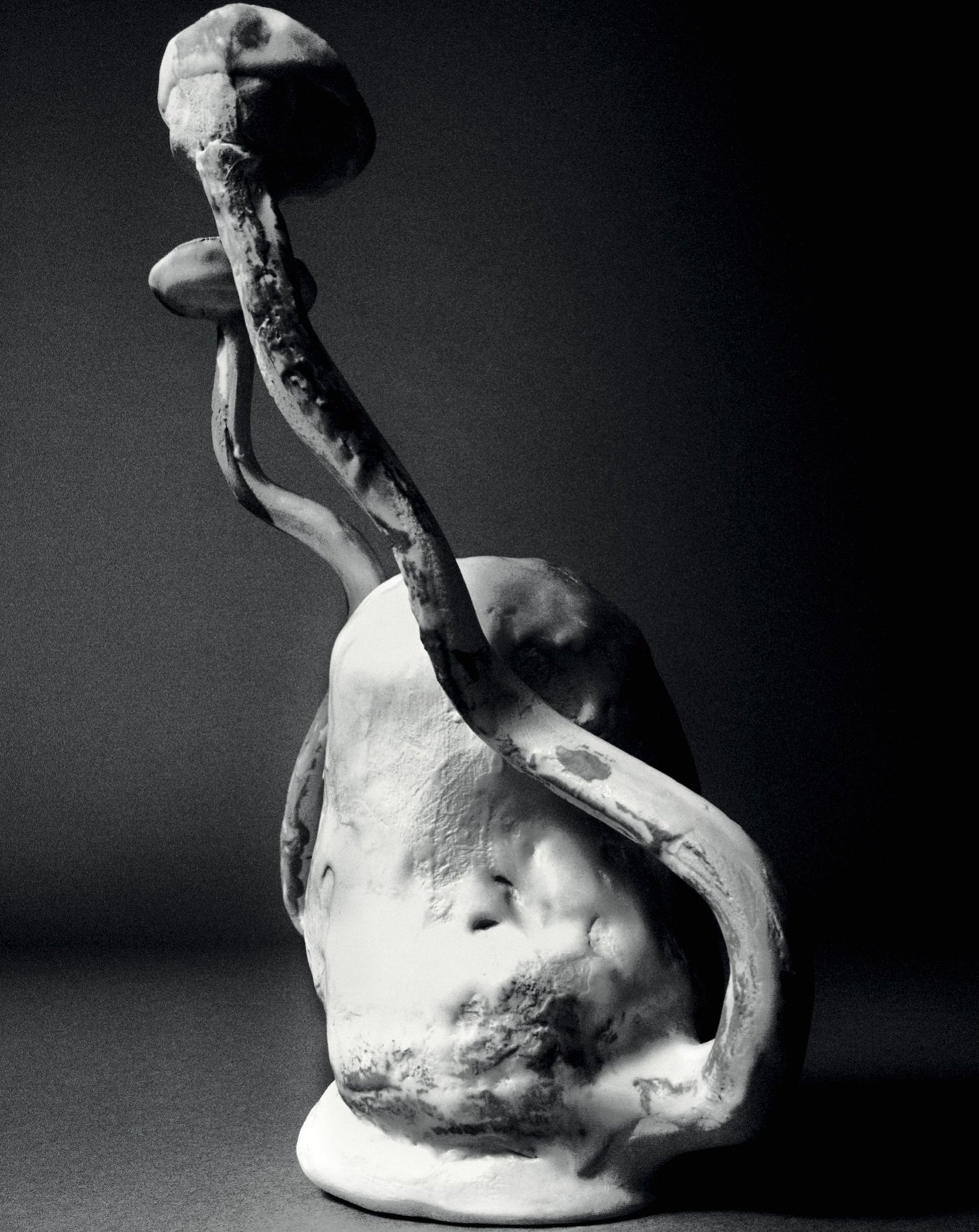
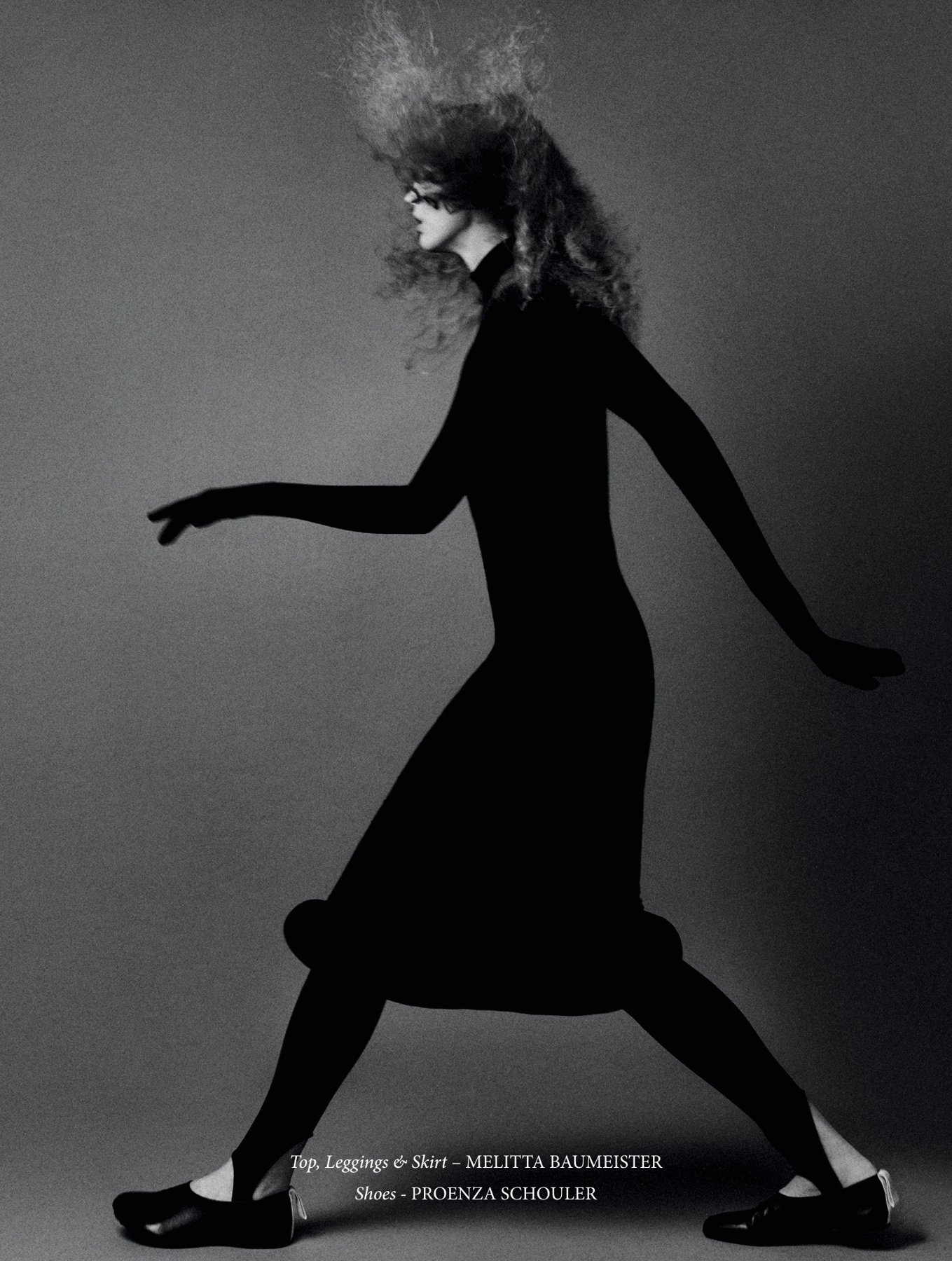
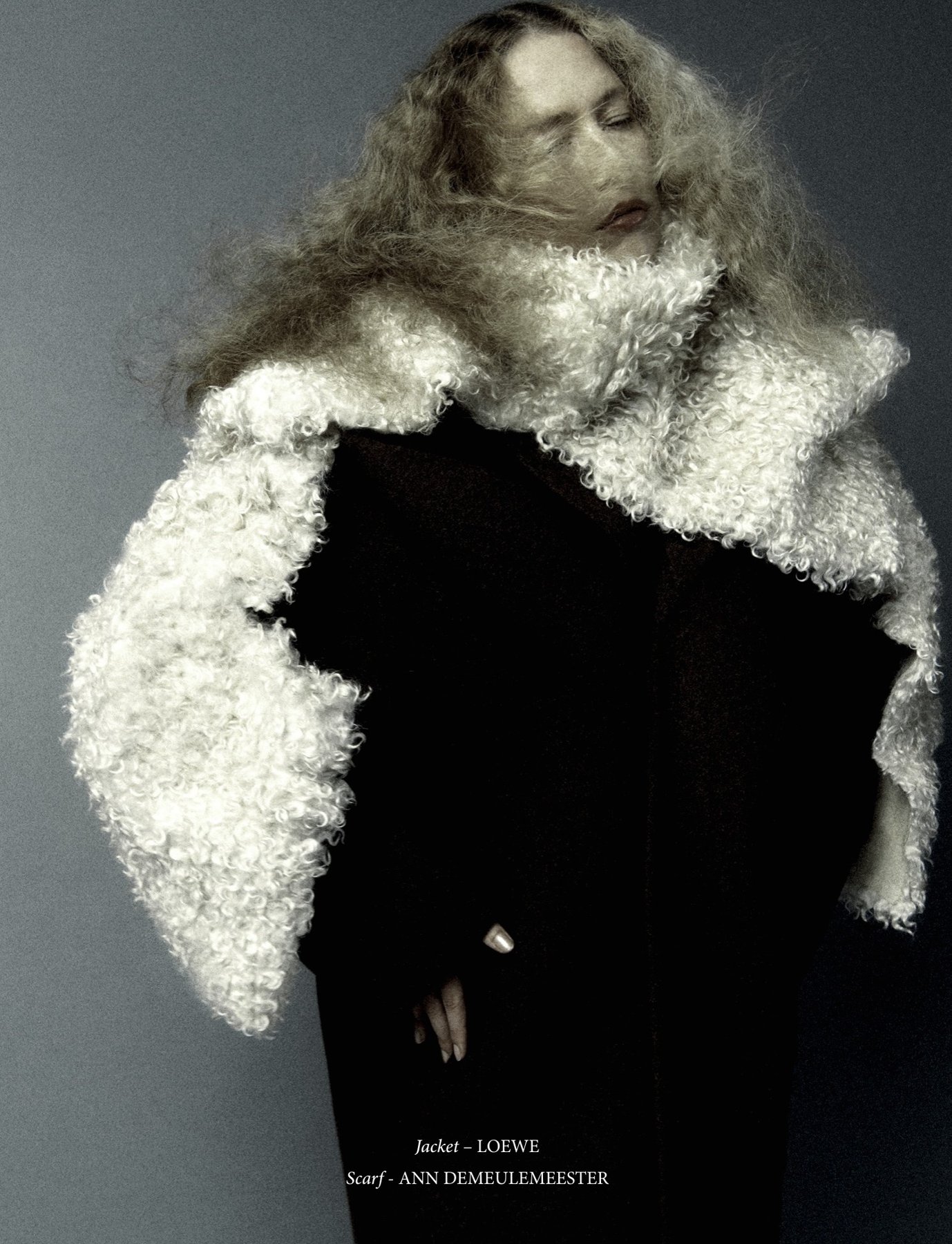
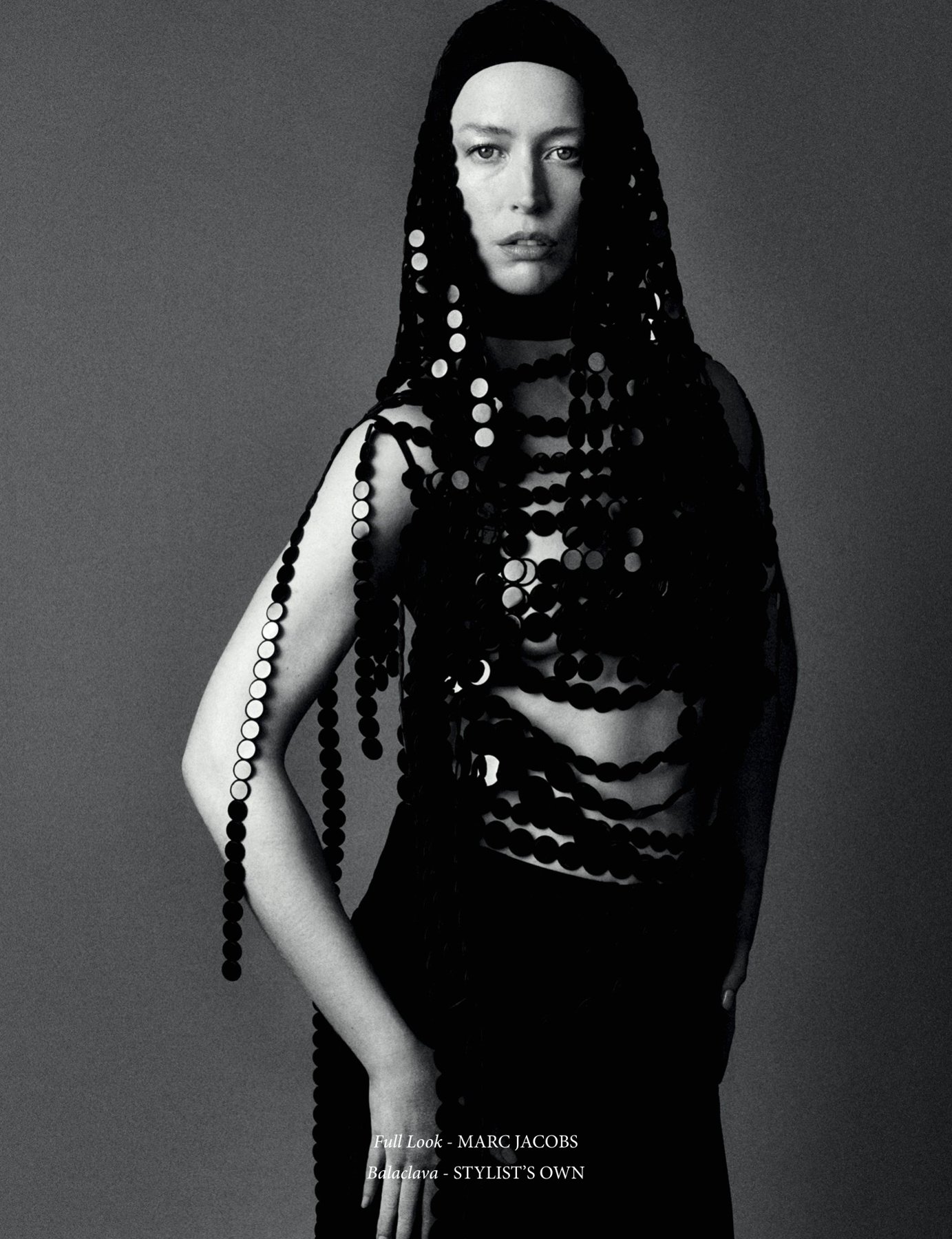
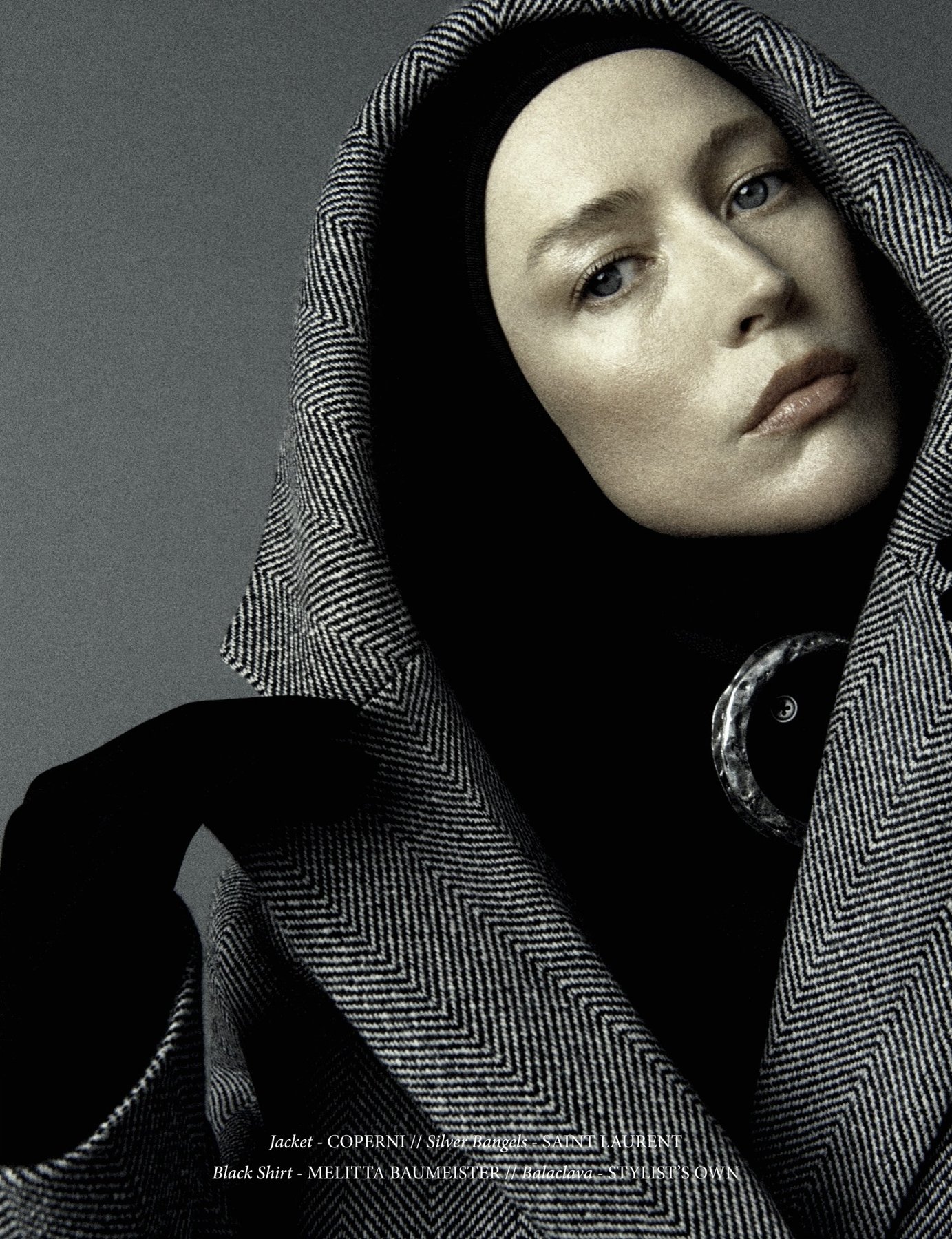
It is much more than just the industry that makes clothes. First and foremost, it is a form of creativity. It can be both a craft and a sublime art form. A good example of the latter is the TTA shoot that accompanies this interview. In the shape of the clothes and poses of my arms, we played with the form of ceramic vases—a fashion shoot and an art project at the same time.
Who has been the biggest inspiration in your modelling career?
Cindy Sherman would be at the top of my list.
It surprises me that you name an artist as your biggest source of inspiration, rather than another model.
Cindy Sherman was a true pioneer, paving the way for many more female artists to follow. She has the ability to portray various characters like an actress, which fascinates me. As a model, this versatility inspired me greatly. As a result, I began to think of modelling as a very peculiar form of acting.
One of the three things you are most praised for as a model in the fashion industry is your versatility in embodying different characters.
At this point, I’m curious. What are the other two?
The first is your legendary punctuality, said to be second only to Cindy Crawford’s. The other is your proactive and creative approach to modelling. You are known for injecting your own ideas and input into photoshoots, far from simply being a pretty face.
To function properly at work, I must be interested in what I am doing. To connect with the creative process on set, I always ask the photographer and stylist what are their sources of inspiration for the shoot.
A crucial figure in your career has certainly been Steven Meisel. It was your serendipitous encounter with him at the age of 16 that changed your life forever.
I come from a humble background. Neither did I know anything about fashion nor speak English when I arrived in New York. Fortunately, my agents at DNA Model truly believed in me—for sure more than I did at the time. One day, at the beginning of the year 2000, they sent me to Steven Meisel’s studio for a go-see.
A go-see?
During that time, the internet barely existed, so models had to go to the photographers’ studios if they wanted to be chosen. Steven Meisel was busy that day, so I didn’t get to meet him. His assistant took a few Polaroids of me. Several months later, his studio contacted my agent; I had been selected to shoot for a cover of Vogue Italia in California. I had no idea what that meant at the time. My agent told me, “Raquel, this is a big deal, you’ll see.”
What was the shooting like?
There is a funny anecdote connected to that day. All dressed up in Italian Vogue outfits, I am sitting in the garden of this beautiful LA mansion. I remember Stephen Meisel approaching me and starting to speak with me in English. He was probably explaining to me what the shooting was about, and what character I should embody. After he spoke for a while, I began to laugh, which made him realise I hadn’t understood a word he said. “Do you not speak English?” he asked me. “No,” I replied, lowering my gaze. Then, he smiled back at me and left. In the aftermath of that shoot, I thought I would never hear from him again. But then he called me again for Italian Vogue. And then Versace, Prada and so forth. In spite of the initial faux pas, he has been my biggest supporter throughout my career. We have been working together for more than 20 years now, and I count him among my closest friends.
You have travelled virtually everywhere in your career as a model. Do you ever take time to travel in your own country?
I recently visited Bahia for the first time and discovered a whole new world. I took the occasion of this trip to take, for the first time, Capoeira lessons. I discovered that Capoeira is in fact a martial art disguised as a dance, invented by African slaves to protect themselves. So smart!
Where did you grow up in Brazil?
I grew up in a state called Rio Grande do Sul, in the south of Brazil. You can’t help but feel isolated in this remote province of the empire, among pristine but empty landscapes. As you look at the ocean, you know that the Antarctic is the next thing that you’ll see after thousands of miles. I think living on the periphery of the world shaped me enormously, since it gave me a hunger for exploration. I realised only much later that I grew up in a paradise. But when you’re a teenager, you’re impatient to explore the world as much as you can. Travelling to other continents had been my dream ever since I began my modelling career, and I remember feeling so elated when that dream came true.
Have you ever visited the Amazon, Brazil’s cultural and spiritual heart?
Unfortunately, no. Nevertheless, I am fascinated by indigenous culture, especially its deep connection to nature. Nature and indigenous people are one. The ego is less important in their mental state than it is in our society; it’s a privileged state of selflessness that I try, with great effort, to achieve through my daily meditation practice. Seeing the Amazon and its inhabitants disappear, helpless, is heartbreaking. We still have a lot to learn from them.
According to Michael Pollan’s bestseller about psychedelics, How to Change Your Mind, psychedelic experiences may help people to reconnect with nature, as they allow one to experience a profound sense of connection with trees, plants and their natural surroundings, with life-long effects. He also believes that raves and intense meditation can help us to connect in the same visceral, intuitive way.
It’s funny you mention this—I was just thinking about the similarities between meditation and raving last week. Both allow you to connect with other people and your surroundings in a non-cerebral way. To dismiss clubbing as merely a ludic activity would be reductive. Connecting viscerally with other people through music can be considered a spiritual experience in itself—a sort of meditation. My approach to reaching that powerful mental state does not include using psychedelics, but rather meditation in nature. When your ego temporarily reduces its importance inside your brain, you realise you are more than an individual immersed in the whole—you are part of it. It’s a really powerful and life-changing experience.
How did you come to choose transcendental meditation out of so many other meditation techniques?
I shot a TV commercial with David Lynch over 15 years ago. One of the things that impressed me about him was his kindness, which I didn’t expect from such an icon. It was he who explained to me for the first time what this technique is about: repeating a mantra to achieve relaxation. Years later, a friend mentioned that technique again, so I decided to try it myself. My favourite thing about it compared to other meditation techniques is how effortless it is. It doesn’t require you to concentrate on something such as your breath or a flame. You repeat a mantra over and over until a meditative state takes over your mind. That’s all there is to it.
After all these years, how do you feel transcendental meditation has transformed you?
I don’t think it changed me, but rather it made me realise who I am. Connecting with your true self makes the opinions of others less important. There’s something beautiful and liberating about it. As a model growing up, I was always judged by my appearance. It is obvious that the way you look is different from who you are, but this constant judgement can be very confusing for a teenager. Meditation changed all this.
Besides meditation, ceramics is another great passion of yours. What brought it into your life?
In my early thirties, having worked in the fashion industry for over a decade, I began to experience burnout symptoms. I suddenly realised I needed to take care of myself and began exploring many new interests and wellness practices, paying attention to which ones made me the happiest. Meditation and ceramics both became a part of my life around that time.
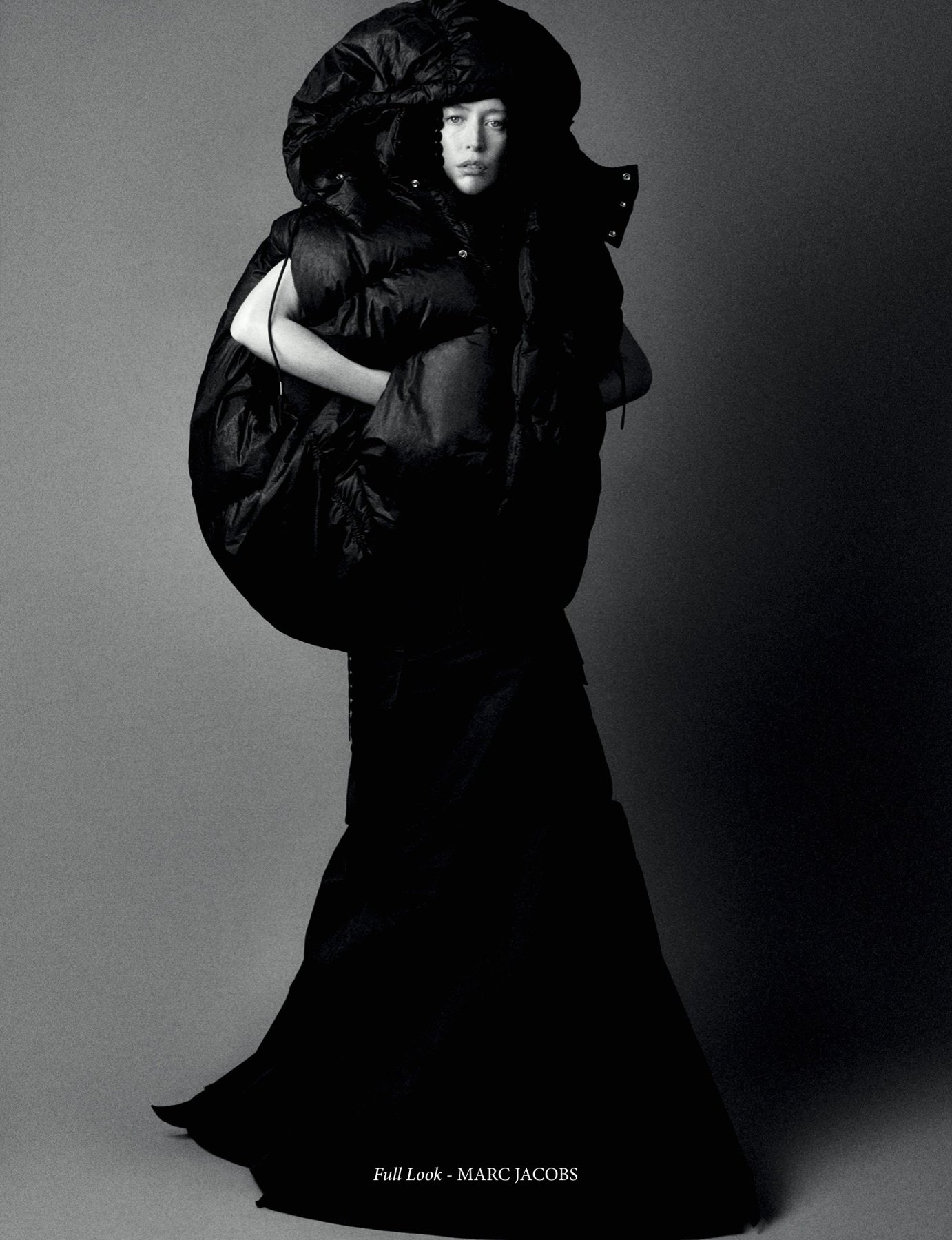
During an interview, Richard Layard—author of several seminal books about happiness—told me that crafting objects with our own hands is among the things that make us most happy.
The feeling of creating with your hands is so fulfilling and relaxing, I agree! Many people find gardening therapeutic. For a while, they put their hands in the earth and disconnect from their worries. Similarly, ceramics rekindles your connection to the Earth by letting you touch the clay. Having spent so many years in fashion, I find ceramics to be even more empowering, as it gives me a feeling of being the only person in charge of the creative process.
What do you mean by that?
Models are always left with the impression that those conceiving the shoot, especially the photographer and creative director, are doing the real creative work, not them. As a model, I have always tried to offer my personal creative contribution, hoping to interpret their vision, but there is only so much input you can provide. Now that I’m doing ceramics, I’m the one in charge, and I’m loving it. Having said that, ceramics is also full of surprises. There are times when you work on a vase for a whole week, and then the surface cracks in the oven, which can be frustrating and disappointing. Sometimes the pigments in the glaze mix unexpectedly, producing beautiful hues. Ceramic glazing is an emotional, wild and unpredictable process, rather than a methodical one. I enjoy how little intellectual effort goes into this phase of the work.
What inspired you to pursue this passion?
My passion for ceramics is a byproduct of my love for Japan. When I started modelling, my first trip abroad was to Japan. I was a Brazilian teenager from a modest social background, who had never travelled outside her country. The culture had an enormous impact on me. One of the most impressive things I saw during that trip were Japanese ceramics. I love how poetic it is. As soon as I decided to learn ceramics, I knew I had to find a Japanese teacher—a sensei. In New York, I found an excellent one. With her help, I was finally able to make those adorable Japanese tea cups I loved so much. I was hooked on this technique before I even realised it.
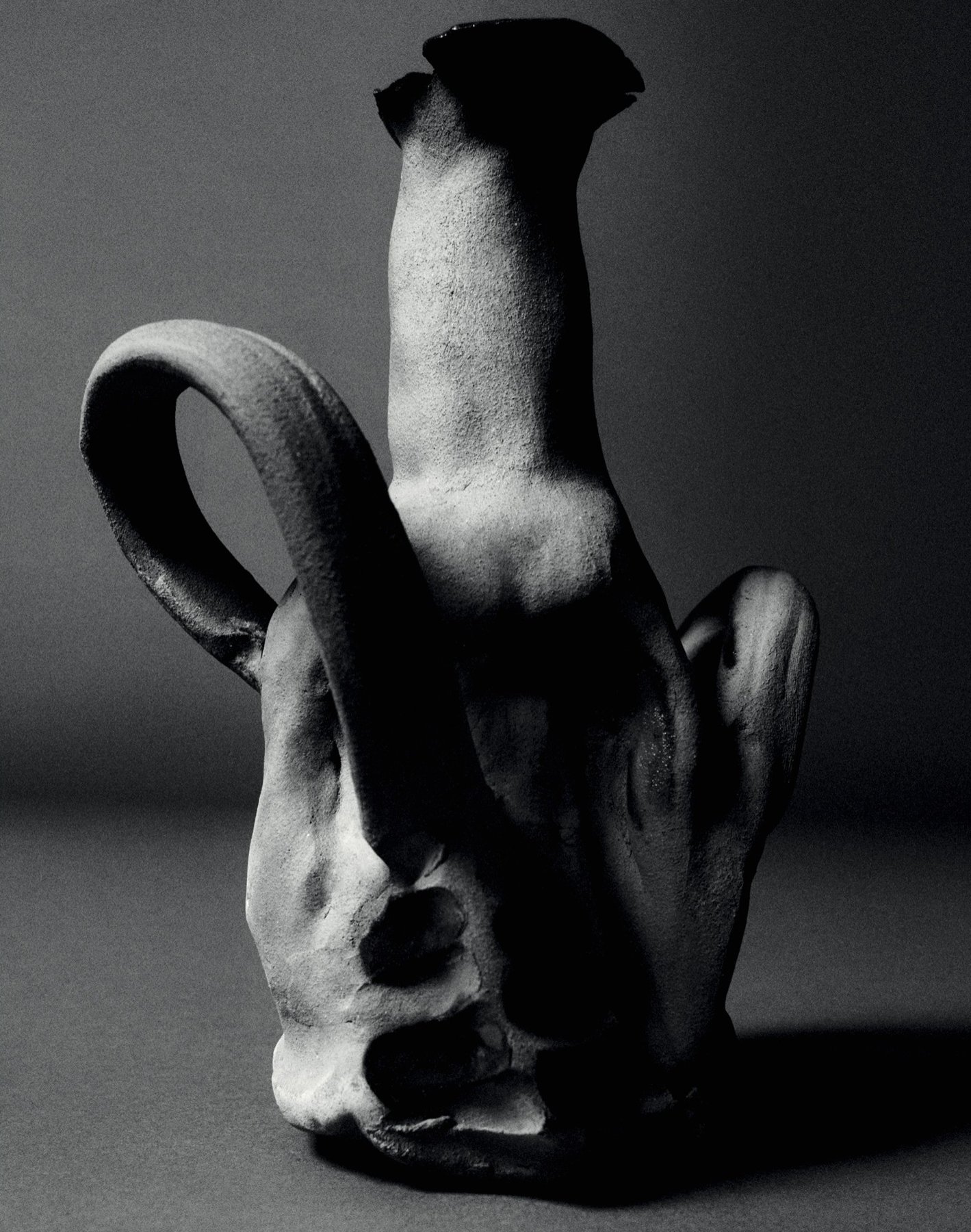
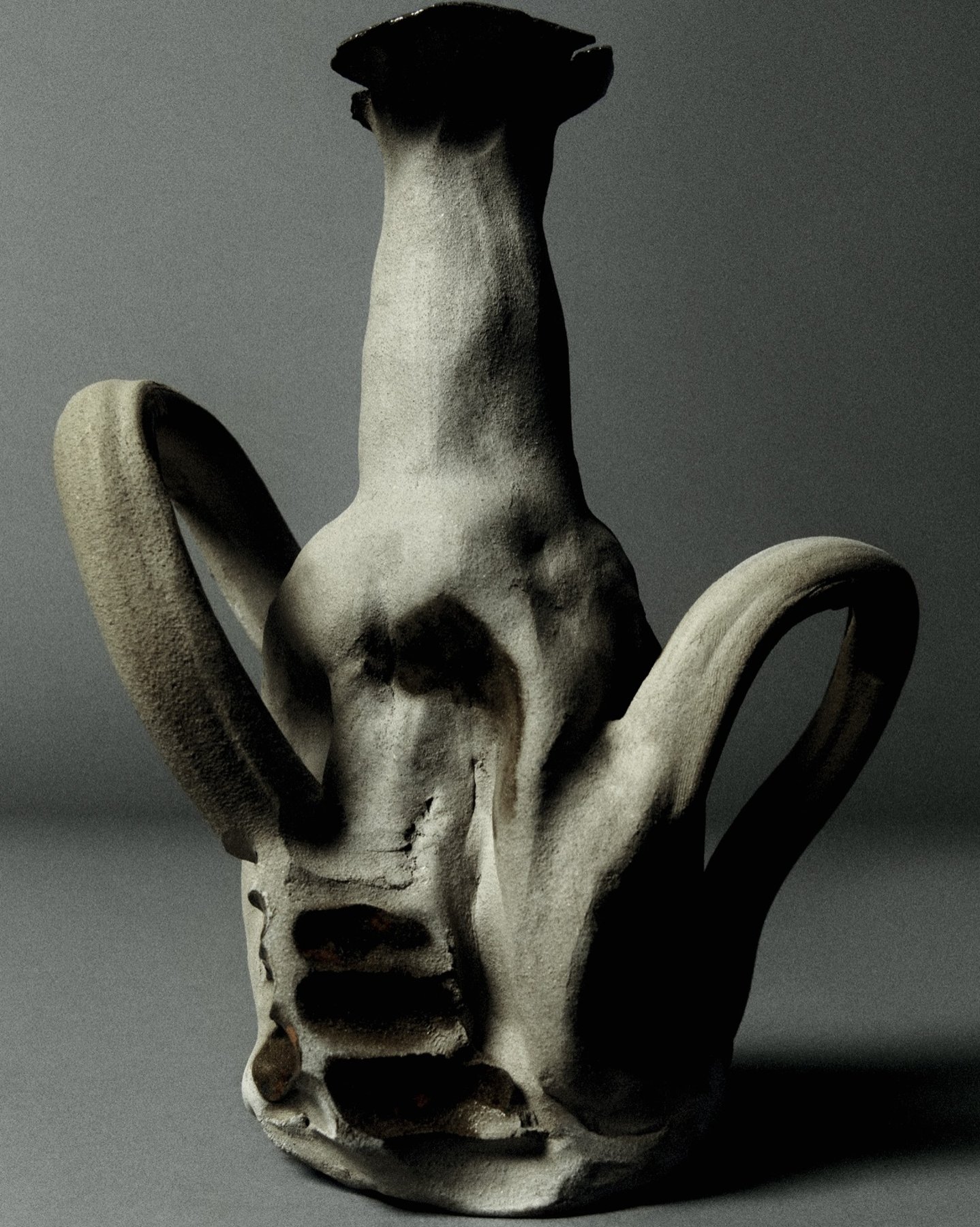
I am intrigued by your more recent line of vases, which are asymmetrical in shape and with handles resembling tree branches or alien arms. What inspired them?
The inspiration for this new line of work came from the forest. As a nature lover, I often go on forest trails; above my head, tree branches form intricate networks that never cease to amaze me for their organic and asymmetrical yet equilibrated beauty. The pandemic also played a role. As soon as it all started, I suddenly had no access to my ceramic studio. Without the wheel at my disposal, I paradoxically had more freedom to play with the clay. That’s how I started experimenting, for the first time, with asymmetrical shapes. In the same period, I met the owner of Castor florist, an exclusive flower shop in Paris, with whom I began a fulfilling partnership. I create my vases in New York and then ship them to Paris, where he fills them with stunning flower arrangements.
What is your relationship with cut flowers?
My grandparents were farmers. As a child, I spent much time on their farm in the south of Brazil. In her flower garden near the house, my grandmother grew a variety of flowers. There was something mesmerising about that place. For me, going there was like entering a dream. I would go from one flower to another, smelling and observing.
Almost like a bee.
That’s right! [laughs] Children always create their own fantasy worlds. My garden was my kingdom. I remember my grandmother performing a ritual every time we were leaving. Knowing my love for roses, she would go into the garden, cut a rose and offer it to me. It was just a flower, but it meant the world to me. In my mind, cut flowers symbolise love since then. What I really enjoy is how they enhance vases—complete them—and manifest their functionality.
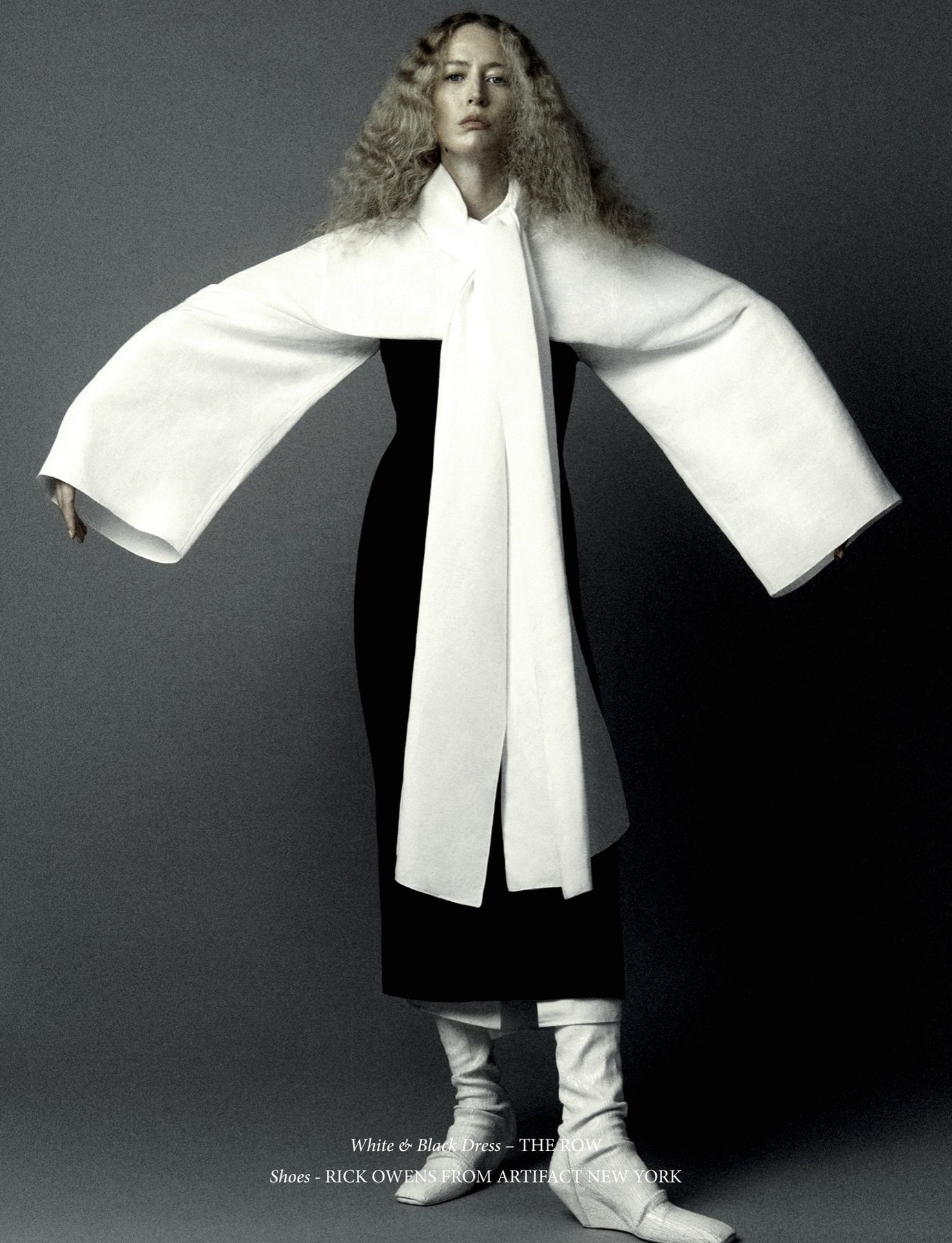
Are you more inclined to consider your ceramic practise an artform or a craft?
Like fashion, ceramics can be both. What I do is somewhere between the two. All of us should allow ourselves more time to explore and embrace the creative side of our personalities. There is no such thing as creative people and non-creative people. All of us can find a way to express our creative side, if we only learned how to listen to it.
Educating people on how to explore their creative side would have a powerful positive impact, I believe. There is a lot of frustration in today’s society because people don’t know how to express themselves either creatively or artistically.
It’s not only that our society doesn’t allow it. A major issue here is self-censorship. The fear of others’ judgement can paralyse us, as we all know. After much meditation, I learned a basic lesson: if something makes me feel good, fulfilled and happy, what others think doesn’t matter.
Interview Michele Fossi · Photography Robin Galiegue · Styling Clare Byrne · Hair Lucas Wilson · Makeup Cyndle K · Manicurist Ada Yeung · Casting Bert Martirosyan
By Michele Fossi
Published in The Travel Almanac #21