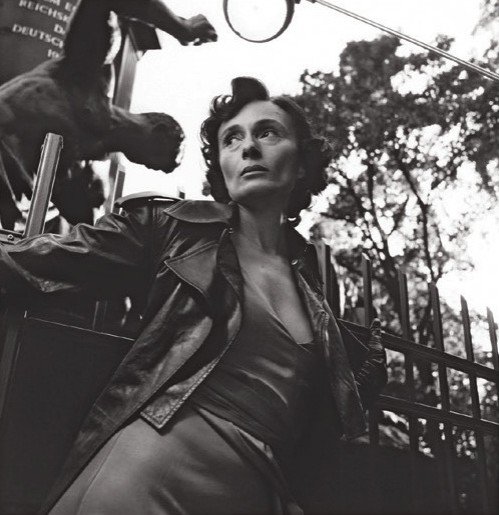
“Helmut’s Berlin”
Helmut Newton fled his natal city – at the time it was the capital of the Third Reich – in ’38. He would later return on occasion, commissioned as a photographer by renowned magazines. At the end of his career, although he had spent most of his life in other cities, he chose his birthplace as the location for his future eponymous foundation. A marginal shooting location in his career compared to Paris, Los Angeles and Monte Carlo, Berlin nevertheless provided the set for some of Newton’s most iconic photographic series, such as Jenny Capitain’s portraits in the Pension Dorian in 1977, or, two years later, the fashion story for German Vogue dedicated to the photographer’s childhood memories in Berlin.
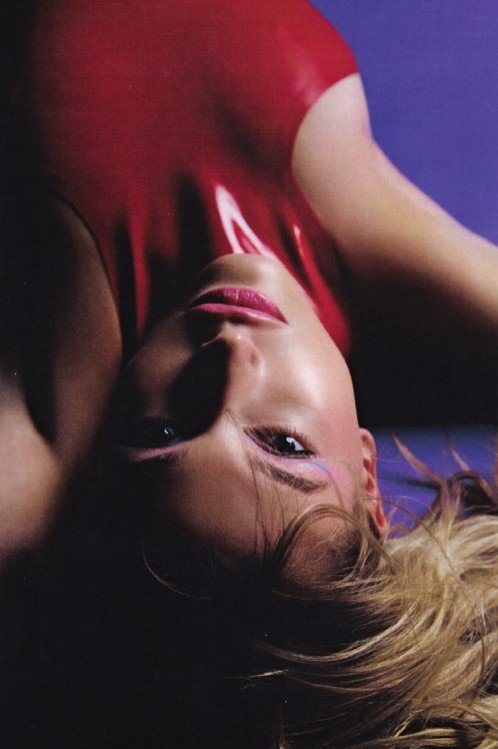
Taking inspiration from this shoot, Mark Peckmezian photographed a portfolio of women at various locations in Berlin associated with Newton’s life. Among them, the Stadtpark Schöneberg, the closest park to his parents’ house, where he used to go after school with his nanny; Yva’s studio near the Ku’Damm, where he took his first steps in the field of fashion photography and shot his early self-portraits; the Tiergarten, Berlin’s Central Park; and finally, the artsy and smokey bars where, after work, Helmut and June loved to hang out with their friends – the Paris Bar and the Diener Tattersall, and his favourite hotel in town, the Savoy.
“Room 49”
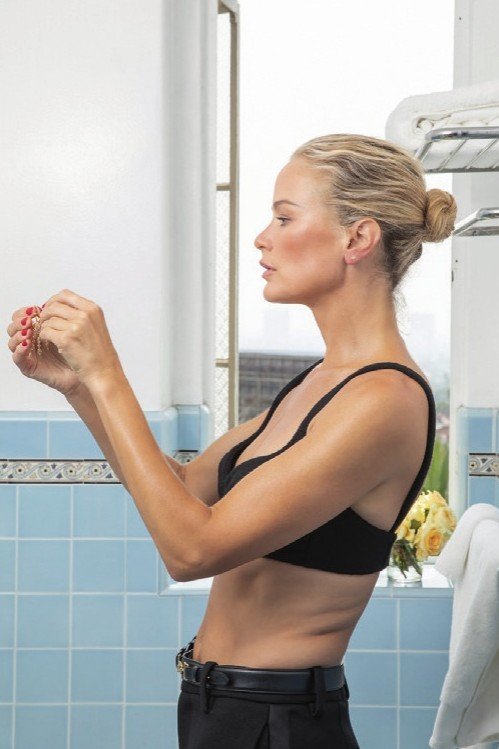
Located at 8221 Sunset Boulevard in Los Angeles, and known as a long- and short-term residence for celebrities, the Chateau Marmont hotel has gained the reputation of being Hollywood’s glamorous version of New York’s funky Chelsea Hotel. In this emblem of the high life of Lotusland, stars of the likes of Quentin Tarantino, Tim Burton and Anthony Bourdain have stayed and produced work.
Among them, the name of Helmut Newton stands out. Every year from 1957 until his death in 2004, the photographer wintered, together with his wife, at the Chateau. The Newtons always sojourned in room 49. In this fully equipped, elegant suite, some of the most intimate portraits of Helmut Newton, June and their friends – many of which were later included in the 1999 book Us and Them – came to life. In the private kitchen of this room, Newton also shot his notorious ten-picture series Domestic Nudes (1992), in which he placed strong naked women in a series of domestic scenarios.
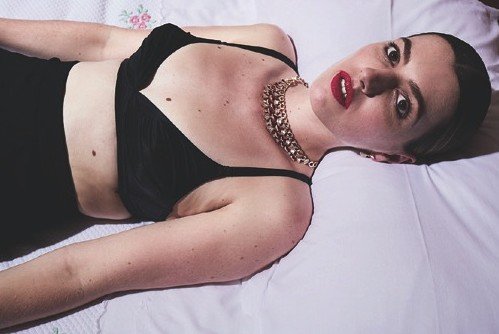
The Vogue Italia story is a tribute to the time Newton and June spent at Chateau Marmont. Buck Ellison photographed model Carolyn Murphy, styled by George Cortina, at different locations in and around the hotel, including the room 49.
“I Am the Father of Your Performance”
In 2000, Vanessa Beecroft was photographed twice by Helmut Newton for American Vogue. The first photo, taken in a Miami Beach storefront, was not published because the nipples of the mannequins had been painted red. The second one, taken in a studio in Los Angeles, made it onto the pages of the magazine. For however successful, the shoot proved a turbulent one. It ended with a slightly irritated Helmut telling her in a peremptory tone: “Don’t forget I am the father of your performances!” “I suspect he had the impression I wasn’t sufficiently aware, let alone grateful, of how much his work had paved the way for mine,” the artist recalls. “The truth is, when I started doing my performances, I wasn’t familiar with Helmut Newton’s work. But when I eventually came across his pictures, they left such an impression on me that in 1996 I dedicated a performance to him commissioned by Miu Miu. Two bare-legged models were wearing furs, and one of them, with a smile, raised the fist of black power. In the following years, Helmut Newton’s photos were destined to inspire several other performances of mine.”
Beecroft’s tableaux vivants – large-format pictures documenting performances, usually staged in museums or galleries, involving nude and clothed women arranged in precise formations and moving in slow motion – share many themes with Newton’s photography: constraint, nudity, voyeurism, politics and fashion. Hence why the Helmut Newton Foundation invited Vanessa Beecroft to the collective exhibition Body Performance (March-September 2020), to which she contributed with the documentation of her performance VB55, presented at Berlin’s Neue Nationalgalerie in 2005.
We invited the Genoa-born, LA-based artist to pay homage to Newton. “In this fashion story, I decided to honour him not stylistically, but through an evocation of his spirit. As protagonists, I picked Kyra Kennedy, my brother, the Castle of Cigognola, Renzo Mongiardino and Suzanne Koller. The association of these different places and characters, I thought, would create situations full of complex meaning. On Ferdinando Verderi’s invitation, I accepted to play a role myself, too – something I never did in the past, or maybe just once.”
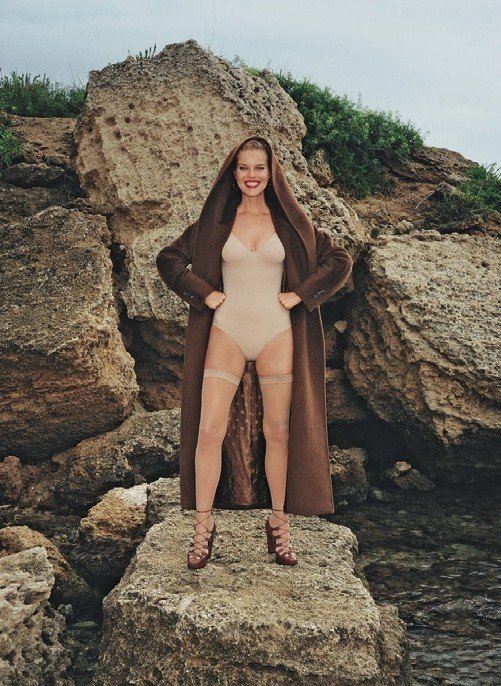
“Eva’s Smile”
We invited Eva Herzigova to be the protagonist of this story, shot by Angelo Pennetta in collaboration with stylist Anastasia Barbieri. Elegant, strong and sexy, she embodies the perfection of the empowered Newtonian woman. Not surprisingly, between 1993 and 1997, she posed for Helmut Newton six times. The two met in Miami on the set of shoots for American Vogue, with fashion editor Grace Coddington, first in 1993 and then in 1995. In the same year, she took part in Newton’s Blumarine campaign and posed for the photographer in Gianni Versace’s house on Lake Como. In 1997, she went to Newton’s home in Monte Carlo and posed in swimsuits in several different locations, thereby contributing to some of Newton’s most iconic pictures of the ’90s. But the shoot the supermodel recalls as one of the most intense of her career was, undoubtedly, the one for Paris Match during Cannes Film Festival, a year earlier.
“Helmut sent me to the Croisette in a leather S&M outfit, with even a whip in my hand. There was a moment on a pier when he and I found ourselves surrounded by a ravenous crowd of paparazzi. It was pure madness! In order to get the best shot, they started pushing each other off the pier; one even broke his leg. At some point, I told him I couldn’t watch that scene any longer and that I was about to go. ‘Please don’t leave me alone,’ he whimpered in a whisper. Miraculously, we managed to get into a car. In a second, the faces of the paparazzi had completely obscured all the windows. That’s the hysteria Newton was able to create with his kinky female imaginary.”
One of Eva’s biggest regrets is not taking on Newton’s proposal to teach her the art of photography. “He understood I had a genuine passion for photography and was willing to train me. With my busy agenda as a model, I regretfully had to decline the offer.”
“Occasionally, he kept on giving me suggestions, though. ‘In order not to age, you have to be flexible,’ he told me one day, referring not so much to my body, as to the importance of maintaining the freshness of the gaze, without which a photographer’s career inevitably comes to a halt.”
“Us and Them”
During his career, Helmut Newton shot various celebrity couples. Some of his couple portraits – like the one with Serge Gainsbourg and Jane Birkin, immortalised at the time of their hit Je t’aime… moi non plus, or the one with Mick Jagger and his wife – were explicitly charged with eroticism. Others, such as the photo of Gabriel García Márquez and his wife, and in particular the self-portraits that Helmut and June Newton would shoot in front of mirrors, are more intimate and personal. On several occasions, Newton exploited the co-presence of two subjects to introduce an element of ambiguity into the photo. How to interpret David Lynch’s straight finger on Isabella Rossellini’s candid and exposed neck, in the iconic photo that he took of the two in 1988, at the height of their Blue Velvet fame? Is this a tender, sensual gesture? Or rather one hinting at brutality and aggression? Or both?
Similarly, Newton used the couple motif to play with gender ambiguity. In his notorious 1975 picture for Vogue Paris, featuring an androgynous woman dressed in a YSL tuxedo, standing in a hazily lit Parisian alleyway entwined with a model dressed only in black stilettos, the viewer only realises at a second glance that they’re witnessing a lesbian affair.
To honour Newton’s rich and complex couple portrait photography, we asked one of today’s most-followed celebrity couples, Hailey and Justin Bieber, to be the protagonists of a Newton-themed cover story. The two posed in-studio against backdrops of locations associated with Newton’s biography or his work, such as the Berlin Wall, the Victory Column and the Helmut Newton Foundation.
From Vogue Italia’s Helmut Newton special, October 2020: read also Epopea di un genio ribelle, Ossessioni, Materiale riservato and One Last Thing (in Italian).
By Michele Fossi
Published in Vogue Italia, October 2020


4 thoughts on “5 Stories About Helmut”