
In this age of ecological crisis and technological acceleration, artist Marco Barotti offers a strikingly poetic countercurrent: he listens. And then, he lets the Earth sing.
From the depths of coral reefs to the hidden networks of forest fungi, Barotti’s work merges shamanic chant, environmental data, and machine learning into artworks that feel part ritual, part science fiction. His “Technosciamans” don’t just process information — they perform speculative healing rituals, singing to nature in a language that bridges code and cosmos.
In this conversation, Barotti takes us from Ayahuasca ceremonies in the Peruvian jungle to underwater sound experiments in the Maldives, tracing the evolution of a practice where song becomes both memory and future — one in which taumaturgic chant, both ancient and reimagined, might help restore damaged ecosystems.
He introduces us to curanderos who sing back the Amazon, to Sámi joikers defending the Arctic, and to the silent hum of coral — revealing a planetary culture of chant that modern science is only beginning to understand.
In a time when the world feels increasingly disconnected from its roots, Barotti’s work reminds us: the Earth has always had a voice. We just need to remember how to listen — and perhaps, how to sing back.
Marco, there’s one of your works that has intrigued me for a while: the Technosciamans. What exactly are they?
The Technosciamans are machine learning algorithms that I trained using recordings of shamanic music I collected myself in Peru, South Korea, and Japan — from Peruvian curanderos, Korean mudang, and the yuta shamans of Okinawa.
In a way, the work creates a dialogue between ancient shamanic traditions and contemporary artificial intelligence, transforming hard scientific data into a new, living sound experience.
Which hard scientific data?
In my project Corals Technosciamans, for example, developed together with the Technical University of Berlin and the Science Gallery, particularly in collaboration with the Bifold Research Institute, one of Germany’s leading centers for machine learning, AI, and big data research, we use solid scientific data on the ocean’s biochemistry — things like waves, currents, bleaching alert areas and sea surface temperatures — providing a near real-time snapshot of ocean conditions. This data comes from sources like NASA, Copernicus, and NOAA.
And what exactly do these sculptures do?
The Technosciamans perform speculative healing rituals for coral reefs around the world.
The algorithm taps into this incredible ocean database, selecting a different location every 10 to 15 seconds. Based on the current condition of the corals at that spot, the Technosciamans “sing” a healing ritual to them.
So are there actual speakers placed underwater to play these chants to the corals?
No, not exactly. As I said, it’s a speculative ritual. The artwork itself is the medium — a symbolic vehicle for transmitting the healing chants.
The piece is exhibited in physical spaces: right now it’s in Mexico, but it has also been shown in Japan, Germany, and Italy.
Every time the installation is turned on — from morning until evening — it continuously emits these healing chants addressed to corals around the globe.
It’s a blend of the real, the metaphorical, and even the metaphysical, if you will.
Where does your interest in shamanic chants — specifically their ability to heal nature and create a positive flow toward the environment — come from?
I’ve always had a connection to shamans, even as a child. My mother used to take me to see shamans and healers in our town and elsewhere. She followed certain spiritual practices, and sometimes she would bring me along for personal reasons or simply to be part of those rituals. I think that early exposure stayed with me.
Later, in 2019 or 2020, I travelled to Peru and had a powerful experience with Ayahuasca. That journey really sparked this deeper interest.
The idea of healing through singing — the inspiration for it — comes from the time I spent four weeks in the jungle near Iquitos, living with a shaman and participating in Ayahuasca ceremonies. After that experience, a series of nature-driven projects emerged — like the moss and coral artworks — all, in some way, echoing what I lived and felt during those months in the jungle.
Tell me more about what you experienced during those four weeks.
I originally went for personal reasons — searching for something new, as people often do with these kinds of journeys. They say Ayahuasca calls you — that la Madre, the spirit of the plant itself, eventually finds a way to reach you. My departure was completely spontaneous. I didn’t know much about the practice. Someone put me in touch with a shaman, and within a couple of days, I decided to go. I think it was a Friday when I was still in Berlin, and by Monday, I was already on my way.I flew to Lima, took a boat to Iquitos, then a car to a place called Aguaardiente. From there, I walked three hours into the jungle — barefoot, guided by two very young children. As we entered the forest, it started raining. The experience of the very first ceremony shaped everything that followed. It was when I truly discovered the healing power of the chants — the songs, the rhythm, the smoke, the movement — used by the curanderos during their rituals.
What happened during that first ceremony?
During that first ritual, I understood the power of this type of chanting — how it can guide and heal you.
At first, I wasn’t sure how long I would stay. I hadn’t gone there thinking, Okay, I’ll stay four weeks. It was more like, I’ll check it out, maybe I’ll leave tomorrow.
And to be honest, at the beginning, it was a little shocking. One day you’re in Berlin, and a few days later you’re deep in the jungle, completely disconnected — no electricity, no communication, far away from everything.
I had never experienced anything like it. There were only a few people around, walking like zombies, and I remember thinking, Where have I ended up?
I started drinking a herbal medicine — a kind of tea that helps you relax and dream — as part of the preparation.
After a few days and a short diet, I began the one-on-one sessions with the shaman.
At first, I thought I knew why I was there, but when I told him, he just smiled and asked, “But why are you really here?”
It was a process of peeling away the layers to get to the truth.
Once we reached that point, the ceremonies became easier, because he knew how to guide me to what I needed to face. From there, the connection to nature became total.
Can you describe the feeling?
When you take the medicine, you become incredibly sensitive: sounds are amplified, you hear the fish under the floorboards — because the temple where the ceremonies took place was built over the river. The sound of the water literally enters you. It’s an incredible experience, really. And from all of this — being able to see through the “eyes of a plant,” in a way — my interest in the scientific side of listening to nature grew. That’s where my focus on Acoustic Ecology started to take shape.
What do you mean by Acoustic Ecology?
Acoustic Ecology is the practice of making silence within yourself and truly listening to nature. It’s the study of natural soundscapes — understanding ecosystems by listening to them. Through sound, you can detect environmental problems, measure biodiversity, and grasp the health of an ecosystem.
That’s when I began to shift my work more towards Acoustic Ecology — really listening to the natural world.
My first real project in this area was MOSS, where I started recording the soundscapes of forests and the underground world.
By listening more closely to these hidden layers — the movements of insects, the vibrations underground — I developed a growing interest in ecosystems and their secret dynamics.
This led me to work on mycorrhizal networks — these incredible fungi that live in symbiosis with plants.
They were actually responsible for helping plants establish themselves to land millions of years ago.
The fungi provide minerals, water, and nutrients to the plants, and the plants, in return, offer sugars and carbohydrates produced through photosynthesis.
By listening to the underground world, I became fascinated by these hidden ecosystems. From there, I created another piece — this time using algorithms that are even more complex than the Technosciamans ones. These algorithms are decentralized, inspired by the structure of fungal mycelium. They collect soil data from different locations around the world, specifically about the richness of mycorrhizal networks, and translate that data into sound.
What kind of sound?
The sound comes from a traditional polyphonic song called Women Gathering Mushrooms, sung by the women of the Aka people.
When they go into the forest to search for mushrooms, each woman sings a single note.
Individually, it’s just one sound — but together, their voices blend into a multichannel, harmonious chant that calls out to the forest and, symbolically, to the fungi.
This idea resonated deeply with me, especially through the work of Merlin Sheldrake in his book Entangled Life, where he compares mycelium to a living polyphony.
Each hypha — the tiny thread of the fungus — acts like a single musical note, and together, they create the incredible harmony of the “Wood Wide Web.”
Do you believe there’s a real interaction between these traditional chants and nature — not just a spiritual connection, but perhaps even a scientific one?
Absolutely. In many indigenous cultures, singing and listening to nature have always been intimately linked. Through chant, people attuned themselves to the rhythms of their environment — the migration of animals, the change of seasons, the shifts in the land and sea. Listening wasn’t symbolic; it was survival. This kind of ecological awareness was deeply embedded in daily life.
What we now call Acoustic Ecology — the scientific study of natural soundscapes — actually has its roots in this indigenous knowledge. Western science only formalized it later, turning ancient practices into academic disciplines. But the original teachers were the communities who lived in direct dialogue with their ecosystems.
And today, thanks to advances in technology, this way of listening is becoming accessible again. You no longer need a 7,000-euro microphone at a university lab — with affordable tools, anyone can begin to hear the environment with new ears.
That’s where citizen science comes in. People are now recording and monitoring the ecosystems around them, listening for changes, and contributing to collective environmental understanding. In a way, it’s a return to ancestral wisdom — a form of modern re-alignment with ancient ways of knowing.
If we keep moving in this direction, if we truly learn to listen again, we might not just reconnect with nature — we might actually heal society itself through its sounds. Because ultimately, by listening, singing, and entering into conversation with the natural world, we also begin to restore something in ourselves.
So your artworks aren’t nostalgic at all — in fact, they seem to suggest a way forward.
Exactly. It’s not about nostalgia. It’s about responsibility — about reclaiming the act of listening, the way indigenous peoples have always done. And part of that means acknowledging the violent interruptions of those traditions through colonialism. To listen deeply today is also to take an anti-colonial stance — to honor knowledge systems that were silenced, and to bring them into the present with care and respect. Part of this work is also about recognizing that history, taking an anti-colonial perspective, and reclaiming the ancient practice of listening. By doing so, we can better understand the health of ecosystems — and, hopefully, re-embrace nature in a deeper and more meaningful way.
Across different cultures, are there other traditions where song is used to heal or interact with nature?
Yes, definitely — there are countless examples that reveal just how deeply singing to nature is rooted in ancestral knowledge around the world.
In Peru, for instance, I saw how curanderos use icaros — healing songs — not just to treat people, but also to communicate with the forest itself. Some even “sing back” devastated parts of the Amazon in ceremonial acts aimed at countering deforestation.
In the Arctic, Sámi people practice joik — a form of singing intimately connected to the land, the reindeer, and the rhythms of the seasons. Today, some Sámi artists are reviving joik as a tool of environmental resistance, using it to protect migration routes and defend sacred landscapes from mining and industrial projects.
In Japan, the Ama — elderly women who free-dive for shellfish — hum softly to the sea before diving. It’s a quiet ritual of gratitude and respect, a way of asking permission from the ocean before entering its depths.
These traditions show that singing to nature isn’t a poetic fantasy — it’s a global, time-honored practice.
And it’s not only ancient: many contemporary indigenous artists are continuing this legacy.
Tanya Tagaq, from the Inuit tradition, uses throat singing not just as cultural expression, but as environmental protest — channeling the voice of melting glaciers, suffering animals, and a land in crisis. In Australia, Aboriginal communities lead public Earth Song ceremonies, using music and chanting to “reactivate” the energy fields of the land and reawaken its spirit.
Can you share some examples of your journeys to these communities where chanting is used to heal nature? Earlier, you mentioned Japan.
Yes — the Yuta experience in Japan was one of the most difficult.
None of the Yuta shamans initially wanted to meet with me.
At the time, I had won a grant from the Italian Council to do a residency in Japan while showing my coral work at the Tokyo Biennale. I wanted to expand the Technosciamans project and create new connections in Japan, where the Yuta — the sea-connected shamans — live and work. They are known for communicating with spirits.
When I arrived in Tokyo, I had a contact in Okinawa who had promised for months to arrange a meeting with a Yuta.
But in the end, it didn’t happen — the shaman refused after a first meeting with someone else that didn’t go well.
So I had to find another way.
What did you do?
Once you’re there, you start talking to people, and through a Japanese artist friend, Tsubasa — whom I had previously exhibited with in Korea — I found a new connection on a different island, Amami (which sounds like “love me” in Italian).
There, I learned about an annual ritual, and after spending some time on the island — about a week or two — I finally met someone who arranged a meeting with a Yuta.
You enter what is essentially her home, which is also a temple.
She started asking me a lot of questions — through a translator, a New Zealander who grew up in Japan.
I explained to her why I was there, how I wanted to use her chants in the Technosciamans project to create healing rituals for coral reefs worldwide.
She was impressed — I think she wasn’t used to someone coming with such a different kind of request.
She improvised a chant for me, lasting about twenty minutes, singing in a very local dialect — a language that even many Japanese don’t fully understand.
The chant was entirely based on our meeting and on my request.
And what happened after that?
The whole encounter lasted about 45 minutes.
We spoke about my past, my future.
One thing she told me really stayed with me:
“You are one of those who, when looking at the ocean, knows where to go.”
It resonated deeply because my life has always been a mix of luck and instinct — seeing the destination without always knowing exactly how to get there, but somehow trusting the drive that pulls you forward.
Oh, and I should mention something else:
While developing the Technosciamans, I also started studying the sound of coral reefs themselves — something I had never really listened to before.
It completely blew me away: it’s this cosmic yet simple sound, like the crackling of a fireplace.
Those tiny crackling noises are the sounds of life on the reef — shrimp, fish, all the micro-movements.
And hearing that for the first time was like falling in love with a whole new world.
(The artist plays the sound of corals).
It sounds like the sizzling of garlic in a pan when you’re making spaghetti aglio, olio, and peperoncino!
(laughs). It’s amazing, isn’it? It’s a crackling, simple, almost cosmic sound.
How did this discovery influence your work?
Discovering this sound opened a whole new world for me.
I started incorporating it into the Technosciamans project — layering the coral reef crackles underneath the chants.
From a technical standpoint, the coral sound acts as a “driver” for the voices: it compresses and shapes the Technosciamans chants in real time.
So, it becomes a real collaboration between the coral reef sounds and the shamanic chants — they interact and create the final ritual.
And from there, your research into underwater Acoustic Ecology deepened?
Exactly.This discovery led me into studying the underwater soundscape more seriously, and eventually into an incredible scientific finding: playing the sounds of healthy coral reefs in damaged reef areas can actually help restore them. Fish, coral larvae, and other marine life are drawn back by these sound cues — they follow them and begin repopulating bleached, degraded reefs.
So sound healing is real — at least in this context?
In a way, yes — at least when you make nature listen to the healthy sound of itself.
This idea comes from a research project led by marine biologist Timothy Lamont at Lancaster University. His work really inspired me. Timothy went to the Great Barrier Reef and conducted a study called Acoustic Enrichment. He recorded the sounds of healthy reefs and played them, using underwater speakers, in degraded reef areas for 40 days straight.
The results were remarkable: the marine life began returning.
Did you work directly with Timothy Lamont?
Yes, I reached out to him, curious to understand more about his methods.
He was very open and explained how they carried out the experiments.
Their goal wasn’t to create permanent installations — just to prove that Acoustic Enrichment works. Based on that, I decided to take things a step further.
How did you expand on his research?
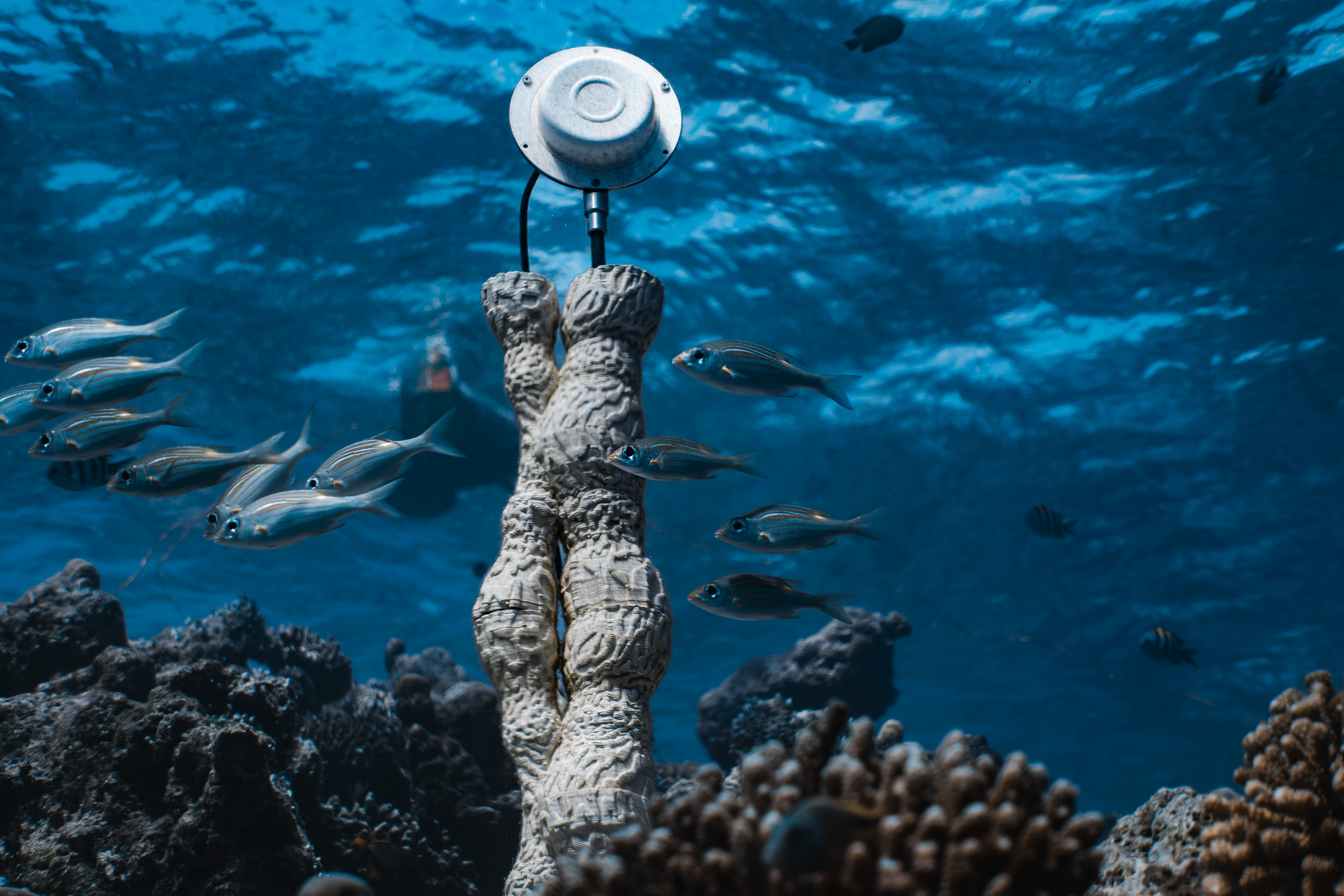
I created a new project called Coral Sonic Resilience. It transforms Timothy’s scientific research into an ongoing artistic intervention. Following my sound-centered approach, I collaborated with the University of Padua in Italy and the University of Malé in the Maldives.We worked on a Coral Restoration Project near a small local island called Feridhoo — a real local island, home to around 300 residents and only about 50 tourists at a time. No luxury resorts, just a few guesthouses and a couple of restaurants.
What did you do there exactly?
We recorded the soundscape of the healthiest coral reefs around Feridhoo.
One of the best spots was actually near a deserted island called Madoogali. .
Years ago, it hosted an Italian resort, but after the lease expired and the government raised the rental fees, the resort was abandoned.
Now only a caretaker lives there — and there are even ghost stories about it!
We placed microphones in the reef for two days at a time, collecting the rich sounds of the ecosystem.
Back at the lab, researchers from the Polytechnic of Turin and Padua University are now cleaning the recordings, removing noises like passing boats, and creating 24-hour sound loops.
How is your project different from Timothy Lamont’s original experiment?
The key difference is that I’m building an infrastructure.
We’re installing sculptures alongside the Coral Restoration Project’s existing structures.
These sculptures don’t just act as speakers — they serve as new shelters for fish and marine life.
When the ecosystem starts coming back, it won’t just find a dead reef; it will find small pockets of life — places to lay eggs, hide, and rebuild.
What’s next for Coral Sonic Resilience?
The second phase of the project will run from July to the end of December.
During that time, we’ll collect data on how successful the experiment has been, and then we aim to publish a scientific paper based on the results.
So, the coral reef example you mentioned earlier seems to hint at something much bigger — the idea that nature not only speaks, but also listens to itself?
Exactly.
The acoustic aspect of ecosystems — the idea that sound could help heal nature — has been almost completely forgotten.
But it’s a real possibility. What we’re discovering with coral reefs could potentially work with forests, with different ecosystems, even with animals in general.
There’s still a lot to explore, isn’t there?
Absolutely. Researchers have already tested some things in specific fields, but there’s an entire new universe waiting to be listened to.
We already know, for instance, how nature sounds affect humans.
The sound of waterfalls, streams, or forests puts us into a meditative, calming state — that’s the essence of biophilia.
Just being immersed in the soundscape of a healthy forest can deeply relax us.
So it’s very likely that nature responds similarly within itself.
And you see a deeper philosophical problem too — our relationship with nature itself.
Yes. One of the main issues is how we separate ourselves from nature. When we talk about it, we tend to look at it from above, as if we’re the rulers of the ecosystem. But we’re not separate — we are part of nature, just like an ant is. These discoveries about sound and healing aren’t about nature as “the other” — they’re about us, too. The sooner we can reprogram ourselves to truly belong to the ecosystem again, the sooner we’ll be able to engage in a real exchange with the natural world.
That shift in mindset also shows up in how people are beginning to take responsibility for listening to their environments — not just metaphorically, but practically.
Earlier, you mentioned something called “Citizen Science.” Can you explain that a bit more?
Until fairly recently, cities relied on a few centralized, expensive air monitoring stations.
For example, a single sensor located in Wedding would also be used to estimate the air quality in Kreuzberg. But now, through Citizen Science, we can “zoom in” at the neighborhood level. These new sensors are very affordable — between €50 and €80, made in Poland — and anyone can buy and install one outside their window, following a few simple guidelines.
Once installed, your data becomes part of a collective platform called Sensor Community.
The air quality on your balcony, in your street, adds to a growing open-source map. In Berlin alone, what started with 20 sensors in Stuttgart has now grown to thousands worldwide — maybe around 10,000 sensors If you look at Berlin’s map today, you’ll see it full of colored dots — green, yellow, red — showing real-time air quality.
How did that experience impact you personally?
It made me fall in love with the idea of citizen empowerment.
We don’t have to passively wait for government agencies to tell us about our environment.
Through Citizen Science, we can contribute directly, build our own understanding, and create real community-driven knowledge.
It seems that Citizen Science also ties into a broader movement — the decentralization trend we’ve seen in recent years.
Exactly. It’s part of a much larger revolution, the shift from centralized to decentralized systems — something that really took off with the advent of Bitcoin.
You can see it everywhere: in banking, in energy networks, in technology.
It’s one of the major macro-trends of our time.
And it resonates much more closely with how ecosystems actually work, and with the principles of science itself.
Has this movement grown significantly in recent years?
Definitely. There are many more initiatives today supporting Citizen Science.
For example, there’s a major festival called Ars Electronica that has even created a dedicated award for Citizen Science projects.
Across Europe, more and more groups are launching projects that invite communities to participate directly in scientific research.
Any projects in particular that you find interesting?
Yes — for instance, there’s a group called SeaPaCS based in Rome.
They launched a project that engages citizens in monitoring ocean health, specifically by measuring the amount of microplastics in coastal waters.
It’s another example of how communities are being empowered to listen, measure, and interact directly with nature.
So the technology behind all this has become much more accessible?
Absolutely.
The technology for sensors — whether for air quality, water pollution, or other environmental factors — has become much cheaper and more widely available.
Today, anyone can become a “listener” of nature, participating actively in understanding and protecting the ecosystems around them.
And perhaps, in a way, this is what it all comes down to: redistributing the act of listening.
Not just to scientists, not just to artists, but to all of us.
With low-cost sensors, underwater microphones, and open-source maps, the ancient task of paying attention to the Earth — once the domain of shamans and elders — becomes a collective responsibility again.
Whether it’s a coral reef in the Maldives, a forest floor in Finland, or a balcony in Berlin, we are being invited to become participants in a new ecology of awareness.
Like the chants that once called back lost herds or calmed stormy seas, these projects teach us that healing begins with sound — and sound begins with care.
The Earth is still singing. The question is: are we ready to join the chorus?
by Michele Fossi
Punlished in DUST magazine issue #27

 Michele Fossi