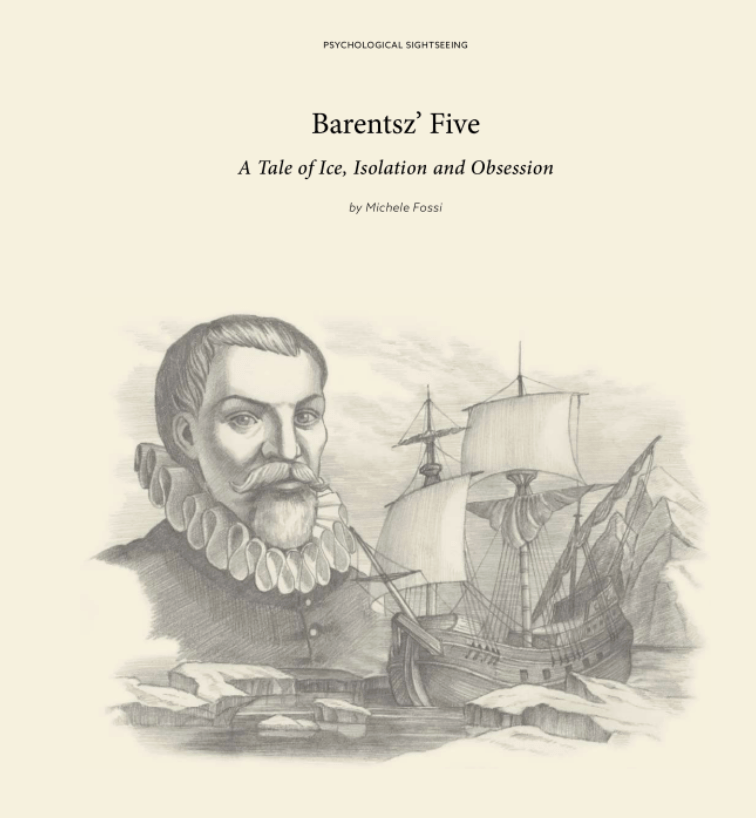
Among the most fascinating aspects of a trip to the Svalbard archipelago, the northernmost inhabited land in the world, are the legacies of adventure nestled among the cracks of the perennial glaciers. These stories speak of men contemptuous of danger, determined to reach a ‘beyond’ imagined by the mind, whose call, like Ulysses’ sirens, cannot be resisted. One such tale centres on the Dutch navigator Willem Barentsz’s obsession with finding the Northeast Passage, a navigable route through the Arctic region to China. Over the course of three missions at the end of the XVIth Century, this fixation led him firstly to travel off course and ‘discover’ the Svalbard archipelago and then later become trapped in the ice of the Russian seas. With enormous effort, Barentz and his men reached the island of Nova Zembla where they built a cabin from driftwood, a shelter known as the Behouden Huys [Safe House], and survived an entire winter by makeshift means.
Enduring great hardship, two crew members died on Nova Zembla, including the carpenter who built the cabin. The survival of Barentsz and remaining crew during the brutal Arctic winter of 1596-1597 is testament to human resilience, but.when the arrival of summer failed to free their ship from the ice, Barentsz was forced to lead his men on a perilous journey in an open boat. Tragically, he died a few days after leaving the wintering site, succumbing to general fatigue and scurvy, along with two other sailors—their graves have never been found. Only 12 of the original 17 crewmen made it back to Amsterdam, yet their legacy continues to inspire adventurers and explorers centuries on, as vividly captured in the detailed accounts of Gerrit de Veer, one of the survivors.
De Veer’s writings offer invaluable insights into the harsh realities of Arctic exploration. His fluid, almost literary style captivates readers from the very first pages, vividly portraying the crew’s skilled navigation as they sail northward, delving deeper into the icy waters while skillfully avoiding icebergs. As the journey progresses, on September 11th, tragedy strikes: the ship becomes ensnared by the frozen grip of the Arctic, the immense pressure of the ice forcing it upward, its bow creaking and groaning as it is lifted out of the water. The desolation of the ship’s crew is palpably conveyed in his diary entry from that day; as the realisation sets in that they are irrevocably trapped, in a barren land inhabited by polar bears, where even trees were reluctant to grow.
“ (...): and after we had debated upon the matter, to keepe and defend ourselves both from the cold and the wild beastes, we determined to build a [shed or] house upon the land, to keep us therein as well as we could, and so to commit ourselves unto the tuition of God. And to that end we went further into the land, to find out the most convinient place in our opinions to raise our house upon, and yet we had not much stuffe to make it withall, in regard that there grew no trees, nor any other thing in that country convenient to build it withall”.
In the pages that follow, De Veer details the harsh daily lives of the sailors on Nova Zembla. Outside the shelter of their cabin, they kept busy by setting traps for arctic foxes, using their pelts to make hats, inspecting the ship, and participating in sports to maintain their strength. They also defended themselves from polar bear attacks, managing to shoot several. The bears’ fat provided a crucial fuel source for their oil lamps, which along with the dim light of the stars and moon offered the only illumination during the unyielding darkness of the polar night. Barentsz’s crew avoided consuming the meat of the bears due to its potential health risks, except for one occassion when they ate a liver, resulting in severe hypervitaminosis A—an ailment first documented in the West by De Veer.
On December 7, 1596, a narrow escape from carbon monoxide poisoning occurred after they burned coal in their tightly sealed cabin to fend off the cold. By Christmas, with their shelter fully buried in snow, a deep despair eventually overwhelmed the crew. “”The 26th of December, it was foul weather, the wind north-west, and it was so cold that we could not warm ourselves, although we used all the means we could: with great fires, good store of clothes, and with hot stones and billets laid upon our feet and upon our bodies as we lay in our cabins. But notwithstanding all this, in the morning our cabins were frozen white, which made us behold one another with sad countenance,” the explorer notes in his diaries. “But yet we comforted ourselves again as well as we could, knowing that the sun was then as low as it could go, and that now it began to return to us again, and we found it to be true; for as the days began to lengthen, the cold began to strengthen, but hope gave us good comfort and eased our pain”.
The 26 of December it was foule wether, the wind north-west, and it was so cold that we could not warme vs, although we vsed all the meanes we could, with greate fires, good store of clothes, and with hot stones and billets laid upon our feete and vpon our bodies as we lay in our cabens; but notwithstanding all this, in the morning our cabens were frozen white, which made vs behold one the other with sad contenance”, the explorer notes in his diaries. “But yet we conforted our selues againe as well as we could, that the sunne was then as low as it could goe, and that now it began to come to vs againe, and we found it to be true; for that the daies beginning to lengthen the cold began to strengthen, but hope put vs in good comfort and and eased our paine.” On Epiphany, however, the men’s spirits were temporarily lifted by a ‘feast meal’ made from rations they had set aside, complemented by wine that had been reserved for emergencies.
Among the most striking entries in De Veer’s diary are those detailing the constant threat of polar bear attacks, which kept Barentsz and his men in perpetual vigilance. One particularly anxiety-inducing page, reminiscent of the fairy tale “The Three Little Pigs,” captures the primal fear of an evil beast trying to break in through the roof to devour its occupants. “The 6 of April it was still foul weather, with a stiffe north-west wind. That night there came a bear to our house, and we did the best we could to shoot at her, but because it was moiste weather and the cocke foistie, our peece would not giue fire, wherewith the beare came boudly toward the house, and came downe the stairs close to the dore, seeking to break into the house; but our master held the door fast to, and being in great haste and feare, could not barre it with the peece of wood that we vsed thereunto; but the beare seeing the dore was shut, she went backe againe, and within two hours she came again, and went round about and ypon the top of the house, and made such a roaring that it was fearful to heare, and last got to the chimney, and made such worke there that we thought she would have broken it downe, and tore the saile that was made fast about it in many peeces with great and fearful noise; but for that it was night we made no resistance against her, because we could not see her. At last she went awaie and left us”.
De Veer’s diaries helped cement the Arctic in the European imagination as a land of extreme and almost mythical dangers, illusions and mysteries. His description of the Novaya Zemlya effect, in particular, where the sun appeared to rise earlier than expected, added to the Arctic’s reputation as a place out of the ordinary, where the rules of nature were bent. This phenomenon, a kind of mirage caused by still relatively undocumented and not understood at the time, appeared to Barentzs’ crew like an almost magical event: “For this observation was contrary to the calculations of all the scholars, and to the course of nature, the tour of the earth, and the laws of heaven”, De Veer observed.
With such dramatic tales of endurance, ferocious beasts and natural wonders, it is no surprise then that Gerrit de Veer’s account of the overwintering became an instant literary hit at the time. Initially published in Dutch as Waerachtige beschryvinghe van drie seylagien (Amsterdam: 1598), the work quickly gained popularity, leading to Latin and French editions being published in Amsterdam by Cornille Nicolas that same year and a German edition in Nuremberg. An Italian edition followed in Venice in 1599. In the following years, De Veer’s accounts were widely read and sparked significant interest across Europe, fueling a growing cultural fascination with the Arctic. These narratives eventually became woven into the folklore of the far north.
However, it was only with the advent of Romanticism in the late 18th and early 19th centuries that the Arctic truly captured the imagination of poets and artists. This movement, which emphasised the sublime and grandeur of nature, saw in the Arctic—a vast, uncharted landscape with extreme conditions—an ideal symbol of beauty, terror, and the mysterious unknown. It inspired Romantic ideals, offering a powerful metaphor for writers like Coleridge, who, in ‘The Rime of the Ancient Mariner’ (1798), depicted the Arctic seas as a perilous journey into the awe-inspiring and terrifying forces of the natural world.
“And now there came both mist and snow,
And it grew wondrous cold:
And ice, mast-high, came floating by,
As green as emerald.”
In visual art during the same period, the Arctic was similarly depicted as a vast, desolate, and almost supernatural place, becoming a subject in its own right. One notable example is Caspar David Friedrich’s painting The Sea of Ice (1824), also known as The Wreck of the Hope. This work portrays a shipwreck in the Arctic that could have been Barentsz’s, with jagged ice sheets towering over the ship’s remains, showcasing the insignificance of humanity across an immense and indifferent environment. Not surprisingly, the sense of isolation and danger in the Arctic also found a place in Gothic literature, where it was a fitting setting for tales of madness, death, and the supernatural. One of the most famous examples is Mary Shelley’s Frankenstein (1818), where the icy polar expanses serve as the bleak, desolate backdrop for the novel’s climactic pursuit, the intense and final segment of the story where Dr. Victor Frankenstein chases his creation. Shelley uses the Arctic to symbolise the extremes of human experience—ambition, loneliness, and the pursuit of knowledge at all costs—and the inner desolation of Victor Frankenstein and his creature, making it a powerful geography of the mind where the physical and psychological landscapes intertwine.
One question may still linger in the reader’s mind: Does the Northeast Passage, which claimed the life of Barentsz, indeed exist, or was it just a chimaera, the malicious call of a siren? This question has haunted explorers through the ages. Nearly three hundred years after Barentzs’ ill-fated expedition, the first successful navigation of the entire Northeast Passage was achieved by Adolf Erik Nordenskiöld, a Swedish-Finnish explorer, aboard the steamship Vega. Nordenskiöld set out from Gothenburg, Sweden, in July 1878, travelling eastward along the northern coast of Siberia. After a winter halt due to ice near the Bering Strait, the Vega finally completed the passage in July 1879. This voyage marked a significant milestone in the history of Arctic exploration, proving that the Northeast Passage was navigable, at least under favourable conditions, and that Barentsz’s obsessive pursuit of this elusive route was not entirely mad nor in vain.
In recent years, the Northeast Passage has become increasingly accessible due to the reduction of Arctic sea ice driven by climate change. While still challenging and not open year-round, the route has begun to see use for commercial shipping during the summer months, offering a shorter alternative between Europe and Asia compared to the traditional Suez Canal route, potentially reducing travel time between Europe and Asia by up to 40%. Once a symbol of the unattainable, the Northeast Passage is now on the brink of becoming a vital and contested global corridor, capable of reshaping the world’s economic and geopolitical landscape while posing significant risks to one of the planet’s most pristine environments.
As the ice recedes and GPS-based certainties replace mystery, one of the Earth’s last enigmas melts away; the once ‘forbidden’ frontier is now just another line on a map. Yet, as humanity encounters these once legendary limits, new modern-day Hercules Pillars are already emerging—whether in the depths of the oceans, the far reaches of space, or the uncharted terrains of artificial intelligence—each with its risks, but also its irresistible call to adventure. “Consider your origins: You were not made to live as brutes, but to follow virtue and knowledge”. With these words, in Canto XXVI of Dante’s Inferno, Ulysses urges his men to embark on their final, fatal journey. Since the night of times, the spirit of discovery,, compels explorers, undaunted by the potential dangers, to push onward. And although Ulysses, like Willem Barentsz, paid for his curiosity with his life, his fate has never deterred those possessed by the demon of exploration from setting sail towards the unknown.
By Michele Fossi
Published in The Travel Almanac #25
 Michele Fossi