By Michele Fossi
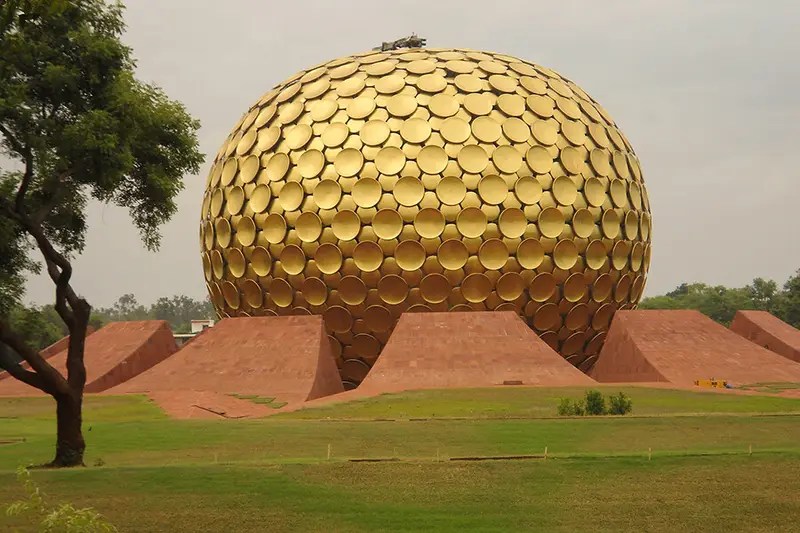
At the heart of Auroville, a visionary community in Tamil Nadu, India, established in 1968 with the ambitious aim of promoting human unity, the Matrimandir stands as a majestic presence. This colossal edifice, with its radiant spherical dome clad in golden discs, dominates the town’s lush forests, resembling a spacecraft that has descended from a distant world. Completed in 2008 after 37 years of meticulous construction, the Matrimandir was conceived by Auroville’s founder Mirra Alfassa, a spiritual leader known as “The Mother,” as a universal space for “focused contemplation”, open to individuals from all creeds and cultural backgrounds.
A one-of-its-kind architecture rich in symbolisms, the Matrimandir’s geodesic structure has often been likened to a colossal lotus flower, an emblem of enlightenment across Asian cultures, signifying the emergence of the soul from the muddy waters of material existence into the pure air of divine enlightenment. This symbolic association is further reinforced through twelve imposing earth-red structures that, like petals, encircle the dome. The ramp-like configuration of these structures presents the golden dome as if it is surfacing from the ground, metaphorically embodying Auroville’s declared other mission, besides fostering peace among the nations: to usher in a higher form of consciousness on Earth, igniting humanity’s spiritual awakening.
Within the dome, the atmosphere transforms starkly, enveloping visitors in a serene space of cool white marble and sleek angles. A suspended inner meditation chamber, the sanctum of the edifice, is linked to the ground floor by two giant spiral staircases also made of white marble – one for ascending, the other for descending. Similar to Giuseppe Momo’s double helix staircases in the Vatican Museums, these spirals never intersect, representing a symbolic voyage that includes both spiritual ascent and descent.
Upon entering the inner chamber, visitors find themselves in a spherical space clad in white marble, featuring high columns in a circular arrangement that reach up to the curved dome, whule floor cushions invite meditative seating. At its centre, an awe-inspiring sight: a massive crystal perched upon a pedestal, known as the world’s largest optically perfect crystal, captures a solitary shaft of sunlight streaming down from an opening at the dome’s apex, scattering a diffused light in all directions. A small marvel of engineering itself, this aperture in the chamber’s ceiling is designed to maintain a consistent angle for sunlight, ensuring it precisely focuses on the crystal, regardless of the sun’s position in the sky.
The inner chamber’s design allows this natural, diffused light to act as the sole source of illumination, creating a serene and calming ambience. Furthermore, the chamber’s acoustics are finely tuned to dampen echoes, further deepening the sense of inner quiet. The sensation is one of absolute stillness, a respite from external stimuli; as the collective meditation starts, one experiences a reassuring sense of being nestled inside a vast, hollowed-out pearl, or a giant womb, feeling secure and cocooned, protected from the world’s cacophony.
****
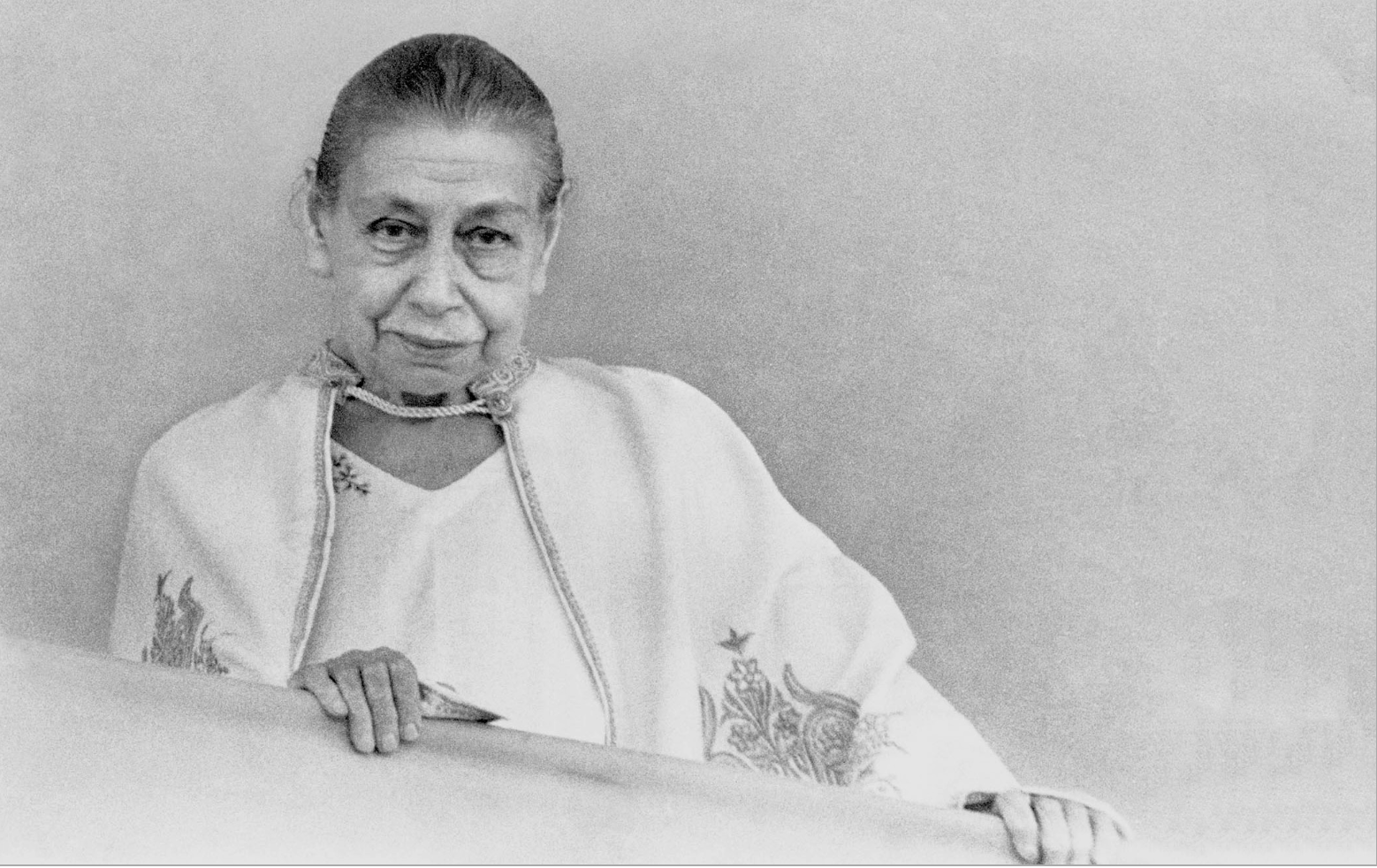
Born into a Sephardic Jewish family in Paris in 1878, Mirra Alfassa manifested a penchant for spiritual exploration from a young age, immersing herself in a myriad of philosophic and esoteric traditions. Her journey led her to study occultism, Eastern and Western religious philosophies, and eventually to India, where she became the collaborator of Sri Aurobindo, an eminent Indian philosopher, yogi, and nationalist. Her teachings encouraged inner development through disciplines of mind, body, and soul as a path to achieving “a divine life on earth”. Spirituality, for the Mother, was not a retreat from the world but a means to fully engage with it – transforming oneself to transform the world.
As a pivotal figure in conceptualising both Auroville and its iconic dome, The Mother played a central role in planning the town’s layout, with a focus on sustainability and harmony with nature, and established an enduring framework for cultural and educational development. Moreover, she personally supervised the Matrimandir’s design, ensuring that the structure reflected the community’s high ideals.
Fifty years after her death, the myths and legends surrounding The Mother have created a nearly mythical narrative, elevating her status from merely a spiritual leader to one more resembling a semi-divine or prophetic entity. Much like Evita Peron’s omnipresence in Argentina, her image today pervades Auroville – from murals on public buildings and artworks in restaurants to depictions on buses and yoga studios, and even adorning trinkets, books, and educational materials – imparting a sense that she continues to extend a watchful, nurturing presence over her community. Stories often circulate of her incredible intuitive powers, with accounts asserting her ability to perceive individuals’ thoughts, to ‘summon’ them in dreams to join Auroville, or even to foresee forthcoming events.
Inevitably, the Matrimandir, an architecture designed to embody the Mother’s mystical vision, carries a sense of enigma akin to its founder, which has led to numerous New Age interpretations regarding its true purpose and symbolism over the years. Some have proposed the hypothesis that the building functions as an energy accumulator, with the golden dome serving as a colossal antenna to attract and channel cosmic energy, allowing for its concentration and amplification. According to Patrizia Norelli-Bachelet, the author of The New Way, the Matrimandir’s design incorporates sacred geometry principles, with geometric patterns believed to possess potent energetic properties, rather than serving solely as decorative elements. Some go as far as to believe that the Matrimandir, supposedly structured along occult energy lines, serves as a portal to alternate dimensions or levels of consciousness, and might even conceal a secret pathway to the future.
****
Now, fifty-five years after its foundation, Auroville has grown into a dynamic cultural hub, offering an extensive variety of activities and workshops that span yoga, meditation, music, dance, and art, and boasting a diverse array of educational institutions, including alternative schools that break from traditional educational moulds. (Notably, the community is home to Svaram, a music research institute widely regarded as a pioneer in the field of sound healing). In addition, around 200 small and medium-sized enterprises operate here, specialising in fields as varied as organic farming, renewable energy, handmade paper, and fair-trade textiles.
In Auroville, the ‘maintenance’ system is prevalent; residents receive basic living essentials in exchange for their contributions to the community, and an internal financial system, the Aurocard, is operational. The town’s uniqueness is acknowledged by Indian authorities, who have allowed the land on which it sits to be owned and managed by the Auroville Foundation under a special kind of custodial trust. This arrangement is exceptional, marking a rare instance of a government dedicating a part of its territory to a project aimed at human betterment and collaboration what some would call utopia.
Further contributing to the New Age aura that surrounds Auroville, the presence of silent volunteers in white attire, guiding visitors in and out of the Matrimandir’s inner chamber, imbues the experience with a sense of an exclusive secret society, reminiscent of the mysterious atmospheres found in Stanley Kubrick’s ‘Eyes Wide Shut. Moreover, the sight of individuals engrossed in silent contemplation around the radiant crystal instinctively evokes ancient litholatric practices, where stones were venerated as mystical entities and divine channels.
It would be a misconception, however, to view the Matrimandir as a “temple” associated with a neo-pagan movement. Rather, the inner chamber’s ultra-minimalistic design’s declared mission is to steer visitors away from all sorts of entrenched dogmas and beliefs and toward a more foundational, quintessential spirituality that transcends religious constructs and reaches into the core of collective human experience.
Inside the inner chamber, the Aurovillians are not honouring a higher power, but rather engaging in the eternal quest for wholeness—the merging with expanded consciousness—that, whether one calls it Nirvana, Enlightenment, Satori, Moksha, Divine Union, Ishq, self-actualization, or even psychedelic trip, has captivated the human soul since time immemorial, throughout the ages and across the globe. The Mother believed that consciousness was not limited to individual beings, but rather was diffused throughout the universe, and that the goal of human evolution was to become more and more aware of this ineffable, unifying force. “Everything that happens is interconnected”, she wrote. “All things are closely connected consciously; there cannot be a vibration at one place without consequences at another.” In her writings, The Mother outlined simple meditative practices designed to broaden one’s awareness. She suggests envisioning oneself adrift in the vastness of the ocean, initially feeling diminutive and then slowly merging with the expansive sea. Another exercise involves progressively extending one’s consciousness from the confines of the physical body to encompass the entire earth, ascending skyward, and ultimately embracing the stars, galaxies and vast cosmos beyond.
Exiting the Matrimandir’s inner chamber, one is enveloped by a sensation in which the futuristic and archaic intertwine, as if having traversed time in two directions at once. Have we glimpsed a distant future that merges all faiths into a unified, non-theistic belief system, akin to the one Arthur C. Clarke imagined in his science fiction masterpiece Childhood’s End? Or have we, through the contemplation of a glowing crystal in a highly theatrical setting, symbolically journeyed back in time to the very origins of all religions and spiritual paths, rekindling the primordial, quintessential sense of wonder of our ancestors — the initial spark that ignited all human quests for the transcendent?
***
Far from being an accomplished realization of utopia on Earth, though, the City of Dawn (another name by which Auroville is known) also faces its own set of real-world controversies. Disputes over land ownership with local Tamil villages and allegations of social stratification or elitism within the community have been reported. Issues of governance and decision-making have also come under scrutiny, with some nationalities accused of exerting more influence than others. Critics also point to an apparent lack of a clear, democratic governance structure, which sometimes results in power imbalances and accountability gaps. Amidst these challenges, the Matrimandir stands unwavering, seemingly untouched, in its golden radiance, by the imperfections of the community. As an architectural embodiment of an ideal, It steadfastly represents the Mother’s optimistic – some would argue delusional – vision for humanity. One where the human mind’s potential remains largely uncharted, and inner peace is not an escape from the world’s conflicts but an integral part of their resolution.

****
Published in The Travel Almanac 23, Jan 24
 Michele Fossi